

- The $1.54 trillion FY2027 defence budget request faces delays and tighter scrutiny
- The Trump-class battleship could be cut, while Golden Dome and the F-47 may be scaled back or rebranded
- Spending on China deterrence, readiness, and weapons replenishment is likely to continue
The US midterms have delivered a huge win for the Democrats and upended the final years of Republican President Donald Trump’s time in the White House, with the result also offering the potential for significant changes to US defence spending and procurement programmes.
At the time of publishing, the Democrats had made sweeping gains in both the House and the Senate, seizing both, with the remaining results only serving to determine the margin of victory.

Discover B2B Marketing That Performs
Combine business intelligence and editorial excellence to reach engaged professionals across 36 leading media platforms.
President Trump’s bumpy second term in office has made a significant play into US defence manufacturing and spending, as well as using the country’s military to force a regime change in Venezuela and now apparently stuck in an open-ended conflict with Iran.
Much will survive the midterms results, as the need to provide a counterbalance to China in the Pacific requires investment, particularly in areas like naval manufacturing. Replenishing existing weapons stocks is also likely to continue, following significant depletion due to the Iran conflict and historical support for Ukraine.
Trump class: a likely casualty
However, programmes affiliated with Trump are likely to get close attention in the months ahead, none more so than the proposed Trump-class battleships which were the purported centrepiece of a new ‘Golden Fleet’ to revitalise US Navy surface capability.
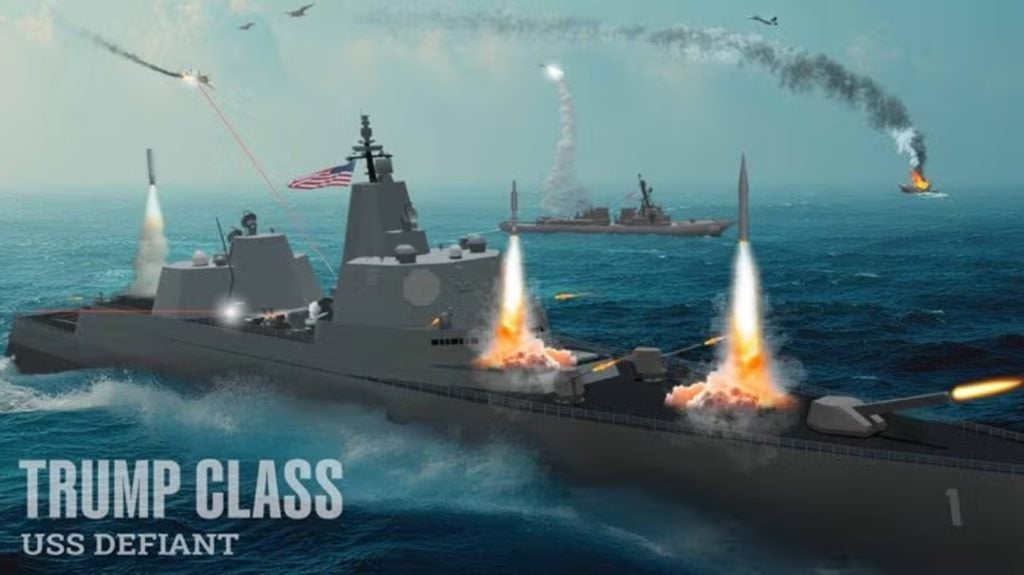
Mark Cancian, senior adviser at the Center for Strategic and International Studies’ Defense and Security Department, said the prospects for the Trump-class battleships were “never very good” over the long-term, with new midterm results compounding the threat.
The result could see the two sides agree on an approach that “stretches the programme out”, until a future president cancels it altogether.
“The administration will fight for it in the near term, even as the Democrats likely try to cut the funding,” Cancian said.
Aidan Knight, defence analyst at business intelligence firm GlobalData, suggested the Trump-class battleships were “effectively dead” given Democratic leadership has repeatedly labelled platforms attached to the so-called Golden Fleet as costly vanity projects.
In addition, funding for the project has also been “severely drained” by ongoing operations in the US-Iran war.
There was also, notably, a risk to programmes which bear a moniker associated with President Trump.
“Signature initiatives with the name ‘Trump’ or ‘Gold’ in the name face the highest risk of scrutiny, complete defunding, or dismantling,” Knight said.
F-47 fighter: survives
Given this, it is possible that, in the air domain, the F-47 next-generation fighter programme could also be examined, although this is likely less about the need for a such a capability as the name it carries; Donald Trump is the 47th president of the United States.
The F-47 is the crewed fighter element of the US Air Force’s NGAD sixth generation fighter programme, with Boeing announced as industry prime by President Trump in 2025. The future fighter is expected to begin replacing the fifth-generation F-22 Raptor from around 2030.
“The F-47 will likely continue in some form, mainly because both parties see the need for a next-generation fighter to deter China. However, lawmakers may push to drop the ‘F-47’ label and rebrand the programme, while imposing tighter budget controls to keep costs in check,” said Harshavardhan Dabbiru, senior defence analyst at GlobalData.
Cancian, meanwhile, agreed the F-47 still maintained “broad support”, although added there was criticism from advocates for a greater reliance on drones and autonomous systems.
“There will certainly be a rebranding at some point, perhaps in a near-term authorisation bill, perhaps after the 2028 election. As with the battleship, this is a vanity item for the president, and he will likely cling to it,” Cancian stated.
Golden Dome: survives, after cuts
The all-domain Golden Dome, an air and ballistic missile defence capability modelled on Israel’s nationwide Iron Dome system, could also be in the Democratic crosshairs, particularly elements of the network that also incorporates expensive space-based interceptors.

According to Dabbiru, Golden Dome will most likely be “trimmed down” rather than cancelled outright, with lawmakers challenging its most ambitious elements, such as space-based systems and the idea of an ‘orbital shield’, which would carry significant price tags.
“A more realistic outcome is that funding shifts towards practical upgrades for existing ground-based radars, interceptors, and regional defences,” Dabbiru suggested.
In doing so, an iterative approach to Golden Dome could mean incremental improvements to conventional missile defence, rather than the originally proposed high technology, next-generational defence system.
Dabbiru’s GlobalData colleague, Knight, said that Golden Dome funding “relies largely on party-line reconciliation” rather than standard defence appropriations, which could threaten its future.
Golden Dome was initiated by an Executive Order in January 2025, with much of its funding in 2026 stemming from the $25bn worth of funding carved out in the One Big Beautiful Bill Act.
“The programme will hence face funding problems, as the legislative path for another unilateral reconciliation package is closed,” Knight explained.
During a keynote speech at the annual Space and Missile Defense Symposium in August, US Space Force General Michael Guetlein claimed there would effectively be “no Golden Dome” without the funding.
However, Knight considers while Democrats would “likely stall future funding”, the programme would continue in some form as they “ultimately see the benefit” of some of the aspects of the Golden Dome air defence network.
The Golden Dome name, unlike the Trump-class battleships and F-47 fighter, is likely to remain, Knight said.
Trillion-dollar defence budgets: survives
In a macro-sense, while a few individual programmes could be closely examined and potentially cut, defence spending overall retains cross-party support. The most recent FY2027 request totalled $1.54trn, comprising a $1.15trn base discretionary request and a $350bn mandatory reconciliation request.
This followed FY2026 and FY2025 requests for $961.6bn and $849.8bn, respectively.
“The defence budget has not been particularly controversial,” said Cancian. “It was not an issue at all in the recent election. I expect moderate growth, though not the huge $1.5 trillion proposal that the president made for FY2027.”
For Dabbiru, the midterm results mean that Democratic lawmakers found themselves “in a much stronger position” to push for flatter defence spending and to challenge open-ended emergency funds.
In addition, should operations in the Middle East wind down, funding would likely be steered towards repairing damaged bases and refilling missile stockpiles, rather than funding high-cost platforms that may not have an immediate necessity.
“Overall defence spending will remain high, but future increases are likely to face much closer scrutiny,” Dabbiru said.
Knight meanwhile said the Democratic control of Congress would shift the immediate question from how much additional defence funding Republicans can secure to how long Democrats can delay and reshape the FY2027 package.
Direct funding comes through the annual defence appropriations process that requires both chambers to pass. Given that the Democrats now control the House and the Senate, annual defence budgets will be delayed and watered down.
“Over the last two years in office, Trump has relied heavily on reconciliation funding, one-time funding authorised through the budget process, to finance increased defence spending,” Knight detailed.
That said, a major reduction in the overall defence budget was not expected to be the most likely outcome.
“Democrats would probably continue supporting funding for readiness, munitions, cyber, space, emerging technologies, alliances, and military personnel,” according to Knight.
“They would be more likely to scrutinize or reduce expensive weapons programmes, legacy systems, and projects viewed as poorly performing or insufficiently connected to national strategy.”
US-Iran conflict: the cause
In a round of media interviews after the scale of the Republican losses became clear, President Trump took to the media to try and defend his administration’s performance over the past two years.

In a telephone interview with Fox News, Trump admitted that he thought “part of [the result] was [due to] Iran”, although made clear that this was as a consequence of voters not willing to pay a “short-term” cost at the pumps amid a global surge in fuel prices.
However, commentary posted to his Truth Social media account seemed to blame Republican candidates for the party’s poor showing, with one post stating, “I wasn’t on the Ballot and if I was, we would have won IN A LANDSLIDE!”
In Knight’s assessment, the ongoing Iran war “played a huge role” in the US midterm results, with economic concerns, namely affordability and energy prices, routinely topped voters’ minds on election night, a factor substantially affected by the closure of the Strait of Hormuz.
“US fuel prices hovered roughly 40% higher than the previous year, with the energy shock rippling into broader inflationary pressures,” Knight said.
Additional factors include the unpopularity of the war itself, as well as large swathes of the Republican MAGA base viewing the conflict as a contradiction to President Trump’s ‘America First’ and ‘No New (forever) Wars’ 2024 campaign promises.
Dabbiru also echoed the determination that the Iran war was a primary factor, adding that while foreign policy rarely decides a midterm election on its own, the conflict may have added to the feeling that the administration was not paying enough attention to economic pressures at home.
“President Trump himself acknowledged that the war was ‘a piece of’ the reason for the Republican losses,” Dabbiru said.


