


The war in Ukraine has demonstrated that modern armoured formations must be capable of relocating quickly if they are to survive the widespread use of drones, precision-guided munitions and long-range artillery weapons. A tank or infantry fighting vehicle that can rapidly relocate after engaging enemy forces is harder to target than one that remains static or moves too slowly. The ability to ‘shoot-and-scoot’, reinforce vulnerable positions and manoeuvre around emerging threats is now a fundamental component of combat effectiveness.
For European armed forces, this requirement is vital as investments increase to bolster defences against a hostile opponent. The continent’s geography, infrastructure and regulatory environment present unique challenges for the movement of heavy military equipment, making vehicle mobility a critical factor in both deterrence and battlefield operations.
Europe’s military mobility challenge and NATO readiness
While Europe possesses an extensive road and rail network, moving heavy armoured vehicles across the continent remains far from straightforward. Infrastructure bottlenecks, bridge limitations, tunnels and border-crossing procedures can all slow the deployment of military forces and armoured vehicles. In a crisis, these delays can affect the speed NATO allies can support one another and respond to emerging threats.
Military planners increasingly recognise that logistics hubs, transport routes and key infrastructure may themselves become targets. Maintaining momentum under fire is a central element of operational planning, placing greater emphasis on the ability of military vehicles to operate independently and manoeuvre effectively when traditional routes or support networks are disrupted.
Although initiatives to improve military mobility across Europe are progressing, infrastructure upgrades and regulatory reforms will take time to implement. In the meantime, armed forces require vehicles that are capable of delivering reliable mobility in demanding conditions and have proven propulsion systems and established logistics networks.
Why modern tanks need more power, protection and mobility
Military vehicles are also becoming heavier and more sophisticated. The modern battlefield is driving demand for improved armour protection, active protection systems, advanced sensors, electronic warfare capabilities and enhanced communications systems. These technologies increase survivability but also place greater demands on vehicle power generation and mobility.
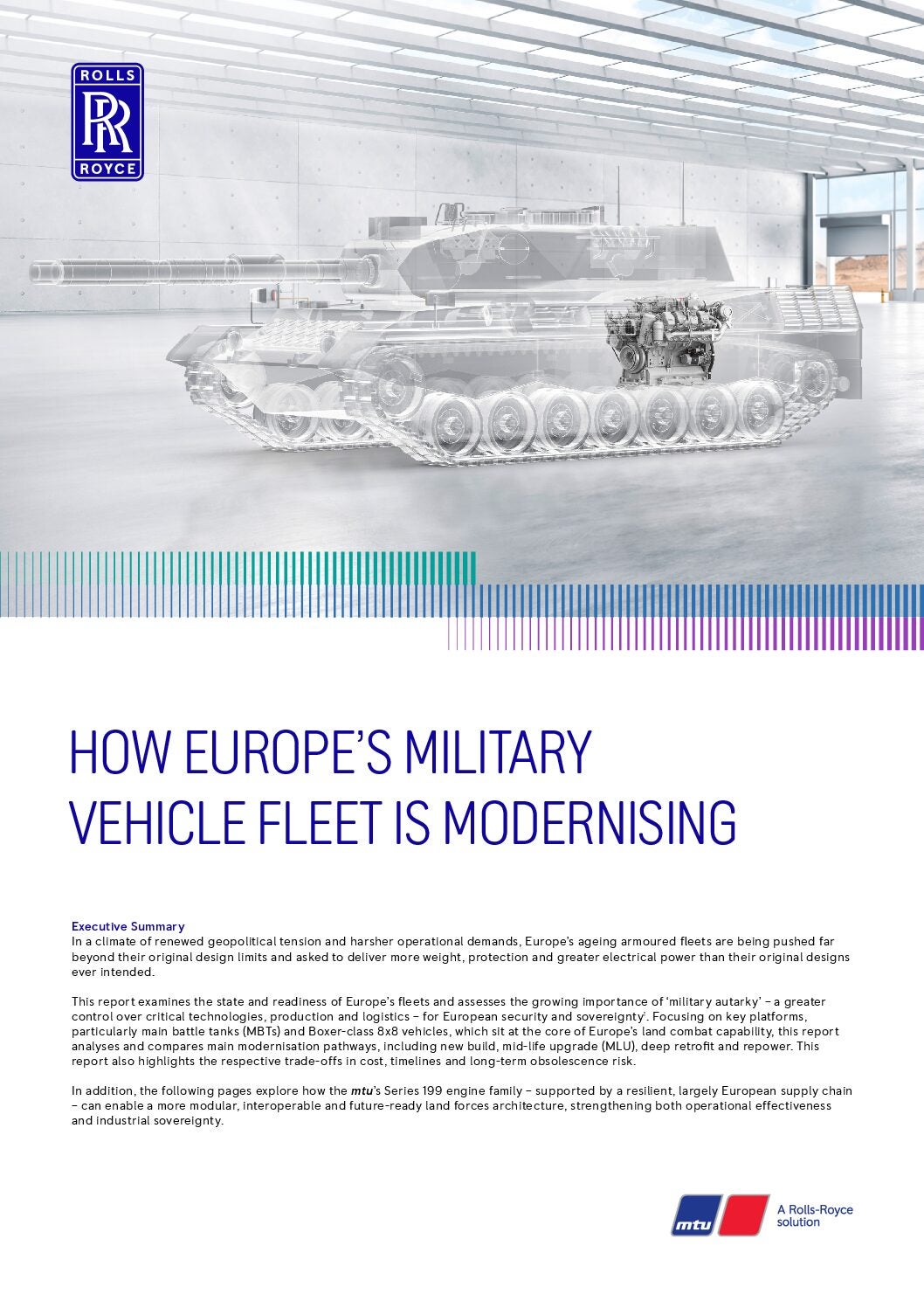
The Leopard 2A8 illustrates this trend. The latest variant incorporates improved protection, enhanced electronics and the EuroTrophy active protection system while retaining the high levels of mobility needed from a modern main battle tank.
The Leopard series of tanks uses the mtu MB 873 engine, which delivers in the current configuration 1,500 horsepower that has been refined through decades of operational experience and can maintain manoeuvrability despite the tank’s rising weight.
Reducing lifecycle risk through proven military engine technology
Across Europe, thousands of military vehicles operate using the same MB 873 propulsion architecture. Common engines, shared spare parts, established maintenance procedures and existing training programmes reduce technical and logistical risk while improving interoperability between allied forces. mtu has produced approximately 4,000 MB 873 engines for Leopard-based platforms, creating a substantial support ecosystem across Europe.
Continued confidence in this approach is reflected in recent procurement decisions. KNDS has ordered 300 mtu MB 873 engines to support new Leopard 2 production for several European countries, including Germany, Lithuania, Sweden, the Netherlands, and the Czech Republic.
Puma infantry fighting vehicle combines protection with agility
The same principles apply to infantry fighting vehicles. As armed forces seek greater agility and flexibility, propulsion systems must deliver power without compromising reliability.
Puma infantry fighting vehicles are a prime example. mtu’s latest PowerPack combines the 10V 890 engine, transmission, cooling system and associated subsystems into an integrated propulsion package that maximises power density while minimising space requirements. Delivering 800kW of power, the system enables the Puma to maintain high levels of mobility despite vehicle weights approaching 45t.
The upgraded PowerPack is designed to improve operational readiness and support reliable performance under demanding conditions, demonstrating how propulsion technology can help operators balance protection, mobility and availability.
Future combat vehicle programmes will demand even greater mobility
Germany and France plan to procure the Main Ground Combat System (MGCS) as a successor to the Leopard 2. The decision came amid Germany’s uncertainty about the ability of the Leopard 2A6 ammunition to punch through the armour of the latest Russian tanks.
While the MB 873 engine is associated with the current generation of tanks, the MGCS will instead use a new, advanced mtu 10V 199 engine. The mtu 10V 199 is lighter and more agile than the MB 873 but still delivers a substantial mechanical output. The complete MGCS powerpack delivers 1,400kW.
Overall the MGCS approach is to deliver a lighter tank, which enables deploy ability also in regions where a 70t tank is limited by traction and weight restriction of the infrastructure. Therefore all subsystems have to get lighter and reduce the volumetric impact on the overall hull.
Because the MGCS is not expected to be ready before the 2040s, Germany expressed a requirement for an interim tank. This tank is the Leopard 3, which is expected to enter production in the early 2030s. Germany has requested 1,000 more tanks, which would be composed of a mix of Leopard 2A8, Leopard 3, and MGCS units.
As armies seek to modernise their fleets, the challenge is to ensure mobility as vehicles become heavier and more complex. These heavier vehicles rely on powerful, proven engines to deliver the mobility and flexibility required by modern operations.
To learn more about mtu engines, download the related document.
