

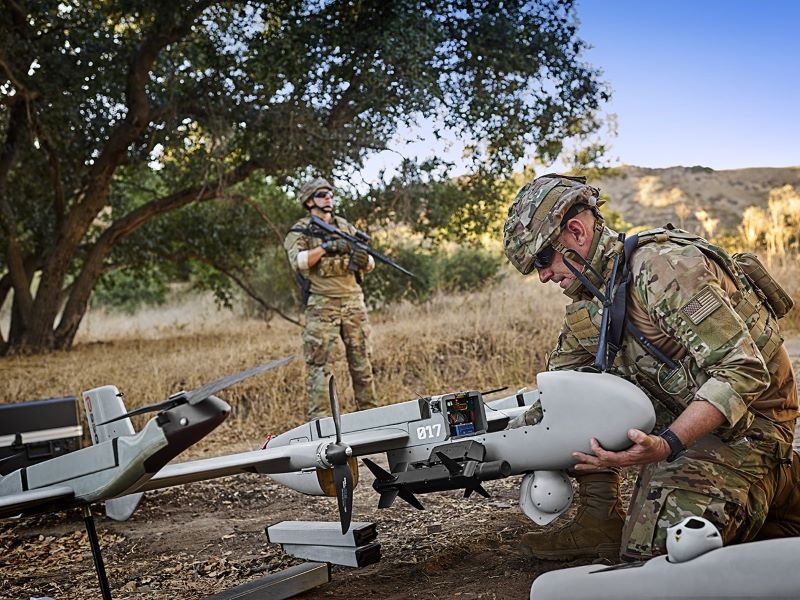
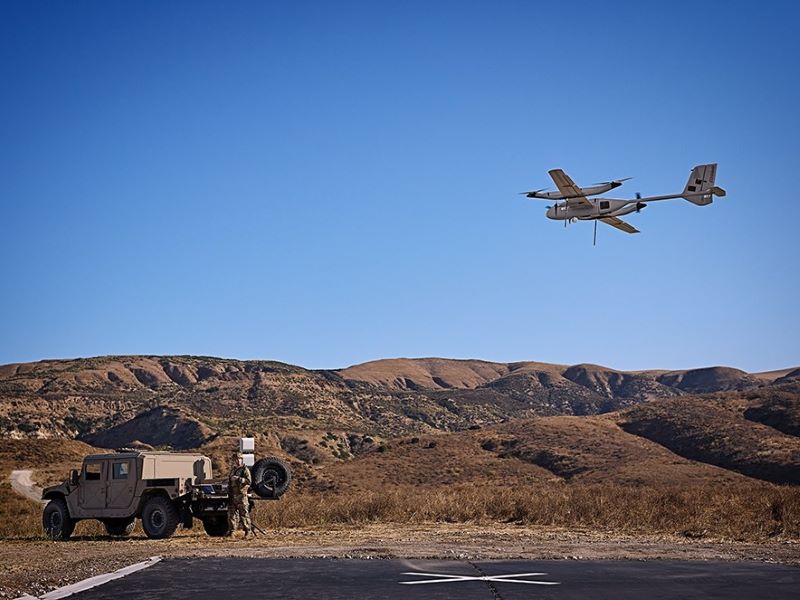
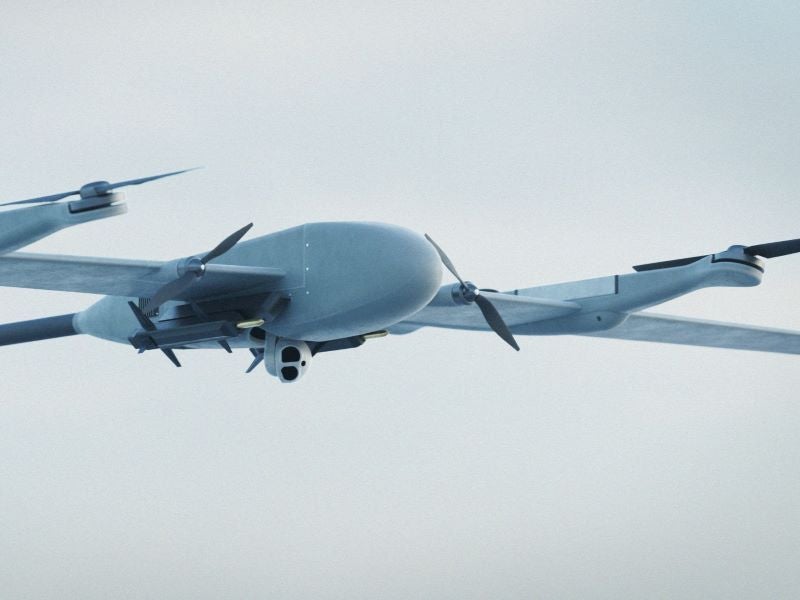
AeroVironment’s P550 is an uncrewed aircraft system (UAS) with electric vertical take-off and landing (eVTOL) capability, purpose-built for the US Army’s Long Range Reconnaissance (LRR) programme.
The platform is intended to provide manoeuvre forces with airborne reconnaissance, continuous situational awareness and precise, mission-focused effects targeting support and force protection across a range of operating environments.
Recommended Buyers Guides

The P550 eVTOL UAS was unveiled at the Association of the United States Army Annual Meeting in October 2024.
In August 2025, AeroVironment delivered its Group 2 P550 to the US Army under the LRR programme for training and operational use by Transformation in Contact brigades. The initial delivery included multiple P550 systems and new equipment training, including instruction for master trainers.
Development background
In April 2024, AeroVironment entered into an exclusive teaming agreement with Parry Labs, covering architecture, development, delivery and integration work focused on digital engineering, software and mission system hardware for the P550.
Parry Labs brought Model-Based Systems Engineering expertise and support for open software operating environments, aimed at meeting LRR requirements while also enabling the addition of future functions.
The company also offered its STRATIA software under a multi-year Enterprise Licence Agreement to broaden the use of open systems software across AeroVironment’s portfolio. The software provides digital infrastructure designed to accelerate the integration of command and control, autonomy and AI applications at the edge.
P550 design and features
The P550 eVTOL UAS measures 5.2m (17ft) in length with a width of 2.8m and has a height of 0.6m.
The system has a gross take-off weight of 24.9kg (55lb) and a payload capacity of 6.8kg. It is intended for a one-person operation.
The design follows a Modular Open Systems Approach to simplify integration of third-party payloads, datalinks and mission software as requirements evolve, while keeping costs and programme risk to a minimum.
The airframe is designed for toolless assembly and supports hot-swappable batteries and interchangeable multi-sensor payloads in under five minutes to sustain readiness.
As an eVTOL system, the P550 can launch and recover vertically under its own power without runways, catapults or dedicated launch equipment, supporting deployment from confined locations and reducing logistical burden in urban or complex terrain.
The platform incorporates SPOTR-Edge Automatic Target Recognition and the AVACORE software suite for onboard edge computing, enabling independent detection and classification of relevant objects such as personnel, vehicles, aircraft and maritime vessels in daytime and low-light conditions and contested or GPS-denied conditions.
It also features advanced AI autonomy that supports sophisticated flight behaviours and smooth transition from hover to forward flight.
Control and communication
For control, the P550 uses the Vigilant Spirit ground control system (GCS) with Quattro STANAG 4586 (Baseline), with Kinesis noted as a future option.
The platform’s communications and datalink suite includes Silvus and Digital Data Link (DDL). It provides a standard link range of 40km, which can be enhanced up to 60km using DDL range, depending on the GCS radio.
The UAS also includes Miniature Distributed Data Link and frequency hopping, alongside day-night visual inertial odometry navigation suited to anti-access and area denial operations.
P550 propulsion and performance
Propulsion for the P550 eVTOL UAS is provided by an all-electric powertrain. The aircraft operates at 15–27m/s (30–52 knots) and offers flight endurance of more than five hours.
Altitude limits include a maximum flight density altitude of 14,000ft and a maximum launch density altitude of 10,000ft.
The UAS has an environmental performance rated at IP-54, with the system capable of operating from -4°F–122°F (-20°C–50°C).
Mission capabilities
The P550 eVTOL UAS is designed for long-endurance operations supporting continuous intelligence, surveillance and reconnaissance, overwatch and communications relay with fewer recoveries, helping units maintain awareness and connectivity over longer mission windows.
The aircraft can be configured for offensive tasks through laser designation, sensor-to-shooter integration and established munitions, and lowering technical risk as requirements evolve.
The platform’s hot-swappable payloads and batteries shorten turnaround between sorties, increase mission generation rates and enable quick reconfiguration to meet changing tactical priorities without specialist support.
Orders and deliveries
In December 2025, AeroVironment secured a five-year Indefinite Delivery, Indefinite Quantity contract valued at $874.26m from the US Army Contracting Command. The award is intended to support future foreign military sales managed through the Program Executive Office (PEO) Aviation, allowing allied and partner nations to procure Group 1–3 unmanned aerial systems and counter-UAS capabilities.
Equipment covered under the contract includes variants of the JUMP 20, P550, Puma, Raven and Titan counter-UAS systems, alongside training, initial spares packages and logistics support.
In the same month, AeroVironment, working with Parry Labs, secured a three-year Other Transaction Agreement with an initial base value of $13.2m and options that could take the total value to $42m to support the US Army’s LRR programme with the P550 UAS.
Under the agreement, the company will provide P550 system updates, alongside support and documentation, to the US Army, PEO Aviation, Project Manager for Uncrewed Aircraft Systems and Product Manager for Small Unmanned Aircraft Systems for testing, evaluation and integration within the Army Family of Systems.
In March 2026, the Capability Program Executive, Aviation’s Uncrewed Aircraft Systems Project Office awarded AeroVironment a production contract for LRR systems. The AV P550 units were procured through the UAS Marketplace Basic Ordering Agreement (BOA).
The award supports the ongoing modernisation of the Army’s tactical UAS portfolio and is intended to enhance support for ground forces operating in complex, contested environments.
In July 2026, AeroVironment secured a $117.3m contract from the US Army to support the LRR programme. The award was placed under the UAS Marketplace BOA and followed a competitive call for solutions process within the Army’s UAS Marketplace initiative. Under the contract, the company will deliver 82 P550 UAS for the Army’s Battalion Reconnaissance effort, marking the first full-rate procurement of the P550 system.ent of the P550 system.
