

- Saab launched HEAT 758, a tandem-charge Carl-Gustaf round to defeat ERA and heavy armour (up to 700mm)
- Firebolt integration with the weapon and FCD 558 improves aiming and first-shot hit odds
- An undisclosed customer has ordered it; production is underway amid rising ERA use (notably Russian tanks)
Saab has unveiled a new munition for the Carl-Gustaf 84mm recoilless rifle, intended to defeat heavily armoured vehicles equipped with explosive reactive armour (ERA), which have become increasingly common on the battlefield.

The new round, designated HEAT 758, features a tandem warhead; the initial charge neutralises the ERA externally fitted to the armoured target, allowing the main change to penetrate the main armour.
The Swedish manufacturer says the munition can defeat “up to 700mm” of armour, enough, according to the company, to defeat the “heaviest armoured vehicles”.
An undisclosed Carl-Gustaf customer has ordered HEAT 758 and production is underway.
“This round is our response of developments of the battlefield where reactive explosive armour has become a major problem for regular munitions trying to defeat armoured vehicles,” said Michael Höglund, head of Saab’s Ground Combat business unit.
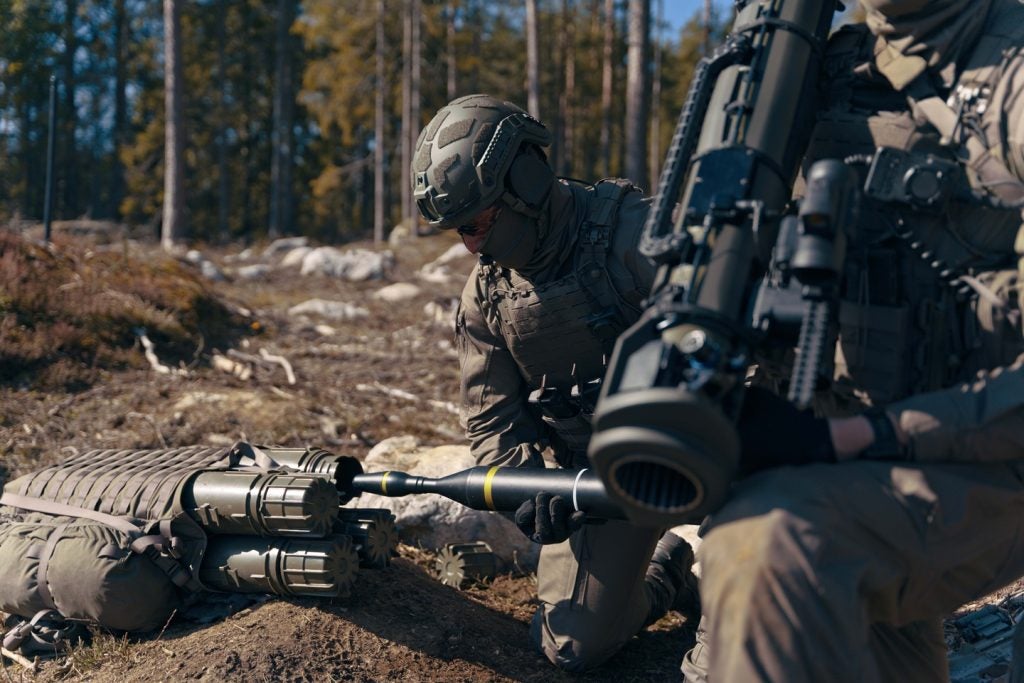
HEAT 758 uses the company’s so-called Firebolt technology, meaning it can communicate with the Carl-Gustaf in which it is loaded and the Fire Control Device 558 aiming system, simplifying the workload for the gunner while increasing first-round hit probability.
The Carl Gustaf M4 (or M3A1 in US service) recoilless rifle is in service with approximately 15 nations, including Sweden, the US, Australia, Canada, the UK, Poland, and Lithuania, with over 40 countries using all variants, including legacy systems.
Russian tanks and ERA
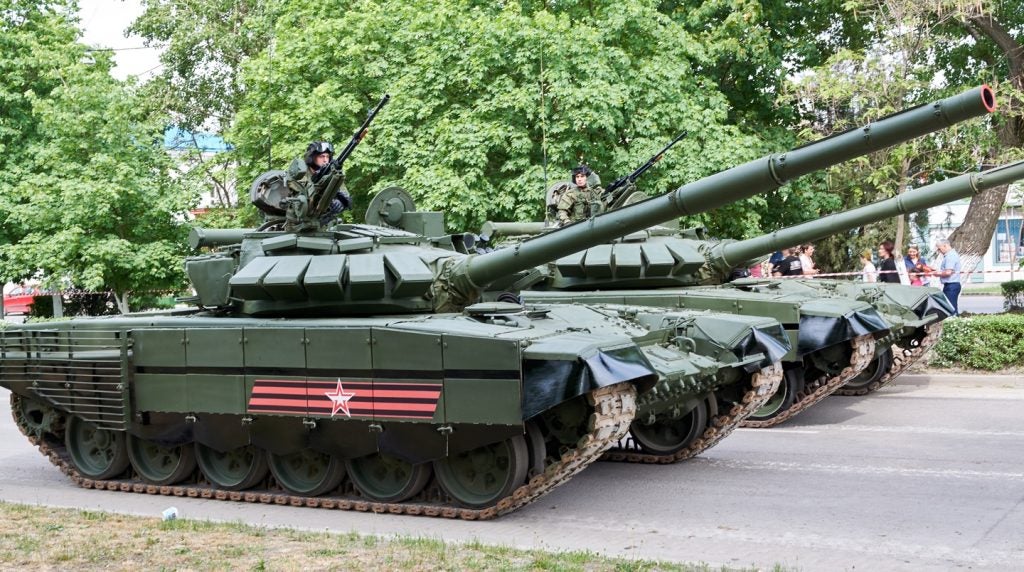
The development of the HEAT 758 round for the Carl-Gustaf M4 appears intended to counter Russian armoured doctrine, which has utilised ERA for decades, from the Kontakt 1 system in the early 1980s through to the modern Malakhit technology with the T-14 Armata tanks.
At the most basic principle, systems such as the Kontakt-1 are fitted in blocks to key areas of the tank – such as the turret – exploding a shaped charge towards the detected incoming threat. This in turn can damage or destroy the incoming round or missile, reducing the overall penetrative value by significant margins.
The ERA defence systems are most effective when countering incoming threats at acute angles, with efficacy reducing the more ‘head on’ the countermeasure is deployed relative to its target.
Given this, combat imagery often shows Russian tanks featuring ERA systems situated at acute angles to increase overall deterrent capability.
Early evolutions of Russian ERA technology were effective against so-called HEAT (high explosive anti-tank) rounds, although less capable when pitted against armour-piercing fin-stabilised discarding sabot (APFSDS).
However, by the late-1980s, the advent of Kontakt-5 ERA was considerably capable of reducing the penetrative value of APFSDS rounds by 25%, and perhaps greater.
The Relikt ERA, fitted to Russian tanks such as the T-80 and T-90 is a third-generation ERA charge designed to increase protection against tandem charge weapons and offers a yet-further improved counter to modern APFSDS munitions.
The latest evolution in Russian ERA technology, the Malakhit system, provides protection against top-down attacks, with modern anti-tank munitions, such as the Javelin or NLAW, typically using such attack profiles to target tanks where they are at their weakest.


