

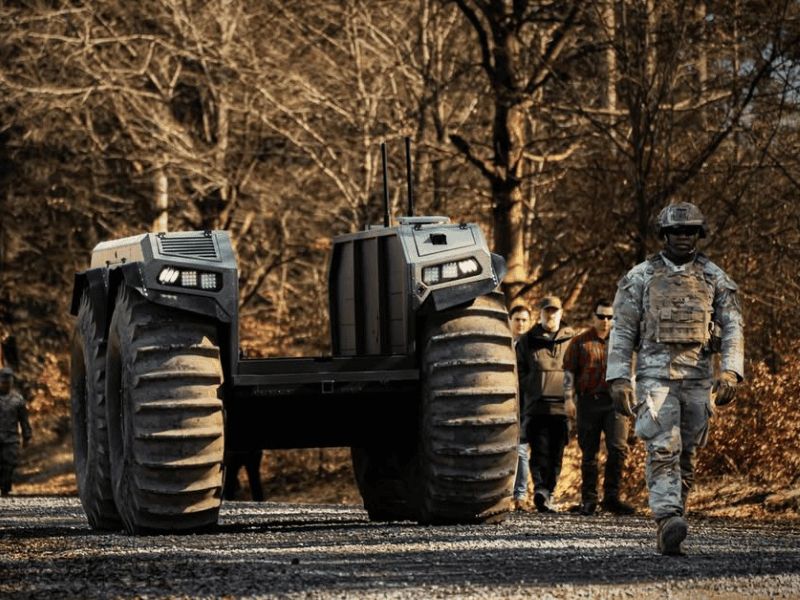
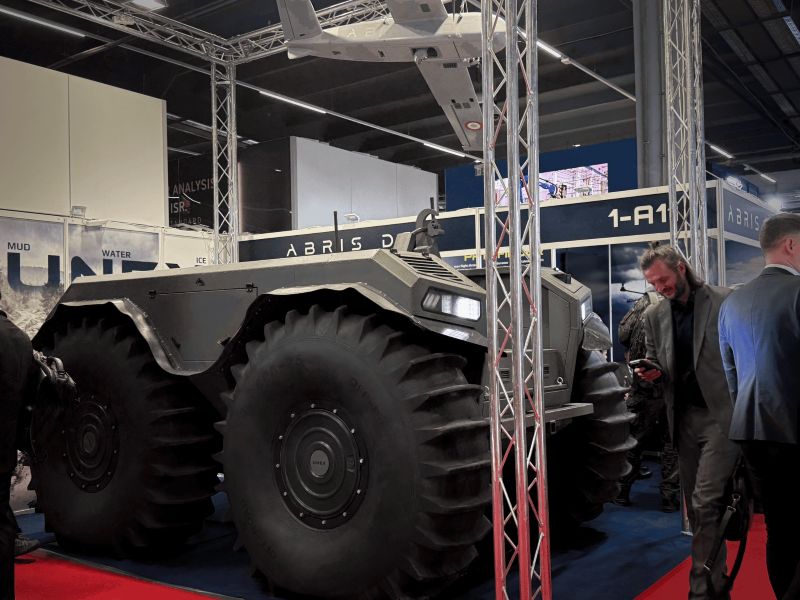
UNEX is an uncrewed ground vehicle (UGV) developed by uncrewed systems manufacturer Abris Design Group (DG).
Introduced in 2025, the vehicle has a modular, autonomous architecture and amphibious capability, allowing it to operate across terrestrial and aquatic environments.
Recommended Buyers Guides

Ukraine’s Ministry of Defence approved the vehicle for service with the country’s armed forces in April 2025.
In December 2025, Abris DG, via its subsidiary UGVR Machinery, entered a cooperation agreement with the Indian Ministry of Defence during the India-Czechia Joint Defence Industry Seminar. Established with Indian defence technology company Anablade, the agreement aims to introduce the UNEX UGV to the Indian defence market.
In March 2026, Abris DG and its US partner Mountain Horse participated in the XTech Edge Strike Ground Competition. The UNEX UGV was selected as one of five finalists and was named a competition winner. It subsequently received a ten-year contract through the Global Tactical Edge Acquisition Directorate (G-TEAD) Marketplace, with Mountain Horse Solutions acting as Abris DG’s partner.
The US Army evaluated the UNEX UGV in several operational scenarios, including the deployment of remote first-person-view (FPV) drones and the towing of Joint Light Tactical Vehicles (JLTVs).
UNEX UGV design and features
The UNEX UGV measures 3.8m (12.5ft) in length, 2.5m in width and 1.9m in height on inflated wheels. The vehicle has a dry weight of 2,250kg (4,960lb). Its architecture supports a maximum payload capacity of up to 1,700kg on land and up to 1,250kg on water.
The amphibious UGV can operate over land, water, ice, mud and snow without prepared routes. The platform’s autonomous capabilities include semi-autonomous transit and a follow-me mode.
The vehicle is designed to operate where a global navigation satellite system (GNSS) is unavailable, using communications systems intended to withstand electronic warfare (EW) conditions. It remains controllable under radio-jamming conditions over distances of more than 10km.
The UGV complies with Nato Standardisation Agreements (STANAG) and has been assigned a Nato Stock Number (NSN), allowing allied armed forces to incorporate it into existing supply chains and inventory systems.
The vehicle’s low-signature design supports reconnaissance, logistics, casualty evacuation (CASEVAC), and demining missions where noise and heat could affect operational security.
UNEX UGV payload options
UNEX can be equipped with weapon stations carrying anti-tank guided missiles (ATGMs), remote-controlled weapon stations (RCWS), or short-range air defence systems (SHORAD).
Available configurations also include logistics modules for cargo transport and casualty evacuation (CASEVAC), explosive ordnance disposal (EOD) and demining kits, intelligence, surveillance, and reconnaissance (ISR) sensor and radar packages, first-person-view (FPV) launchers, and counter-uncrewed aircraft systems (UAS) modules.
Optical payloads include a 30Hz thermal camera with a 1280×1024 sensor matrix alongside a Sony 9500L daytime camera featuring 40× optical zoom. For comprehensive situational awareness, the vehicle can incorporate up to five secondary navigation cameras to deliver a complete 360° field of view.
Control and communications of the UNEX UGV
The UNEX UGV supports several communications layers, from short-range direct operation to beyond-line-of-sight connections. Its open architecture accommodates different payloads, radio types, modems, and network configurations, enabling operators to adapt communications arrangements to mission requirements.
The navigation and control system offers an unlimited operating radius when routed through LTE or Starlink networks, supported by a programmable autopilot capable of executing preset missions.
The vehicle integrates the IRIZI software, which uses AI-based object recognition to identify people and other objects in the operating environment. Analysis of visual and thermal data supports situational awareness, route navigation, and operational decision-making.
A handheld ground controller provides a secure L/S-band connection for short-range teleoperation at distances of 1km. Telescopic masts or fixed towers can extend line-of-sight control to 5km.
For longer-range operations, a multirotor unmanned aerial vehicle (UAV) can operate as an airborne relay, providing encrypted, low-latency communications over 10km. A fixed-wing UAV can serve as a wide-area control node for operations beyond 10km.
The vehicle can also operate through cellular (LTE/5G) networks in rear areas or civilian environments. A low-Earth orbit (LEO) satellite link enables data exchange where terrestrial infrastructure is unavailable, including at sea, in mountainous terrain, and in remote regions.
UNEX engine and performance
The UNEX UGV uses a fully electric drivetrain with high-capacity electric motors, each rated at 32.7kW, supported by a 78kW battery power. The vehicle can reach speeds of up to 20km/h on land and up to 5km/h on water. The electric system reduces acoustic emissions in environments where detection could increase operational exposure.
The vehicle has continuous operational endurance of six hours and a maximum speed of up to 20km/h. Its maximum command and control (C2) range exceeds 10km.
The vehicle has a ground clearance of 600mm (1.95ft), a maximum gradeability of 40° and a tilt angle of 30°, enabling it to traverse challenging terrain. Patented ultra-low-pressure tubeless tyres reduce ground disturbance, supporting operations on fragile terrain and in areas containing explosive hazards.
UNEX can negotiate obstacles up to 1m high, including fallen trees, rocks, and marshland. It can operate across mud, rubble, snow, ice and water, and functions in ambient temperatures from -30°C to more than 40°C.
The platform’s amphibious design allows continuous operation across ponds, lakes, rivers, coastal areas, and icy waters of varying depths. This capability supports deployments in flooded environments, river crossings, and littoral operations.
Mission capabilities of the UNEX UGV
The UNEX UGV is suitable for logistics operations and can transport ammunition, provisions, equipment, and fuel across contested or inaccessible terrain. In casualty evacuation (CASEVAC) missions, it can recover wounded personnel under hostile fire while allowing medical teams to remain outside engagement zones.
For combat engineering tasks, the UGV can breach physical obstacles, conduct mine clearance, and support counter-improvised explosive device (IED) operations. It can also perform critical infrastructure and border protection duties, including patrols intended to deter sabotage and prevent unauthorised crossings.
The platform may also be used in humanitarian and emergency response operations, including flood rescue, firefighting, disaster relief logistics, and post-conflict minefield clearance.
