

- GDLS unveiled PERCH module to deploy loitering munitions from tanks and combat vehicles last month
- The system is designed to fire Aerovironment Switchblade 300 and 600 loitering munitions
- Built and tested on M1A2 SEPv3 Abrams and Stryker, a company spokesperson told this reporter it could integrate with LAV and AJAX too
One concept that may have been overlooked in the thick of the AUSA 2025 exhibition last month is the Precision Effects and Reconnaissance, Canister-Housed (PERCH) module developed by US defence prime General Dynamics Land Systems (GDLS) and drone builder AeroVironment (AV).



PERCH is a drone-launched effect that can be integrated onto the side of an armoured vehicle. The containerised weapon is designed to fire Switchblade 600 and three Switchblade 300 loitering munitions.
At its unveiling, Army Technology spoke to Geoff Norman, director for US strategy and growth at GDLS, who emphasised the simple integration of the component onto the M1A2 Abrams SEPv3 main battle tank (MBT) and Stryker armoured vehicles in service with the US Army.
“We’re able to remove a storage box that’s currently on the [Abrams] tank called a ‘loader sponson box’ [an external storage compartment at the back of the platform], pop that out with two bolts, drop this launcher canister in, and you’re off to the race,” Norman instructed.
BLoS capability
The US Army has not procured the PERCH module just yet but the system provides a coveted beyond-line-of-sight (BLoS) capability.
Currently, armoured units coordinate and share real time intelligence with a number of assets including radios and distinct ISR platforms to paint a picture of the changing battlespace.
But AV’s Switchblade drones offer combat vehicles a BLoS strike capability as they can fly to a distant location, locate targets using their own electro-optical and infrared sensors, and engage threats.
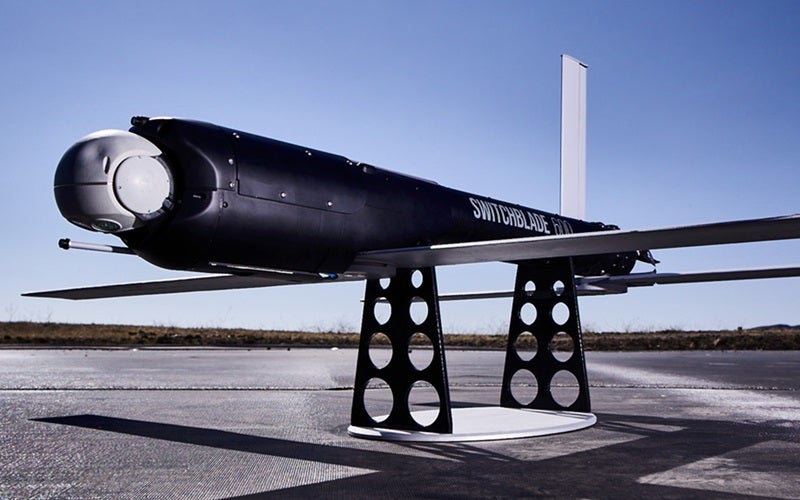
PERCH appears to meet the US government’s ambitions to invest in more lethal programmes. Defense Secretary Pete Hegseth has repeatedly stressed that existing resources are prioritised to improve long-range precision fires and air and missile defense including through the ‘Golden Dome’, among other capabilities.
When it comes to the ill-defined Golden Dome air and missile defence network, numerous defence contractors are coming up with their respective strategies for different layers of the system. This already includes AV, who are working with a commercial uncrewed aerial systems supplier, GRANDSKY, to formulate the inner layer, or as AV puts it, the limited area defense architecture.
At the GDLS stand during AUSA, the PERCH module was displayed nearby the Pandur short-range air defence (SHORAD) system. Applying PERCH to mobile SHORAD could enhance inner layer air defence with yet another no-fuss, modular strike capability.
PERCH on AJAX, LAV
Although the system was displayed with a US Army focus, built and tested on the M1A2 Abrams SEPv3 MBTs and Stryker combat vehicles, Norman alluded to the possibility of integrating PERCH onto other armoured vehicles, namely the Light Armoured Vehicle (LAV) and the British Army’s AJAX armoured fighting vehicle.
Another GDLS representative, Mark Hu, manager for US business development, told this reporter that many allied forces expressed interest in integrating the module unit during the trade show in Washington when it was unveiled for the first time.
The engineering design work had the Stryker, the LAV, and the AJAX in mind, he said, adding that “given time and the right industry partners, we could adapt this powerful capability to other allied tanks and infantry combat vehicles.”
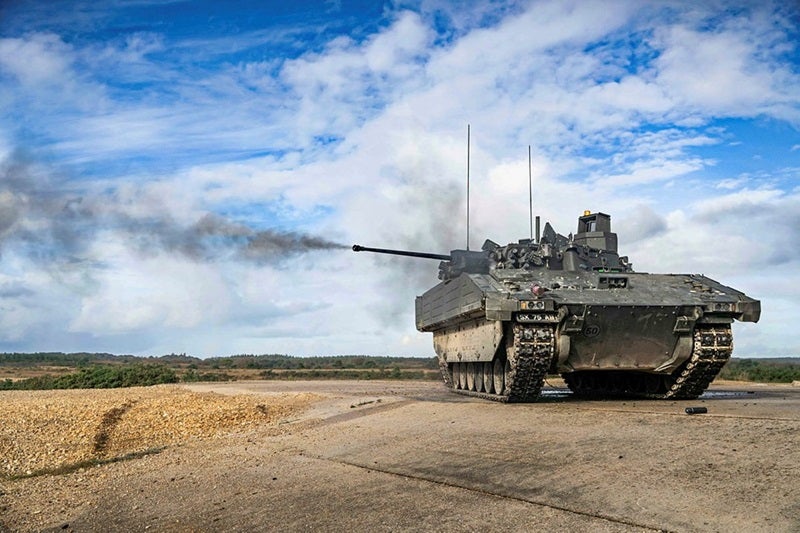
The British Army AJAX is approaching initial operating capability in December 2025. In the end, the fleet will amount to 589 all-terrain medium-weight vehicles.
The UK Ministry of Defence declined to comment when asked about their interest in procuring PERCH for AJAX. Nevertheless, the long-awaited, deep recce strike vehicle has an open digital architecture with good power and weight budgets, meaning it can be upgraded with new components over time.
Meanwhile, LAV, a GDLS platform, is in operation with numerous countries around the world such as Australia, Canada, Colombia, New Zealand, Saudi Arabia, Ukraine, and the United States. The LAV 6.0 is the latest iteration in active service with Canada, while the latest version – the LAV 6.0 Mk II – was unveiled at in May this year, and is projected to enter service in 2027.


