

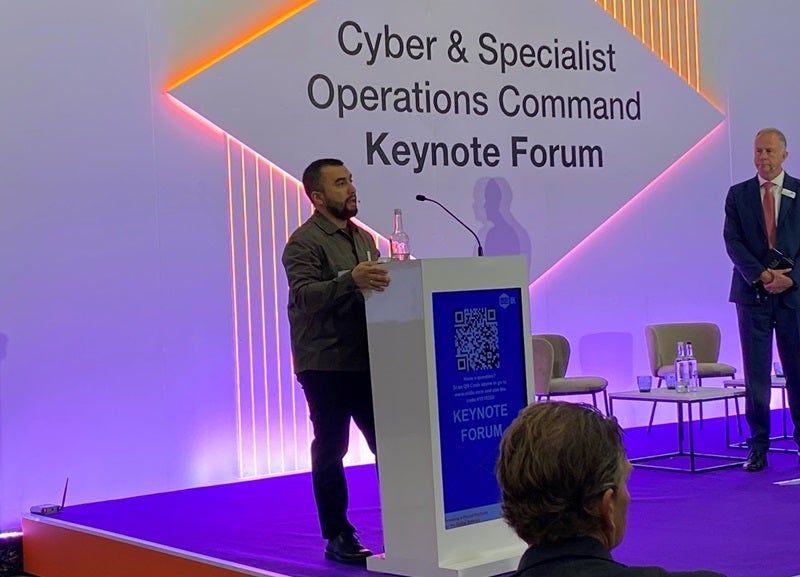
Arsen Zhumadilov, director of Ukraine’s Defence Procurement Agency (DPA), revealed that the Ministry of Defence plan to introduce a new range of systems to the Ukrainian military’s digital marketplace, the DOT-Chain Defence platform, in 2026.



Last week, during DSEI 2025 in London, Zhumadilov revealed that the online marketplace may soon offer interceptor drones and warheads to Ukrainian military units for the first time.
What is the DOT-Chain Defence digital platform?
DOT-Chain Defence was launched in pilot mode only two months ago. Access to the IT system has only been granted to 12 brigades (deployed in Donetsk, Zaporizhzhia, Kherson, and Kharkiv regions) out of more than a hundred.
Commanders can independently select and acquire systems using funds from the DPA.
The platform operates much like an online store but instead of civilian commodities it offers a range of weapons systems. Initially, DPA focused on supplying first-person view (FPV) uncrewed aerial systems (UAS), but this soon expanded to include other autonomous systems and radio electronic warfare (EW) devices. Currently, the marketplace offers products from 25 companies.
As of 2 September, the DPA delivered 5,600 UAS in the first month through the digital platform. There are growing volumes, the government said, as service members have already placed orders for as many as 11,000 drones.
“From an order being placed to a product being delivered to the frontline,” Zhumadilov emphasised, “it takes no more than two weeks on average.” In some cases, he added, delivery took just five days.
Forming a “proper” market structure
But the accession of warheads and interceptor drones into the expanding digital platform still depends on a few prerequisites.
“In some cases, you have just one supplier of a product that is unparalleled in terms of its features – usually, we’re talking about air defence systems – [where] you don’t really have competitive markets out there,” Zhumadilov specified.
“So [our] marketplaces… will be developing to cover those products, where on [the] one hand we have competitive supply, [and] on the other hand, we have well informed consumer choice [from frontline users].
Standard munitions – such as mortar rounds, for example – will not be part of the offerings on the procurement list, where consumer choice does not matter.
“For us to include [warheads and interceptors] into the marketplace, we will have to make sure that there is a proper market structure in place,” he surmised.
In advise to companies in tapping into the expanding marketplace, Zhumadilov noted that “the barrier for you to get to the marketplace is quite low, but for you to get orders, that’s the job that is much more difficult.”


