

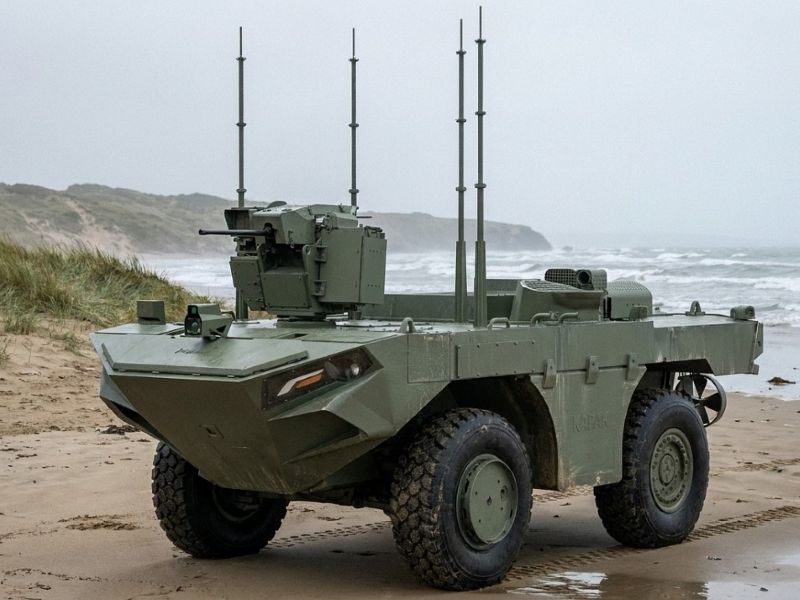
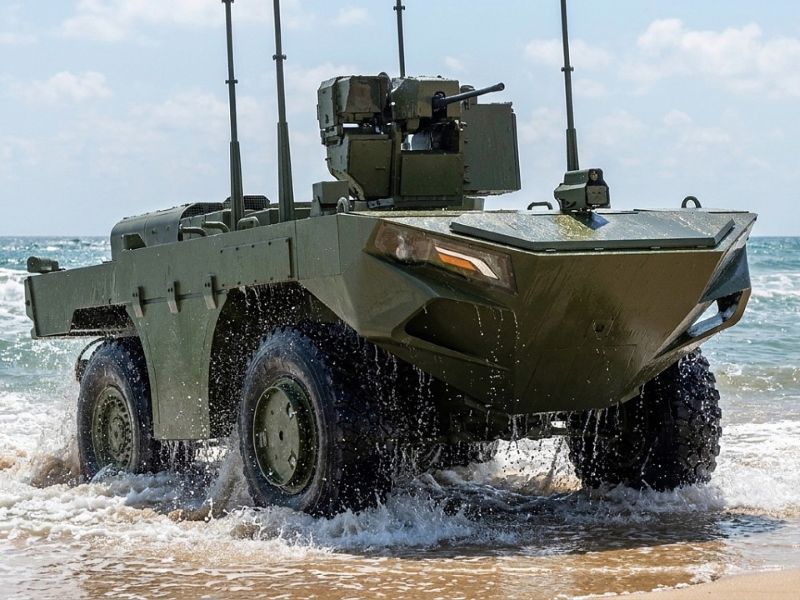
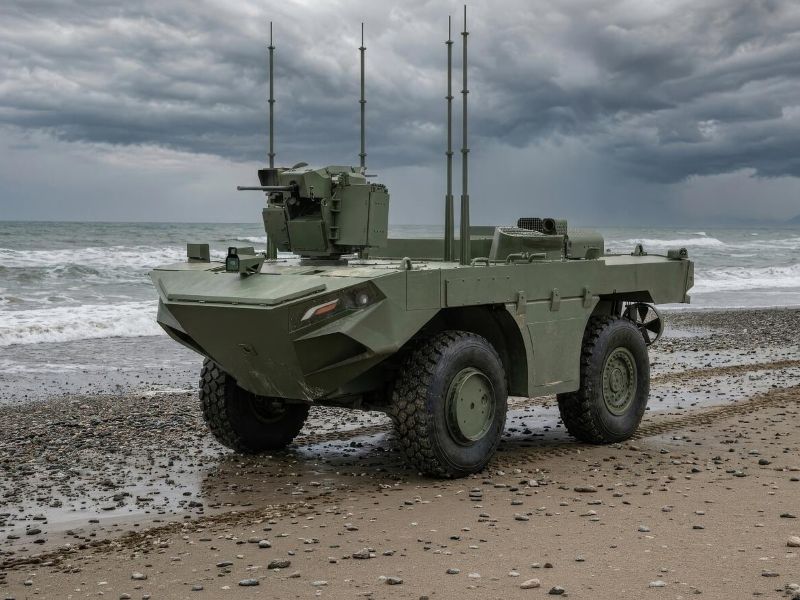
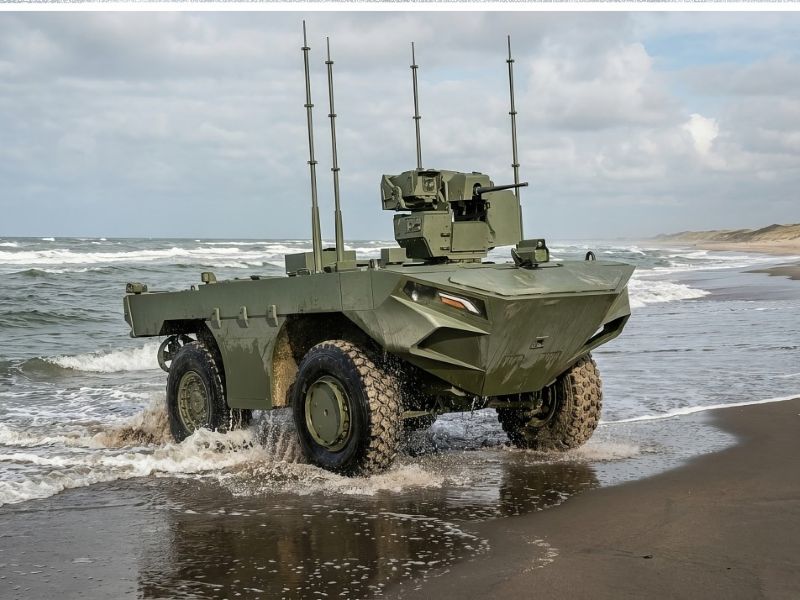
U-MAV is an unmanned amphibious vehicle developed by Turkish defence manufacturer FNSS Savunma Sistemleri.
The multi-purpose, modular platform is designed as a next-generation manoeuvre asset intended to operate closely with Marine units using the MAV/ZAHA amphibious assault vehicle.
Recommended Buyers Guides
FNSS presented U-MAV at TEKNOFEST Mavi Vatan 2026 in August, hosted by the Gölcük Naval Shipyard Command in Kocaeli.
U-MAV design and features
The U-MAVautonomousamphibious vehicle features a modular ballistic floating platform design. It measures 5.4m (17.7ft) in length, 2.7m in width and 1.8m in overall height, with a combat weight of 8,000kg (17,637lb).
The vehicle is designed to be moved by road, rail and sea using standard military logistics assets, and for rapid deployment it can be transported by heavy-lift helicopters and strategic airlifters such as the CH-47F Chinook, Mil Mi-26, C-130 Hercules, A400M and C-17 Globemaster, as well as the C-5 Galaxy, An-124 and Il-76.
The U-MAV’s concept of operations centres on moving ahead of manned MAV/ZAHA platforms to make initial contact with hostile coastal defences; clear mines and other obstacles depending on the payload fitted; prepare the beach for the approach and landing of manned vehicles; and then continue supporting the force as the operation progresses.
The vehicle is designed for autonomous, remote-controlled or hybrid operations, allowing personnel to remain safely on the ship for the duration of the operation. Minimal visual, thermal and acoustic signatures help improve the platform’s low-observable performance.
Armament
U-MAV features a remote-controlled turret that can be fitted with a 40mm automatic grenade launcher, a 12.7mm machine gun, a 30mm auto cannon, counter-unmanned aircraft system capability, loitering munition or drone-based effects, alongside anti-tank configurations.
A 360-degree situational awareness suite and remote control are included as standard, along with a Global Navigation Satellite System/Inertial Navigation System (GNSS/INS) and a navigation system. The electrical system operates at 24V.
Mission support
The vehicle uses AI-enabled image processing to assess camera feeds in real time on an onboard mission computer, transmitting detection data rather than bandwidth-intensive video over the radio link. The intent is to sustain situational awareness when communications are constrained or degraded. Detections are presented with threat scores, category and status using colour-coded overlays and intelligence cards.
Automated target detection and fire-control functions are intended to shorten the engagement timeline by presenting prioritised targets to the operator, while recording and tracking detections with timestamps.
The system is also designed to allow new target categories or engagement rules to be introduced in the field and applied immediately to the live imagery feed.
Control and communications
U-MAV uses an encrypted mesh network together with a GNSS/INS navigation suite and an Identification Friend or Foe (IFF) module to support command and control continuity. An inertial navigation unit maintains position estimates when satellite navigation is unavailable or degraded.
Line-of-sight communications range is 3km (1.86 miles), with extended coverage available via unmanned aerial vehicle relay support across all variants. If the datalink is disrupted, the vehicle can enter a safe hold state and either return to base using a pre-programmed route or continue its task, depending on its configuration.
Self-protection and life support systems
The U-MAV platform has ballistic protection aligned with STANAG 4569, although the specific level is classified. It includes a self-righting capability and carries eight smoke grenade dischargers. An integrated smoke generator is offered as an option, alongside an Armor Integrity armour health monitoring system.
U-MAV is the first unmanned vehicle to integrate Armor Integrity, Nurol Teknoloji’s structural integrity monitoring system, into its digital architecture. With no crew onboard to assess damage, sensors provide an automated evaluation by identifying an impact’s location, direction and severity in real time.
The system then estimates the remaining structural capacity of the affected area, tracking damage accumulation over time, and sending the resulting information to the operator and chain of command. If the link is lost, the data is stored onboard and transmitted when connectivity returns.
U-MAV performance and mobility
U-MAV is powered by a diesel engine with a fully automatic transmission and a road speed of 70km/h (43.5mph). In the water, amphibious propulsion is delivered by a combined 300-horsepower (hp) powerpack, enabling a swimming speed of seven knots.
The platform has a power-to-weight ratio of 37.5hp/t and is intended to maintain consistent performance during the transition from water to firm ground.
The vehicle’s suspension is an independent double wishbone arrangement, paired with hydraulically assisted, electronically controlled steering. It is rated for a 70% gradient and a 40% side slope, can negotiate a vertical obstacle of 0.4m (1.3ft), and can cross a trench of 1m.
The drivetrain uses a 4×4 configuration with differential and axle locks. Braking is provided by a dual-circuit, air-over-hydraulic system with remote control. Run-flat capability and a central tyre inflation system are standard, with selectable tyre options for different surface conditions.
U-MAV variants
Modularity is central to the U-MAV design, enabling mission payloads to be swapped on a common base platform to meet different requirements. In field conditions, a module change can be completed in around 40 minutes.
The platform can be configured into ten mission set-ups covering fire support, mine clearance, combat engineering, electronic warfare and reconnaissance, in addition to deception, counter-drone tasks, navigation and obstacle marking, logistics support and casualty evacuation.
These variants can be deployed together within the same operation, with the shared platform simplifying sustainment and reducing the overall logistics burden.stainment and reducing the overall logistics burden.
