

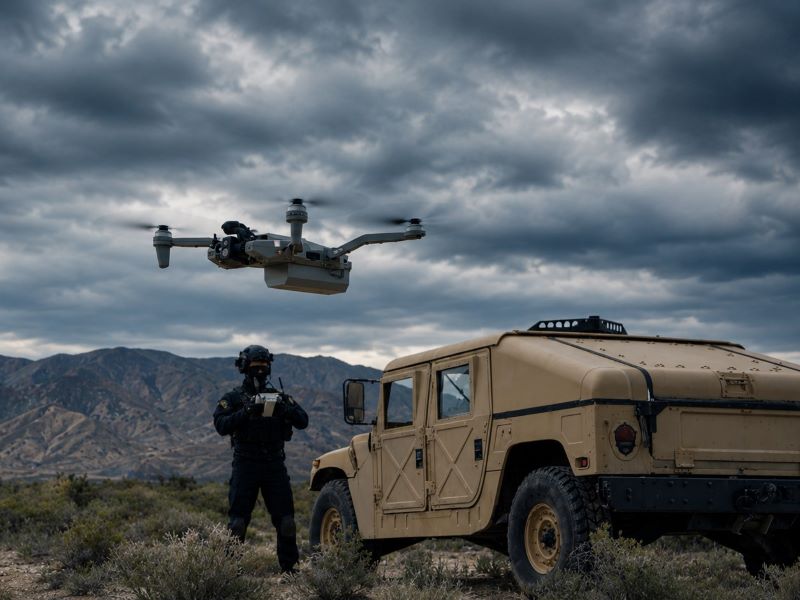
Hellcat is a new dual-use small unmanned aircraft system (sUAS) developed by Red Cat Holdings, a US-based drone and robotic solutions provider.
The system is built on the proven Black Widow platform, which was developed as a purpose-built sUAS to meet the US Army’s Short Range Reconnaissance programme requirements.
Recommended Buyers Guides

Unveiled at the Eurosatory exhibition held in June 2026, the platform is designed to provide intelligence, surveillance and reconnaissance support in rapidly evolving operational conditions. It incorporates input from frontline personnel and insights gained from Red Cat’s continuing collaboration with Ukraine.
The sUAS can accommodate a wide spectrum of customer needs, ranging from varied government acquisition programmes and coalition interoperability requirements to mission-specific software ecosystems.
Hellcat sUAS design and features
Designed in line with Modular Open Systems Architecture principles, Hellcat is intended to let users tailor command and control, payloads, software and integration routes to suit specific missions.
The sUAS weighs 1.93kg (4.26lb) and offers an endurance of more than 50 minutes. It can operate at a maximum altitude of more than 4,000ft (1,219m) above ground level and reach speeds of up to 18m/s or 64km/h (40mph).
With operator line-of-sight maintained, Hellcat has an operational range of up to 11km (6.8 miles). It is also rucksack-portable and designed to be repaired in the field if needed.
The platform is intended to function in GPS-denied environments from power-on, with recovery supported through Return to Home Azimuth without GPS. It also features forward-looking obstacle avoidance and modular arms for primary and secondary payloads.
The unmanned system includes a quiet acoustic signature, a low-visibility tactical finish and a WEB Standoff Radio that allows control from up to 53.3m away from the ground control station (GCS). It emits no detectable radio frequency signal, thereby reducing the risk of exposing the operator’s position.
Onboard cameras and sensors
Hellcat uses the Ocellus 3CP sensor suite, which features a stabilised three-camera payload combining infrared, telephoto and wide-angle coverage, offering 12× optical zoom (telephoto), 8× digital zoom (wide-angle) and video recording 4k resolution at 30 frames per second.
The infrared camera sensor incorporates a forward-looking infrared (FLIR) Boson 640 R+ infrared camera. The telephoto camera uses a 35mm lens with an F2.4 aperture, a 13-degree field of view (FOV) and a 12-megapixel (MP) sensor, while the wide-angle camera uses an 8mm lens with an F2.8 aperture, a 52-degree FOV and a 16MP sensor.
The sensor system provides three degrees of freedom with roll of ±35 degrees, pitch of ±5 degrees, and yaw of +45 degrees/-120 degrees and is designed to be backwards compatible with existing systems.
Hellcat sUAS communications
The platform’s communications are supported by a Doodle Hex-Band Radio with frequency-stepping intended to improve resilience in electronic warfare conditions.
Onboard AI processing is enabled by the Qualcomm RB5 Chip, Adreno 650 graphics processing unit and an eight-core Kryo 585 central processing unit.
The system features an integrated FLIR Prism AI software stack and can also be configured with Sightline Intelligence Athena AI’s aided target recognition software.
Other options that can be added to the platform include Reveal Farsight 3D Mapping Software and Palantir Visual Based Navigation.
Ground control system
Hellcat uses the WEB GCS universal ground control station, designed to support multi-domain platforms including ground robotics. The GCS weighs 1.54kg and uses a 220W-hour battery.
The WEB GCS includes a high-brightness display, quick-attach and detach antennas, programmable joysticks and switches, USB-C power output and HDMI video output, as well as an electro-mechanical interface designed to support future accessories. The user interface supports the Android Team Awareness Kit and QGroundControl.
The GCS provides 1,080-pixel video downlink resolution, uses AES-256 encryption, and operates across frequency bands M1–M6 from 1,625MHz to 2,510MHz. It supports channel and band hopping with a latency delay of <250ms.
The operating system is Android, and the stated battery life is 12 hours using the same battery as the aircraft.stem is Android, and the stated battery life is 12 hours using the same battery as the aircraft.
