

- Despite committing billions of pounds, the UK’s Ajax infantry fighting vehicle programme continues to suffer with significant issues
- Service personnel are still being left injured after operating the platform for prolonged periods, despite an apparent fix years ago
- The UK Government was humiliated after being forced to suspend the use of Ajax days after the IFV had reached IOC
At the recent International Armoured Vehicles exhibition and conference, the £6bn ($8.9bn) elephant in the room that resembles the Ajax programme managed to influence all manner of discussion, without actually being present on the show floor.


Delegates were seen to wince when speakers were introduced as having played a role in the Ajax programme. Some tried to crack jokes.
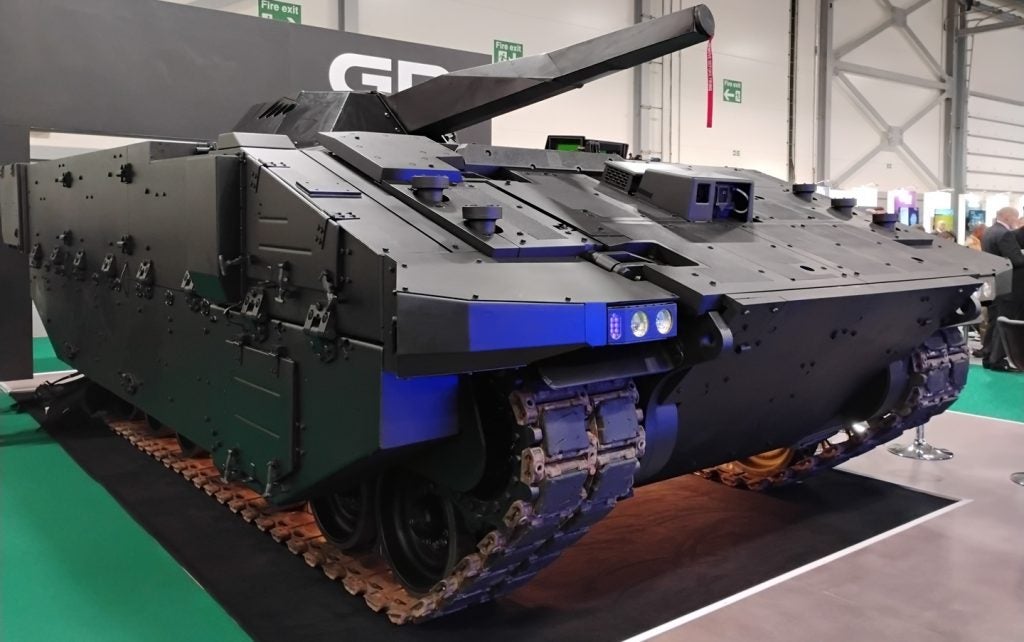
Manufacturer General Dynamics Land Systems opted to showcase the Ajax without the turret, which was replaced by the Patria mortar module, theoretically a capability the British Army might actually need.
An opportunity was missed by BAE Systems in opting not to showcase the CV90, the one-time contender and happily in service across multiple countries and variants. Perhaps, in reality, there is not much to laugh about.
The Ajax is on the naughty step, again, pending a review being conducted by the programme stakeholders following the humiliation of a Labour defence minister after being forced to suspend its use in late-2025, mere days the Ministry of Defence publicly crowed the platform had reached initial operating capability.
Service personnel continue to report injury and illness after operating the Ajax for prolonged periods, the platform still suffering from apparent shaking and noise issues, years after the problem was apparently fixed.
However, Army Technology learned that the programme is still apparently considered central to the future of the British Army, along with the Boxer mechanised infantry vehicle – which has its own problems – and a Challenger 3 programme still years away from delivery.
As of 21 January, 170 Ajax platforms have been delivered up to and including 1 December 2025, including: 87 Ajax, 33 Ares, 25 Athena, three Argus, 13 Apollo, and nine Atlas variants.
Time is not on the UK’s side. The Ajax-series of vehicles had its beginning in the Scout SV programme, with assessment contracts first awarded in 2008. Fully 18 years later, and, if one is to believe the UK Government, the programme could be in the balance.
Within this timeframe, some European militaries at IAV 2026 went into great detail as to how they were embarking on a second round of land platform modernisation since the turn of the millennium, even while the British Army struggles to complete its first.
Labour ministers have poured water on the prospect that the ageing Warrior infantry fighting vehicle could be given a stay of execution and replace Ajax, perhaps with a redux of the Warrior Capability Sustainment Programme, itself another expensive failure.
Even Boxer, officials said, had “well-known capacity challenges” regarding industry’s ability to deliver.
“We all have to be on the same page [regarding] production capacity,” said another, referring to nothing and everything, glaring at the seated delegates.
Perhaps Ajax is the subject then, the answers coming in a Future FRES Scout SV, the solution to all the programmatic problems that plague UK land acquisition.
“It has not been an easy journey,” one said of Ajax, but that the programme had “enabled important lessons”.
It remains to be seen what lessons these might be, short of British Army personnel being recommended to wear three sets of ear protection to drown out the Ajax’s din, both on the combat ranges of England and the halls of defence exhibitions.


