

- OneArc executive Oliver Arup spoke to Army Technology during the ITEC exhibition in London
- The company formed from the merging of several simulation suppliers in December 2025
- Arup detailed the transition from VBS3 to VBS4 and its forthcoming Flowstate trainer
Three months after the formation of OneArc – combining the capabilities of notable simulation suppliers Bohemia Interactive, Pitch and Terrasim – the company revealed its latest updates and market strategy as its approaches the end of its first quarter.



At their stand during the ITEC exhibition in London this week, chief technology and product officer Oliver Arup sat down with Army Technology to discuss ongoing developments.
OneArc is positioned well as around 60 countries transition to its flagship offering, the whole-earth virtual environment creator VBS4.
Among other products, the company has also developed its new first-person view (FPV) drone trainer, Flowstate, over the last four months.
While currently in preview form at ITEC, the company has secured several, unspecified initial contractors. Yet the system is scheduled to enter the market in May 2026.
John Hill: Tell me the rationale behind the creation of OneArc and your strategy in the military training simulation market?
Oliver Arup: The formation of OneArc was a natural progression of bringing together groups of technologies which already existed into a single offer.
Part of what we wanted to do was to reframe what we were offering. We were well known for just offering software. We wanted to expand that remit into solutions.
When we talk about solutions, we’re not just talking about the software but the hardware and a small part of de-risking your integrations.
John Hill: One such solution is your flagship virtual battlespace. I understand Denmark and Norway are the latest to transition from VBS3 to VBS4. Could you describe the difference in capability?
Oliver Arup: There aren’t many [nations] left on VBS3; pretty much every Nato aligned user is now using VBS4 at an enterprise level.
The best way to describe the change is VBS3 will allow you to train in a small training area. We’re talking maybe 50 square kilometres. It was very capable at the individual training level but fairly limited as you started getting to larger scenarios.
VBS4 allowed us to do the whole earth in your simulation. You can find a location you want to train within ten seconds.
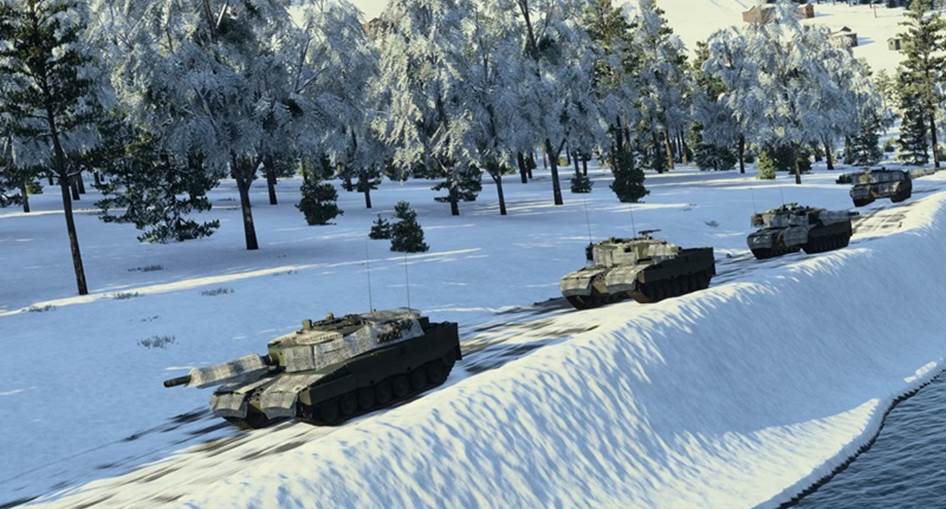
We started seeing a demand signal from the rest of industry and governments saying that as the capabilities and platforms increased, they [were limited to] a world where they had individual soldiers on the ground and all they could see was what was in front of them.
They started moving to a world where ISTAR assets became available to everyone. Suddenly your training has to replicate what’s happening in the real world.
Then you have a problem where your training system, even though you may be training an individual fire team, that fire team has access to assets which may be at the divisional level.
John Hill: Could you tell me about your FPV drone trainer?
Oliver Arup: We have just launched Flowstate. This is very much of-the-moment, as you can imagine, from what’s going on in Ukraine.
We are not just providing flight training for FPV drone pilots because that, in some ways, is the easy bit. Learning to fly a drone is muscle memory. Where our [unique selling point] comes in is the rest of the complexity of the environment.
Flowstate is part of the same OneArc ecosystem: everything works together.
You can connect this trainer to VBS4, you could have an entire battalion exercise going on with 200 real-life trainees running around as dismounted soldiers or operating tanks, and then inject a Flowstate FPV drone into that environment.
Suddenly you must deal with the complexity: how do I use one of these drones as an asset? How do I deal with the safety case of having a drone flying around in an environment where I may have more traditional assets like helicopters or artillery?
John Hill: Drones are adapting quickly in the heat of combat; there are many types. What challenges do you have replicating ever-changing systems?
Oliver Arup: We had a lot of contact with SMEs around the world and various militaries who have experience [on the] frontline using drones.
The idea that all these drones are just off-the-shelf is not true in Ukraine.
Very often these drones are built to order. Yes, they may have a pattern but they’re all slightly different. So there’s a big push to that individual skill set. Drone pilots in Ukraine are key assets.
It’s a skill that takes training and maintenance. But again, there’s tactical learning around it.
For example, we simulate things like transmitter power. If you’re emitting a [radio frequency] signature from your controller that is telling your enemy where you are. So you need to then modulate the power of your transmitter to make sure that you are low power when you’re taking off and not giving away your position.


