

Tensions are high on the world stage after a Russian incursion into Estonian airspace.



Nato allies emerge from putting the case to diplomatic circles at the United Nations in New York and the North Atlantic Council in Brussels this week.
But on the ground, during a visit to Ämari Air Base, 23 miles outside of Tallinn, from which Italian aircraft responded to Russian intimidation across Central and Eastern Europe over the past fortnight, military officials walked Army Technology through the details of the interception as well as their new assets.
Italian personnel currently serve as the latest rotational contingent to conduct Nato Air Policing in the northerly Baltic nation.
The Estonian air base, which opened in 1945, originally supported elements of the Soviet Union’s Baltic Fleet in the early years of the communist regime of the Estonia SSR.
Some time after the USSR’s collpase, the Estonian Defence Forces eventually housed an air force unit there in May 1997. There have been major construction works in that time to integrate the air base into Nato’s collective air defence system.
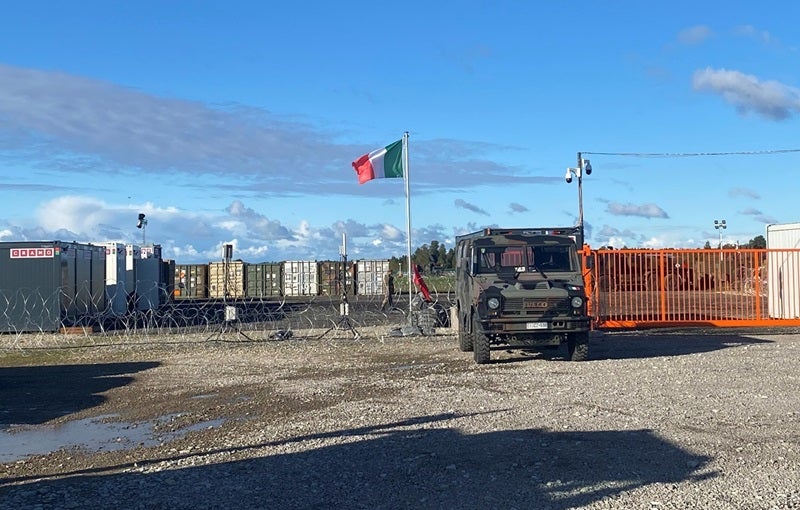
Fast forward to the beginning of September 2025 – the Italian Air Force, under the Baltic Eagle III mission, arrived to provide a Quick Reaction Alert (QRA) response while also delivering a tangible commitment to the defence of the airspace across their area of responsibility spanning the entire Baltic region.
During the visit on 24 September, this presence included F-35A Lightning IIs, Eurofighter Typhoons, a single E-550A Conformal Airborne Early Warning aircraft, and the SAMP/T air defence system.
The Task Force Air 32nd Wing, composed of personnel from the Italian Air Force and Army, assumed responsibility for Baltic airspace surveillance since 1 August 2025. This constitutes Italy’s third participation in the wider mission to Estonia, off the back of stints in 2018 and 2021.
Nato interception
“It was a normal day like today,” said the Italian Task Force commander, Lieutenant Colonel Gaetano Farina, who was in charge of the Nato Air Policing contingent on the ground at Ämari Air Base when two Italian F-35s scrambled to intercept three Russian MiG-31 fighter jets five nautical miles deep into Estonian airspace on 19 September in what became an unprecedented 12-minute escapade.
“We got the indication that something is about to happen, we will have the information [from] the CRC [control and reporting centre] on the ground…
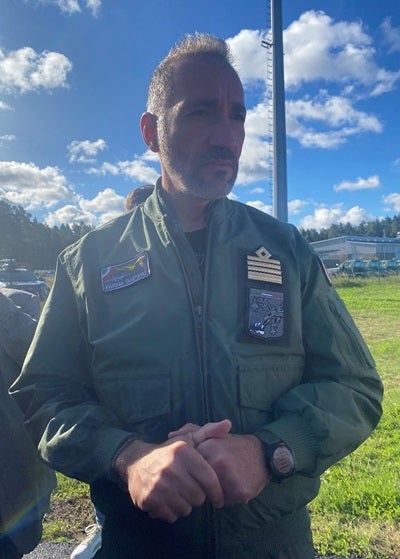
“They sent an alert… We received the alarm. So the pilots, the crew, [were] here in QRA… in a few minutes we were able to take off and see what’s going on,” Farina described.
“Then after that we just escorted [the three Russian fighter jets] through to different planes, so they went through another [jet] from Sweden,” where they were then escorted to Kaliningrad, a Russian exclave sandwiched between Poland and Lithuania.
Curiously, Farina emphasised that the Russian pilots behaved in a “professional” manner, despite the unlawful infringement of sovereign airspace and the fact that their transponders were turned off, meaning the trio were intentionally invisible to radar and Air Traffic Control.
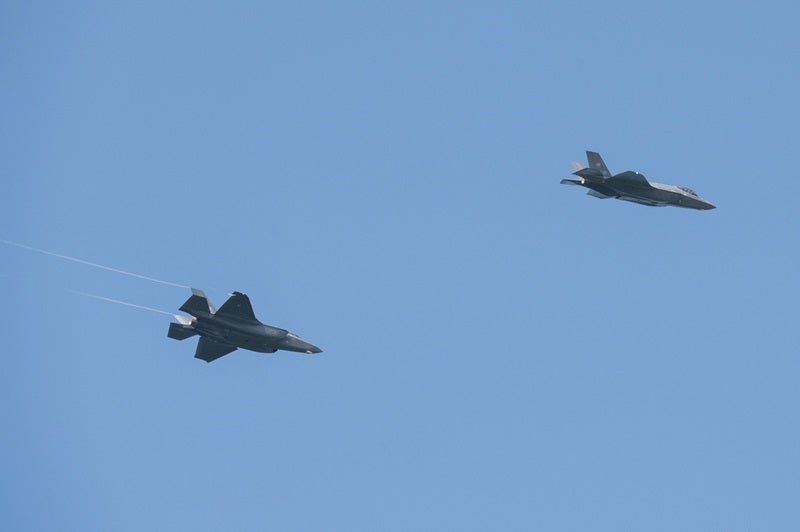
The Russians responded in kind to the F-35’s wing rock, which is an international sign among pilots which indicates compliance during an interception.
The Estonian Minister of Defence confirmed in a media briefing a couple days after the incident that there were no discernible weapons systems carried by the Russian jets.
However, responding to a question from Army Technology during the visit, Farina confirmed that the two F-35s were carrying air-to-air missiles for “self-defence”, but he was not at liberty to say what type they were. Nevertheless, Farina continued, “there was no escalation at all.”
CAEW aircraft
The Italian military is one of 17 countries that operate an airborne early warning and control aircraft.
Based on the Gulfstream G550 business jet, Italy’s CAEW platform – which can fly for eight hours at a time – provides airborne surveillance, command, control, and communications capabilities.
This constructs a 360-degree picture using four radar components for a detection range of around 200 nautical miles, as well as electronic intelligence and secure communications, crucial for battlefield information superiority.
This came in handy in Nato’s QRA response on the night between 9 and 10 September, when 19 cases of incursion by drone-type objects entered Polish airspace, which are said to have been launched from the direction of Belarus and Russia.
An Italian Air Force official confirmed that the CAEW platform was already flying at the time the drones entered Polish airspace, undertaking a routine “scheduled task”.
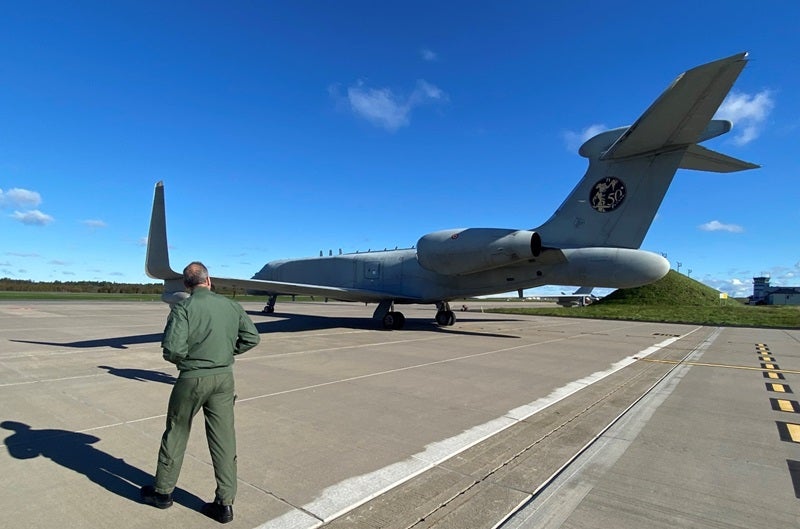
Information soaked up by the Italian asset, which was said to have also entered Polish airspace from Estonia to support the allied response, was then shared with the command level, other aircraft, and units on the ground – all in real time.
The aircraft was not operating alone, however, with multiple assets on the ground that were working at night. It was a shared job to detect and track the threats.
SAMP/T
As part of their tangible commitment to the region, Italy shipped the Franco-Italian SAMP/T medium-range air defence system to Ämari.
The move forms part of a new rotational model that strengthens Nato’s integrated air and missile defence (IAMD) with regular training and rotation of systems across areas of responsibility.
Italy’s SAMP/T deployment marks the inception of the rotational model in Estonia. The concept was initially approved at the Vilnius Summit in 2024 and validated the following year in Washington DC, on the 75th anniversary of the alliance.
Components of the Italian system were strategically dispersed many metres apart in a linear fashion, minimising the destructive effect of potential adversarial attack.
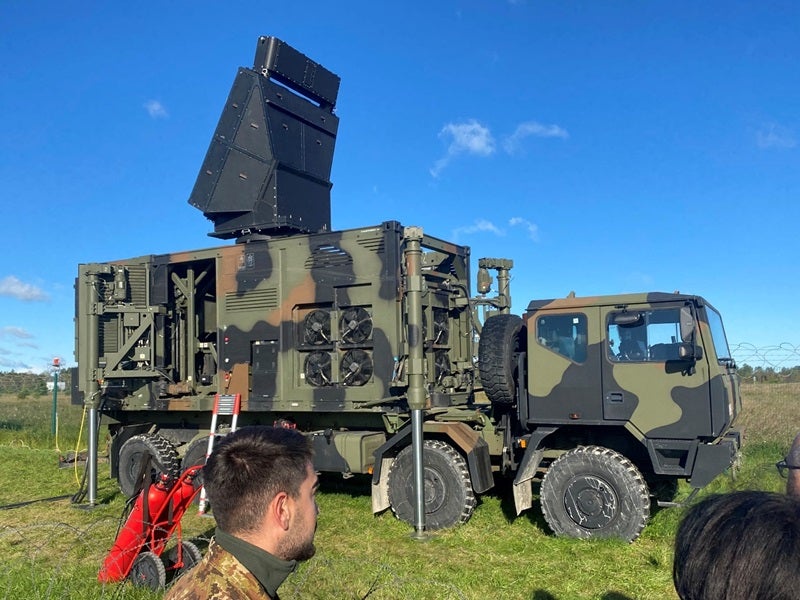
The first component is an experimental radar built by the Italian defence manufacturer Leonardo.
Known as KRONOS GM HP (grand mobile high power), this new generation (NG), multifunctional, active electronically scanned array (AESA) radar was first produced in 2021. Leonardo completed factory acceptance tests for its fourth radar at the end of May this year.
KRONOS is not yet part of the operational SAMP/T system at the air base, but it will eventually replace the existing French radar component, built by Thales, that currently supports the air defence system.
The other operational radar component built by Thales for the SAMP/T, known as ARABEL, also conducts multifunctional, 360-degree tracking and identifiction of threats, but this system is an older passive electronic scanned array (PESA) radar.
This makes KRONOS more agile as the AESA capability means it can form multiple beams simultaneously at different frequencies whereas ARABEL is limited to a single, central, albeit powerful, transmitter.
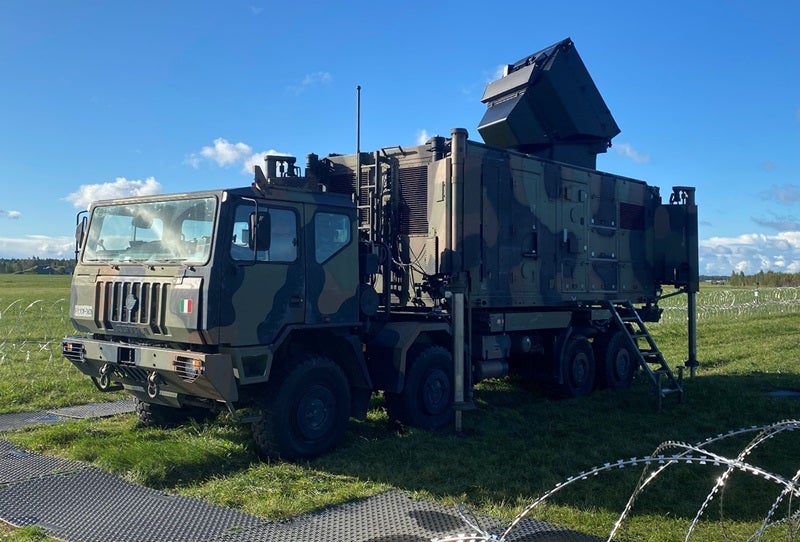
This distinction impacts how each radar transmits, receives, and processes signals, resulting in a massive increase in the number of targets that KRONOS can track simultaneously.
In effect, KRONOS has the capacity to detect up to 1,000 various targets compared to ARABEL’s capacity for up to 100.
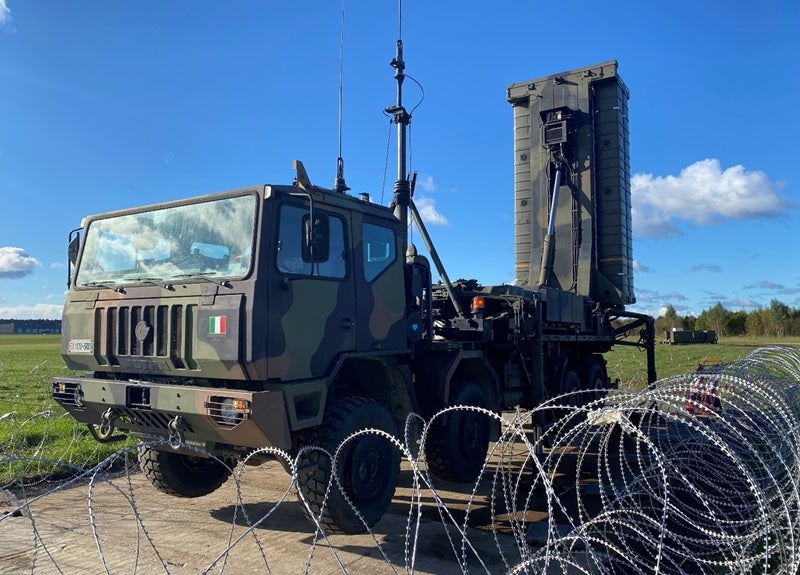
Finally, the launcher sits on the back of a mobile platform. Each launcher has capacity for eight Aster 30 interceptor missiles.
While the system can detect at a range greater than 300km, the launcher intercepts air-breathing targets within a range of 150km. The solid propellant booster ensures the optimum shaping of the missile’s trajectory in the direction of the target and separates a few seconds after the vertical launch



