

- South Korea selected Hanwha as its ‘preferred tender’ for a course correction fuse to be installed on 155mm munitions compatible with the K9 howitzer
- More than $116m will be invested through to 2032 as part of the deal
- Installed at the front of the projectile, the fuse will use GPS-based navigation to correct the projectile’s trajectory
South Korea’s Defense Acquisition Program Administration (DAPA) has selected Hanwha Aerospace as its “preferred bidder” for a programme to develop 155mm rounds with greater precision guidance for the K9 self-propelled howitzer.
Hanwha will enter negotiations with DAPA over specifications, delivery times and contract terms. But the Government will invest ~$116m (Krw164.2bn) through to 2032 as part of the deal.

Discover B2B Marketing That Performs
Combine business intelligence and editorial excellence to reach engaged professionals across 36 leading media platforms.
The prime contractor will develop a course correction fuse. Installed at the front of the projectile, the fuse will use GPS-based navigation to correct the projectile’s trajectory.
DAPA expect the novel fuse will reduce the K9’s impact dispersion to approximately one-sixth of the current level, ensuring a precise engagement of long-range targets with fewer rounds.
Since the K9 howitzer can fire Nato standard munitions, the technology will also be applied to any compatible 155mm ammunition by replacing conventional fuses, providing a practical way to enhance the precision of existing ammunition.
K9A3 rollout
According to buisness intelligence provider, GlobalData, the Korean Army is estimated to procure 725 A3 units between 2026 and 2035. Currently, the service operate 1,200 A1 artillery systems, some of which are over 25-years old.
The latest version will incorporate autonomous capabilities and a larger 58-calibre gun that increases the firing range from +30km to +80km, almost doubling the range of the current 52-calibre, depending on emerging ammunition variants.
Notably, the A3 turret is designed to operate with a sole operator, or completely uncrewed, aligning with the Joint Chief of Staff’s vision of improved autonomy being key to overcome the republic’s demographic crisis. Multiple units of the K9A3 will also be able to be operated by a single person.
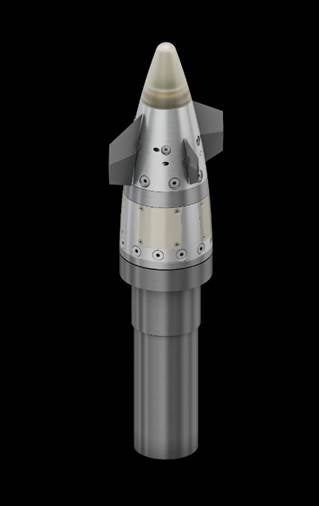
Posting a picture of the concept on the social media platform, LinkedIn, Hanwha envisaged the course correction fuse to rely on a standard cruciform configuration, judging by the fins (a fourth fin is hidden from view in this case).
The projectile will use four control surfaces spaced symmetrically at 90-degree intervals around the body to manoeuvre and correct the shell’s flight path.
A specialised munition design is required as Hanwha will need to consider a retractable fin solution to allow firing from the 52-calibre CN98 barrel, which uses spin-stabilisation to maintain aerodynamic stability in flight. The larger A3 barrel, with an expanded powder chamber volume, remains a rifled gun system.


