

Saab held an exclusive media briefing during the IT²EC 2025 conference in Oslo, Norway last week, where it was suggested that “training without UAVs [uncrewed aerial vehicles] is irrelevant.”
Sweden’s defence supplier reached this conclusion in its continual development of capabilities, informed by its “close dialogue” with customers, according to Hans Lindgren, head of business development at Saab business unit Training & Simulation .
Go deeper with GlobalData


Discover B2B Marketing That Performs
Combine business intelligence and editorial excellence to reach engaged professionals across 36 leading media platforms.
This feedback has determined that UAVs have altered how tactical level units manoeuvre in the field. In Ukraine, these units must maintain a small footprint and move fast, and the same can be said for armoured units, which avoid open clearings and stay hidden with a reduced signature.
“We cannot stand [in one place] for a week,” one Swedish division commander is said to have told Lindgren. “We need to split up the target, [maintain a] smaller footprint, and that experience will shape new information, new demands on behaviour, their appearance on the battlefield.”
Lindgren continued: “By adding the drone as a threat that can act against targets on the ground, then lessons can be learned before they deploy to a potential future operation.”
While Lindgren’s assertion on the significance of UAV training may be obvious, it still touches on an undervalued point that nothing in the battlespace operates in isolation. Military training must encompass all roles and threats, all at once.
For Saab, UAVs fit into the rest of its product as an add-on feature alongside other training elements, such as indirect fires and recently some elements of maritime training. These are brought together into a combined arms training platform.
“We cannot conduct operations in the way we did before,” Lindgren stressed.
Planning new tactics and responses to UAVs
As troops engage with the enemy and attempt to execute their battle strategies, they must also decide what action to take when a single or multiple UAVs enter the scene.
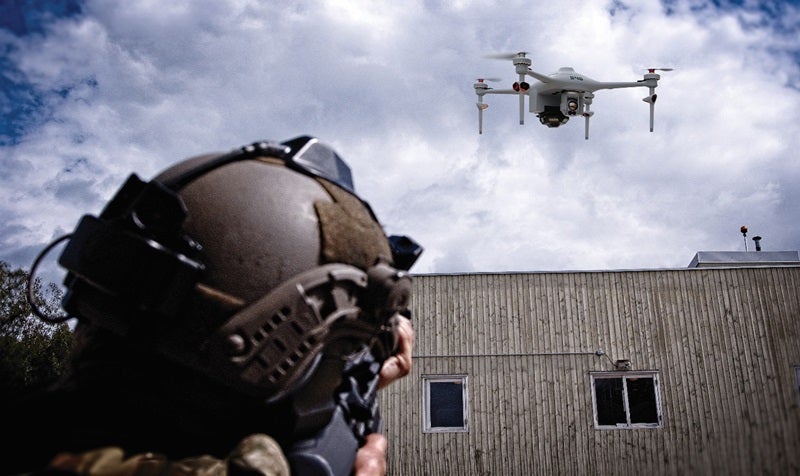
Depending on the customer’s needs, the training drones used can simulate various mission objectives. With weaponised drones dropping munitions proving a major threat in Ukraine, the training drones can, for example, drop virtual munitions.
Saab’s laser-based live training solution can track and record which soldiers are ‘killed’ by these munitions, with the casualties notified they have been hit via lights and audio cues on their training vests.
Trainees are able to defeat UAVs in the sky using weapons with simulated munitions with realistic ballistic profiles. If the system is hit, LED lights on its surface change colour and the pilot removes it from the location.


