

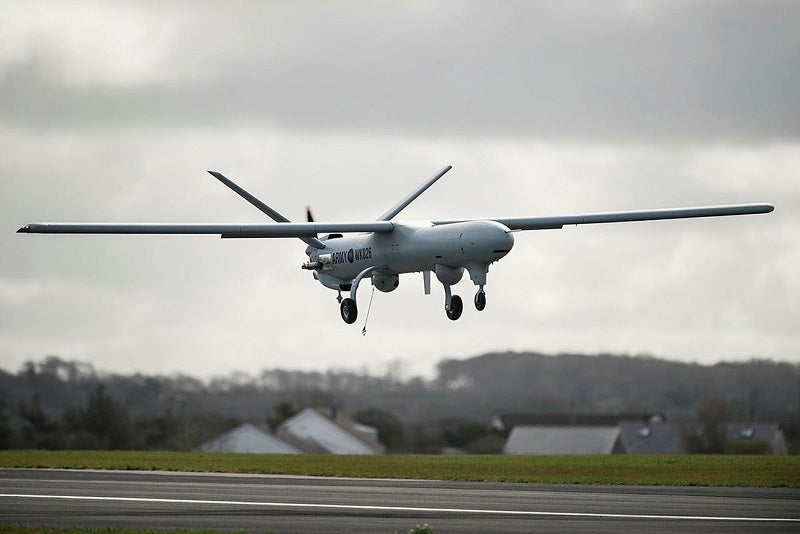
The British Army’s Watchkeeper programme – a critical uncrewed aerial vehicle (UAV) that collects, processes and disseminates high quality imagery intelligence from above – has been cut in the latest round of Ministry of Defence (MoD) programmes to be slashed on 20 November 2024.
Since the first flight in 2010, Watchkeeper has accumulated close to 4,000 flying hours, fulfilling the Army’s Land Tactical Deep Find capability which is an essential element, the service says, of the Future Land Combat System.
Go deeper with GlobalData


Discover B2B Marketing That Performs
Combine business intelligence and editorial excellence to reach engaged professionals across 36 leading media platforms.
At the time of announcing the cuts to programmes yesterday, the UK Secretary of State for Defence, John Healey, noted that there are currently 46 Watchkeeper UAVs, meaning that eight units have been lost in crashes, mostly in Wales, throughout the life of the programme.
Likewise, the total programme has run up to £1.35bn in 2023, up from £700m. The programme has persistently fallen behind developments in drone technology.
“The requirement for unmanned [Intelligence, Surveillance and Reconnaissance] remains, and that is becoming even more critical as demonstrated by the Ukraine conflict,” commented GlobalData Defence Analyst Tristan Sauer.
“The problem is that this programme has cost that much for only 54 drones which, though advanced at the time, are not quite worth the trouble anymore considering you can achieve similar capabilities for a fraction of the cost.”
Healey justified the decision to cut Watchkeeper – besides five other Royal Navy programmes, including two Albion-class amphibious assault ships – in his address to Parliament. These decisions, he claims, are set to save the MoD £150m over the next two years and up to £500m over five years.
“These are common-sense decisions,” he added. “They are decisions which have been backed by the Chiefs and have been taken into consultation with SDR reviewers.”
Lead up to the Strategic Defence Review
Despite conducting a Strategic Defence Review (SDR) to look at the priorities of UK Defence in this new era of demand, which is due come in the spring of 2025, the government has already begun rounds of cuts before the findings have been made public.
These early decisions to cut programmes such as Watchkeeper indicate the tough fiscal position of the MoD at a time of high military demand and global insecurity:
“The fact that Defence either can’t crew them [Watchkeeper UAVs], or is prepared to cut them to make very modest savings over five years in the current international environment is an indication of just how tight resources must be in the MoD right now,” Matthew Savill, Military Sciences Director, RUSI, remarked.
Meanwhile, Healey made an argument for the need to replace legacy capabilities with modern systems in his speech to Parliament:
“Our soldiers, our sailors, aviators have been stuck with old, outdated equipment because [previous Conservative] ministers wouldn’t make the difficult decommissioning decisions.”
Although Healey emphasised the necessity to conclude Watchkeeper, an obsolete programme, and various other projects for different reasons, gaps are now emerging in the British military’s capabilities which are going unfilled with no clear direction in sight on how to remedy this problem.
This is especially ironic since the Defence Secretary repeatedly points to the Conservative’s efforts in hollowing out military capabilities.
The UK Defence Committee, which convened today (21 November) to hear evidence from Healey directly, questioned the ability of the department to sustain military equipment in the dangerous years ahead.


