

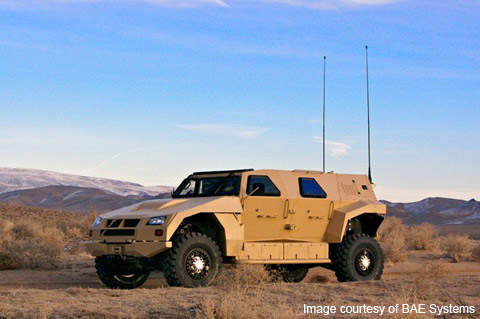

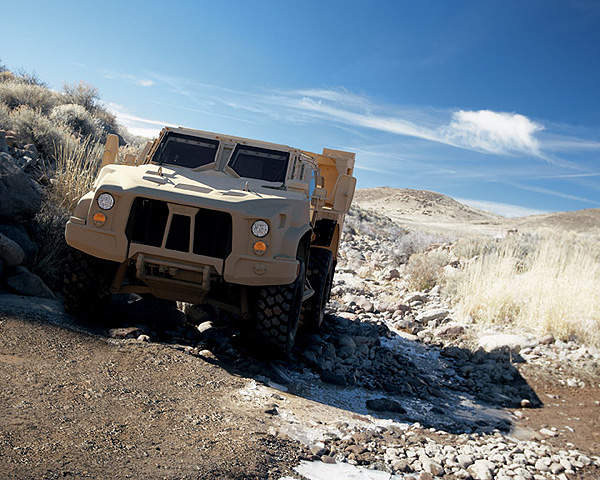
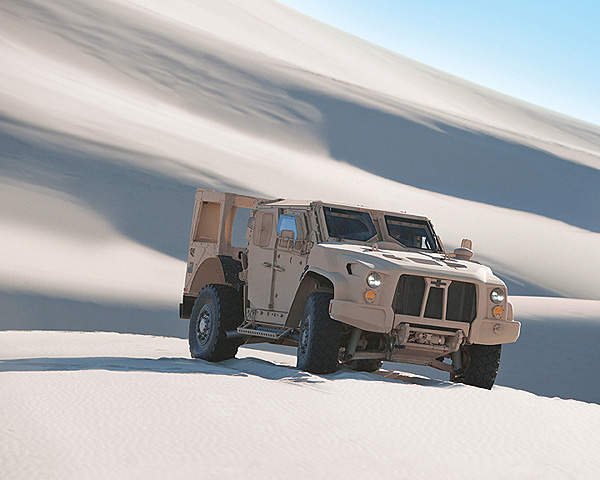


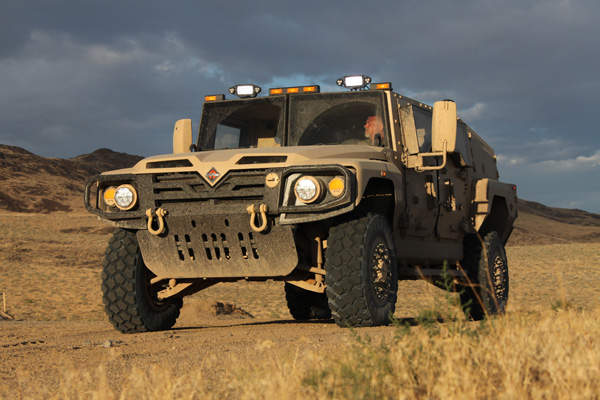
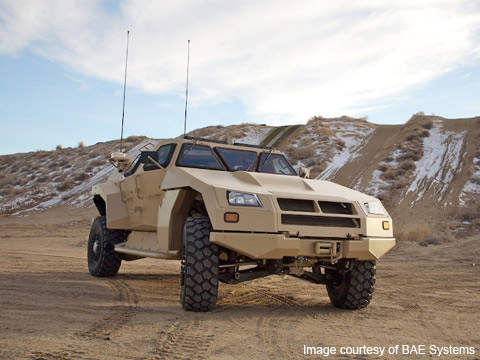
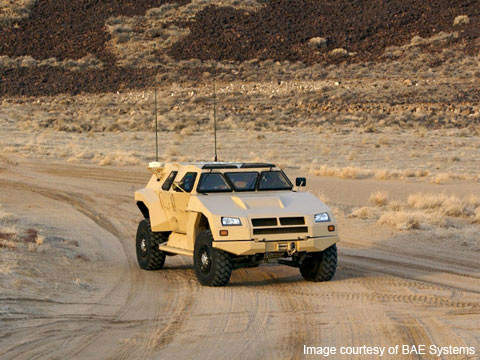
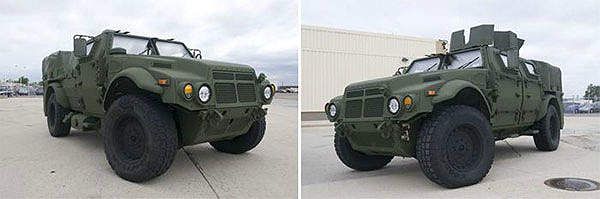

The joint light tactical vehicle (JLTV) is a new support vehicle programme being developed by the US forces, specifically the US Army, USSOCOM, and the Marine Corps to replace the rapidly ageing and outmoded high-mobility multipurpose wheeled vehicle (HMMWV), the design of which is over 25 years old.
Recommended Buyers Guides

The new JLTV vehicle range is expected to confer more survivability from insurgent attacks such as road-side bombings and will also have a greater payload. The HMMWV was not designed from the outset to be an armoured combat and patrol vehicle but nevertheless has been employed as one. In contrast the JLTV has been specifically designed for patrol and combat operations. The JLTV project has been able to benefit from some of the knowledge gained during the future tactical truck system (FTTS) project.
Joint light tactical vehicle family
The JLTV range will contain five armoured versions including infantry combat vehicles, command vehicles, reconnaissance vehicles, and armoured utility vehicles.
There will probably also be an armoured personnel carrier and a number of other non-armoured versions for other purposes such as ambulances, utility vehicles and general purpose mobility.
The US and Australia signed a cooperation agreement for the technology demonstrator phase of the JLTV programme in January 2009. The land force capability modernisation (LFCM) project arrangement (PA) allows vehicle interoperability and integration between the land forces of the two countries.
In May 2010, BAE Systems, with its partners Navistar and ArvinMeritor, delivered seven JLTV prototype vehicles to the US Army and Marine Corps. The team also delivered four companion trailers. Three right hand drive operation configured JLTV prototypes were handed over to the Australian Army in June 2010. The US Army and Marine Corps received an enhanced protection configuration prototype (JLTV – A-EP) in November 2010.
Joint functional vehicle concepts
According to the brief there will be three major variations of the JLTV. These are categorised according to the payload of the vehicle and the general mission requirement but there may also be other variants if required.
The general categories (joint functional concepts) are ‘battlespace awareness’ (BA), ‘force application’ (FA) and ‘focused logistics’ (FL). All of these have to be transportable by CH-47 and CH-53 helicopters and also C-130 aircraft.
There are three payload capacity categories A, B and C which correspond to 3,500lb (1,600kg), 4,000lb to 4,500 lb (1,800kg to 2,000kg) and 5,100lb (2,300kg) respectively. The lower payload will be for the BA category for use as general purpose utility vehicles with a four personnel capacity.
The mid payload capacity is for the FA category used as a six-seat infantry carrier (carrying a small fire team), reconnaissance scout (six seats), reconnaissance knight (six seats), command and control on the move (four seats), heavy guns carrier (four seats and a gunner position), close-combat weapons carrier (four seats), utility vehicle (two seats) or an ambulance (three seats and two litter beds).
The higher payload is for the FL category used as shelter carrier / utility / prime mover (two seats), high-capacity ambulance (three seats and four litter beds).
Companies involved in the JLTV project
There are several companies involved in the development of the JLTV project with several joint efforts having been established including Northrop Grumman and Oshkosh Corp, General Tactical Vehicle, a joint venture between AM General and General Dynamics Land Systems, Lockheed Martin and BAE (formerly Armor Holdings), BAE Systems and International Military and Government, an affiliate of Navistar International Corporation (International Military and Government is a wholly owned subsidiary of International Truck and Engine Corporation), Boeing, Textron, SAIC, DRS Sustainment Systems and Force Protection.
The three contracts for development of JLTV prototypes were placed in October 2008. The critical design review (CDR) for the JLTV programme was completed in November 2009.
The technology development phase was completed in May 2011 and system development demonstration phase began in 2012. After this two contractors will complete the design and development of the JLTV family of vehicles and companion trailers and then compete to produce the multiple JLTV variants.
The MRAP-mine-resistant ambush-protected vehicle development has been given priority but all authorities agree that this will not replace the JLTV as it does not have the payload or versatility of the JLTV.
JLTV design requirements
For the vehicle there are several general requirements that have been stipulated by the US Army and Marine Corps. These include:
- A 30kW generator to give sustained power with the engine running and when the vehicle is moving
- A trailer capable of carrying the same payload as the vehicle at speed with reliability to match
- Ammo-carrying capacity: each JLTV will have capacity to carry two cans of M16 ammo, one can of M203, four cans of M249 and six cans of either MK19, M2, or M60 / M240 ammo
- Jam-resistant doors for easy escape after attack or damage
- An automatic fire-extinguishing system, a extra spall liner to minimise the effect of perforation after small-arms attack
- Two armour configurations (A and the enhanced level B) for protection against mines, artillery and RPG warheads
- Two run-flat tyres
- Systems to keep going after small arms attacks to systems such as fuel tank, coolant tank, or engine oil reservoir
- Electronic monitoring to diagnose equipment and system failures so that they can be fixed
Related projects
Oshkosh Defence Light Combat Tactical All-Terrain Vehicle (L-ATV)
The light combat tactical all-terrain vehicle (L-ATV) is developed by Oshkosh Defence as part of the Joint Light Tactical Vehicle (JLTV) programme.
Lockheed Martin Joint Light Tactical Vehicle
Lockheed Martin is developing a family of light tactical vehicles for the JLTV programme.
Saratoga Light Tactical Vehicle
International Saratoga is a light tactical vehicle developed by Navistar Defense modified to meet the requirements of the JLTV programme.
JLTV Eagle, Light Tactical Vehicle
JLTV Eagle is a light tactical vehicle being developed by General Tactical Vehicles (GTV) for the Joint Light Tactical Vehicle (JLTV) programme in the United States.
Valanx Joint Light Tactical Vehicle (JLTV)
Valanx is a Family of Vehicles (FoV) being developed by the BAE Systems-led team for the Joint Light Tactical Vehicle (JLTV) programme of the US Army, USSOCOM and Marine Corps.
