
The US Defense Innovation Unit (DIU), an organisation within the Department of Defense, announced a solicitation on 5 May for low-collateral defeat (LCD) counter small uncrewed air systems (C-sUAS).
DIU’s call out to commercial suppliers comes under the Replicator 2 initiative, seeking to counter the threat posed by small uncrewed air systems (sUAS) to installations and force concentrations.
C-sUAS effectors have proven time and again to be an urgent requirement. Last year, the UK was unable to fully safeguard American airbases in Britain, such as RAF Lakenheath, which hosts four squadrons of US Air Force F-35 and F-15E fighters, from sUAS.
Likewise, the formidable threat of such low-cost systems buzzing several feet above the surface have left North Korean troops supporting Russian forces in Kursk so fearful that they are said to be indiscriminately downing drones – Ukrainian and Russian.
In response to the sUAS threat, Replicator 2 emerged on 27 September 2024 following the success of Replicator 1, which had scaled the production of sUAS across the joint force. The US Army alone has already assigned more than 300 sUAS to its brigade combat teams.
Meanwhile, the systems that the military will procure under Replicator 2 will help to minimise risk to friendly forces, civilians, and infrastructure in the homeland and abroad.
“North America faces a variety of non-traditional threats, and key among these is the use of [sUAS] operating near installations and critical infrastructure – addressing these threats is a top priority and essential task,” said Commander, US Northern Command and NORAD, General Gregory M. Guillot.
Low collateral
From lasers to jamming, there are various ways to take down sUAS but this solicitation will consider LCD systems specifically.
Last month, the British Army had downed a swarm of 100 small drones using a new radio frequency directed-energy weapon demonstrator. This particular C-sUAS system can defeat airborne targets at a range of one kilometre.
Notably, the UK designed this particular system to jam a mass of attritable sUAS in one fell swoop across a given range, contrary to exacting a precise effect.
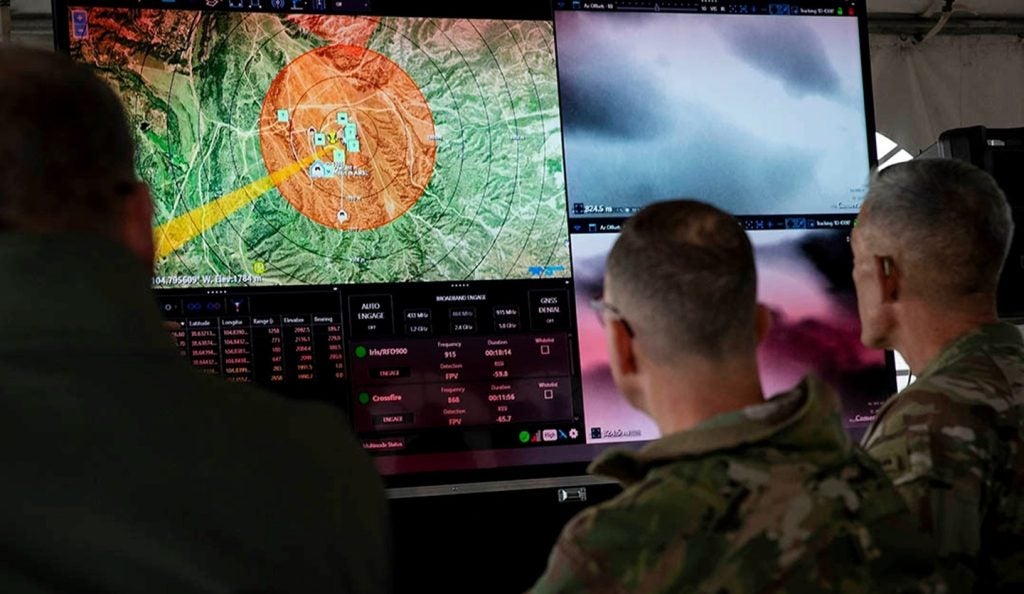
Precision is therefore key to the DIU’s C-sUAS solution, and with it an advanced targeting and tracking capability. For that reason, it may be that a laser weapon system would be an ideal method of LCD.
Software-first approach
US defence primes are taking a software-first approach to systems in the defence industry.
For example, Northrop Grumman offer its Forward Area Air Defense (FAAD) system to integrate different kinds of effectors into a single, holistic suite. Similarly, Anduril is contracted to provide the Marine Corps with an installation-based C-sUAS suite powered by artificial intelligence.
Despite the software-first approach in defence, the US Armed Forces still need different types of C-sUAS effectors to deliver a specific result.