
- Army Technology visited Milrem Robotics’ manufacturing site in Tallinn where further order details of Milrem’s second contract with Ukraine were confirmed.
- More than a hundred UGVs will be sent to the frontline, it was suggested, mainly for logistics purposes.
- Initial deliveries of this second tranche of vehicles will be delivered before the end of 2025.
Soon after Milrem Robotics announced its second contract with Ukraine for THeMIS uncrewed ground vehicles (UGVs) on 3 September, Army Technology toured Milrem Robotics’ manufacturing site in Tallinn, Estonia on 22 September, where additional order details were confirmed.
While the director of industrial partnerships at Milrem, Paul Clayton, formerly commander of Nato’s enhanced forward presence in Estonia, did not relay the precise number of UGVs being sent to Ukraine, it was suggested that the number exceeds 100 vehicles.
While touring the new facility, which opened last year, this reporter saw tens of THeMIS UGVs lined up seemingly ready to be shipped and glimpsed at the construction of several more vehicles.
In their initial statement at the beginning of September, Milrem noted that this follow-on order, taking place over the next 12-18 months, comprised a “record number” of UGVs being sent to Ukraine, financed by an unspecified European government.
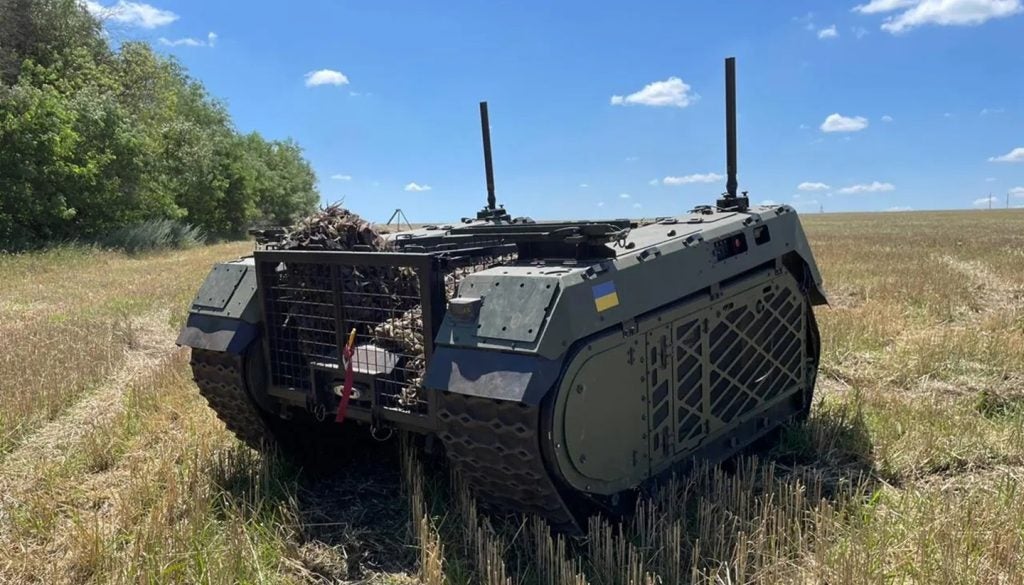
THeMIS is a modular UGV that can be remotely operated, which is most common, or made fully autonomous with the Milrem Intelligent Function Integration Kit.
Use case: Ukraine
The UGV system is already proven in Ukraine’s high intensity combat conditions where there are currently 15 systems on the ground supporting the military in cargo logistics and casualty evacuation. A single platform has the capacity to carry 750 kilogrammes (max.1,200 kg).
To this end, Clayton also confirmed that Milrem will integrate additional armour onto new units being shipped to Ukraine. The company obtains ‘soft armour’ from a company based in the UK to withstand 155 millimetre blast fragmentation.
While the number of combat configured THeMIS units in Ukraine are not high at present, Clayton predicted that the number of fire support UGVs will only increase.
It is said that Milrem can produce up to 500 UGVs per year. But it is worth noting that the Estonian supplier also fulfils orders from a number of militaries around the world, including Australia, Estonia, France, Germany, Japan, the Netherlands, Norway, Spain, Sweden, Thailand, and the United Arab Emirates.
In response to a question posed by Army Technology, Clayton confirmed that Milrem are in talks with Ukraine’s Ministry of Defence to try to bring THeMIS to the military’s digital marketplace, DOT-Chain Defence, in which 12 brigades on the frontline can freely purchase a range of provisions with funds from the government.
Currently, the selection varies among first-person view (FPV) uncrewed aerial systems (UAS), but the online arsenal will soon expand to include conventional warheads and interceptor drones, according to the director of the Defence Procurement Agency.
Looking ahead: UAS integration
“With the FPV threat that is currently in Ukraine, a vehicle this size [2.47 x 2.04 x 1.17 m] is seen as a high priority for the enemy,” Clayton observed, drawing on instances in which Russian forces have destroyed armoured fighting vehicles of all kinds with less costly UAS. For that reason, “we’re working with partners on counter-UAS systems.”
One concept that Clayton outlined was to integrate a UAS payload with THeMIS. As the battlespace becomes more autonomous, UGVs will become more commonplace and will also come to rely on more evasive UAS for aerial intelligence, surveillance, and reconnaissance.
It is ironic that a land systems manufacturer found, in the words of Clayton, that “UAS is one of our highest priorities that match what the customer wants, and a mobile system on [THeMIS] is what we’re aiming to try and get into operation.”
There are a number of projects ongoing with a couple of UAS providers, he revealed, so Milrem will be able to provide both tethered and untethered solutions. A tethered approach could integrate the anti-jamming capability of fibre-optic spool-fed drones, a common capability on both sides in Ukraine since late 2023.
“The ambition will be that it should be working as one system - a system-of-systems element,” Clayton suggested. “From satellite imagery through to UAS being able to pass down information to allow manned vehicles to make the right decisions.”