

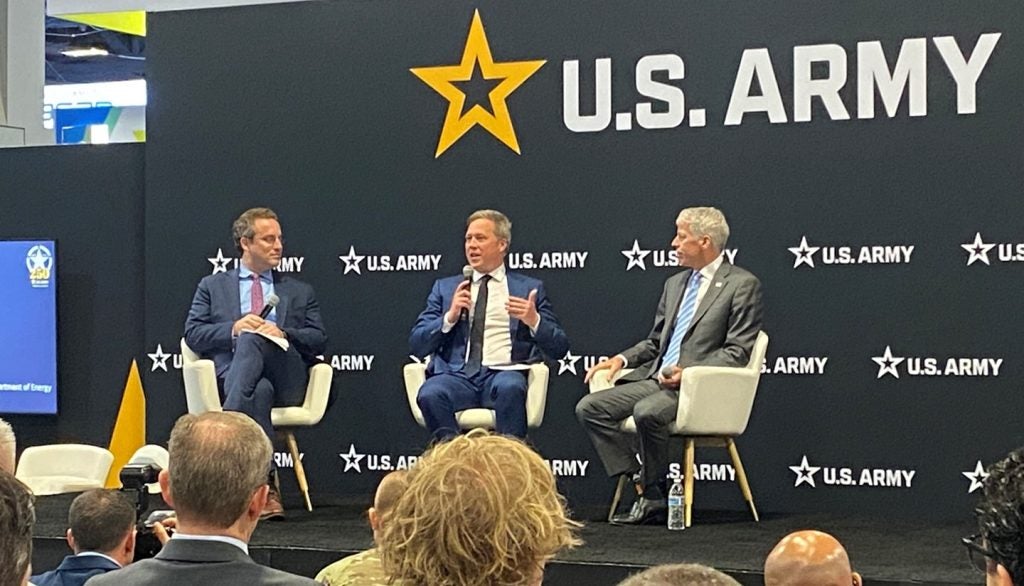
Secretaries of the US Army and Energy Department, Daniel Driscoll and Christopher Wright, announced plans to build micro nuclear reactors to power the Army’s forward presence in the Pacific theatre.
The rationale behind the transition to nuclear energy is that it is an alternative power source to diesel generators, which require an extensive and uncertain supply chain, which are not enough to enable Army missions overseas.
“You may be able to store a few weeks of [diesel] fuel – months is probably too much. But think of a forward deployed, small modular reactor that’s out there and can be flown in on a C-17 [or] on the back of a flatbed truck…
"Nuclear energy will provide multiple megawatts of power… meaningful power to do what [the Army are] doing, and it will run for years,” Wright described.
Project JANUS
Up to a dozen reactors will be delivered in less than a year – before 4 July 2026 – under this programme, dubbed Project JANUS. These nuclear reactors will be based, at first, in Idaho and other unspecified Western States.
Energy consumption in modern military operations has become insurmountable as the battlespace moves according to the data collected and distributed across an integrated network driven by artifical intelligence.
“If you think about our engagement in a conflict in the Indo-Pacific, it is not going to be like a war we’ve had in the last 40 or 50 years,” Wright intimated. “We’re going to need to be able to access power like we have never needed it before.”
HALEU production
Although Driscoll and Wright were persistent in their claims that the new policy comes down to the advocacy of President Donald Trump, who has indeed sought to advance reactor technologies, the military and other agencies have been working to design, build, and demonstrate a prototype for a mobile nuclear reactor since 2016 under Project PELE.
Nevertheless, this latest interagency cooperation aims to cut the bureaucracy of the past, the two maintained. This will see the administration reform the Nuclear Regulatory Commission “to deliver safety and delivery, not bureaucracy,” Wright stated.
But in their efforts to carve out their own nuclear energy policy, the government plan to produce High-Assay Low-Enriched Uranium (HALEU).
Existing reactors run on uranium fuel that is enriched up to 5% uranium 235 – the main fissile isotope that produces energy during a chain reaction.
By definition, HALEU is enriched between 5% and less than 20% and is required for most US advanced reactors to achieve smaller designs that get more power per unit of volume.
Only Russia and China have the infrastructure to produce HALEU at scale, according to the World Nuclear Association. Notably, the former administration under Joe Biden awarded six contracts to secure America’s domestic HALEU supply chain in their closing months in office.