
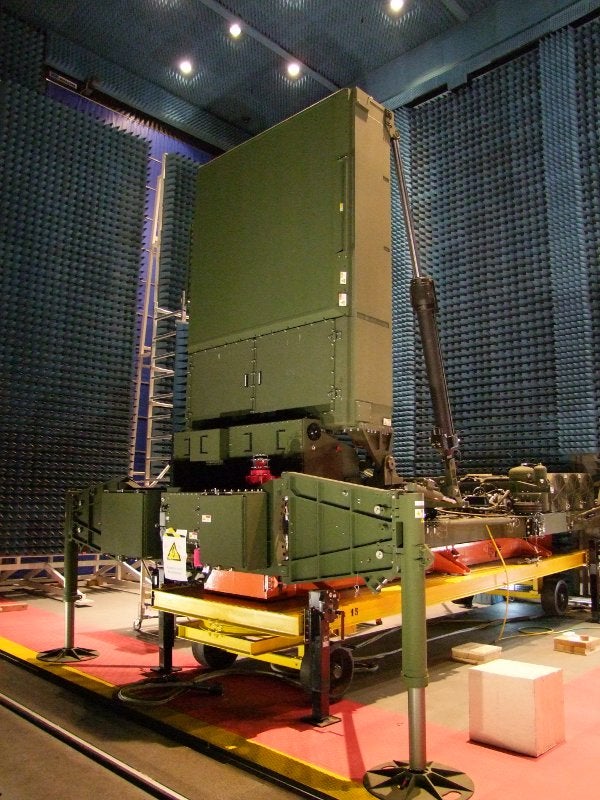
Lockheed Martin‘s medium extended air defense system’s (MEADS) low-frequency sensor has successfully demonstrated its ability to cue the multifunction fire-control radar (MFCR) during testing at Hancock Airport in Syracuse, New York, US.
A small test aircraft was acquired and tracked by the UHF low frequency sensor, with the MEADS battle manager then creating cue search commands, enabling the MFCR to search the cued area, acquire and establish a dedicated track of the target during the demonstration.
Go deeper with GlobalData


Discover B2B Marketing That Performs
Combine business intelligence and editorial excellence to reach engaged professionals across 36 leading media platforms.
Demonstrating the radar’s capability in full 360° rotating mode, the trials form part of an incremental test programme, which is scheduled to conclude in a formal flight test at White Sands Missile Range in New Mexico, US, later this year.
MEADS International president Dave Berganini said the demonstration showed the capability of the radars to detect and track threats, and also support an expanded network deployment.
"The MEADS radars offer greater coverage and flexibility, including complete 360° defence to protect military sites and civilians against next-generation threats," Berganini said.
Both radars were kept more than ten miles apart during the testing.

US Tariffs are shifting - will you react or anticipate?
Don’t let policy changes catch you off guard. Stay proactive with real-time data and expert analysis.
By GlobalDataAn active electronically-steered array radar, MEADS low-frequency sensor offers extended range coverage, while the MFCR is a 360° X-band, solid-state, phased array radar capable of delivering precision tracking and wideband discrimination and classification capabilities.
Equipped with plug-and-fight capabilities, the radars are designed to provide threat detection capabilities against highly manoeuvrable low-signature threats, such as short and medium-range ballistic missiles, cruise missiles and other air-breathing threats in the battlefield.
The radars will also serve as nodes on the MEADS network or other future integrated air and missile defence networks, eventually offering increased capability and flexibility to troops.
Managed by MEADS International, a joint project between LFK, MBDA Italia and Lockheed Martin, the system is intended to replace the ageing Patriot missile systems in the US and Germany, as well as the Nike Hercules system for Italian forces.
Image: The MEADS X-band MFCR during initial performance tests in 2012 at near-field SELEX Sistemi Integrati facility in Rome. Photo: © 2013 Lockheed Martin Corporation.




