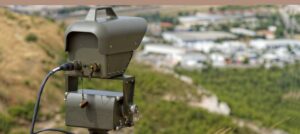


Environmental radiation monitoring networks fulfill a vital function, which is to ensure the health protection of individuals and the environment through the early detection of ionizing radiation of natural or anthropogenic origin, in the vicinity of facilities likely to release radionuclides, and more broadly throughout the national territory.
These types of networks are characterized by a modular and adaptive architecture based on user needs They can thus be composed of a wide variety of probes, beacons and stations to ensure optimal protection against potential radiological dispersals They aim at measuring gamma dose rate values, detecting radionuclides in air, soil and water, monitoring alpha and beta aerosols, measuring beta and gamma ray spectrum, and measuring the volumetric activity of particles in the environment.
Each element of the network provides data to a transmission system that centralizes and routes the information to the DataEXPERT 10 collection, management and control software which can be accessed from a computer, tablet or smartphone.