
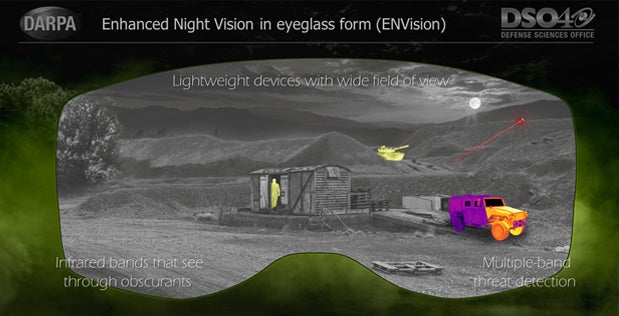
The US Defense Advanced Research Projects Agency (DARPA) has chosen research teams for the enhanced night vision in eyeglass form (ENVision) programme.
Of the ten industry and university teams that were selected, five teams were picked for the two technical areas.
Go deeper with GlobalData


Discover B2B Marketing That Performs
Combine business intelligence and editorial excellence to reach engaged professionals across 36 leading media platforms.
The ENVision programme will use recent advances in planar optics and transduction materials to develop new direct-view night-vision (NV) systems.
These systems showcase an increased field of view (FOV) and improved visual access across infrared (IR) bands, all contained in a low-torque eyeglass form factor.
According to DARPA, current NV systems are heavy, which burden the user and limit the wearer’s agility, as well as lead to chronic injury due to prolonged use.
Physical Sciences, Raytheon Technologies Research Center, SRI International, the University of California-San Diego, and the University of Washington are the five teams selected for the first technical area.
Performers under the first technical area will develop multi-band, wide FOV planar optics and planar image intensifiers to showcase advanced NV systems, imposing near-zero torque on the wearer.
In the second technical area, teams from Raytheon BBN, Stanford University, the University of Central Florida, the University of Melbourne, and the University of Pennsylvania were selected.
These teams will explore new methods to amplify photonic up-conversion processes from any IR band to visible light, to allow for future ‘intensifier-free’ NV systems.
DARPA Defense Sciences Office ENVision programme manager Rohith Chandrasekar said: “The teams in the first technical area are developing technologies that could drastically reduce the bulk and volume of objective, intensifier, and eyepieces of night-vision systems.
“Teams in the second technical area are exploring ways to directly upconvert and amplify light, from the infrared to the visible, using new materials and up-conversion processes.
“These efforts could potentially lead to all-optical night vision systems in the future, without the need for image intensifiers.”
In December 2021, DARPA’s OFFSET programme conducted its final field experiments, which involved deploying autonomous air and ground vehicles to test mission capabilities.


