
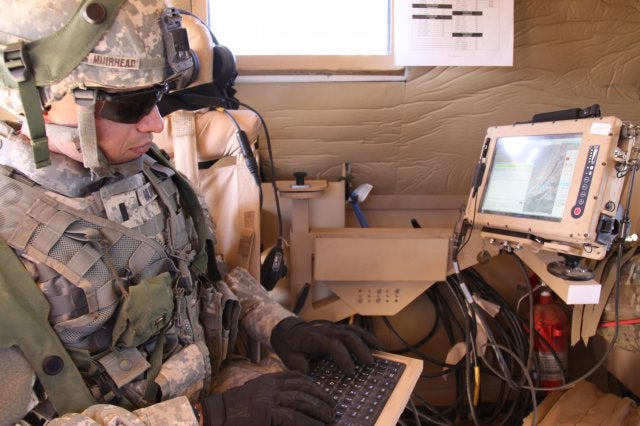
The US Army is readying to field its next-generation Blue Force Tracking 2 (BFT 2) technology for the first time in Afghanistan to provide soldiers with advanced communication capabilities.
BFT 2 product manager lieutenant colonel Bryan Stephens said that the upgraded satellite network would offer real-time force tracking data to the troops on a digital map display screen, as well as enhancing speed and refresh time of the system.
Go deeper with GlobalData


Discover B2B Marketing That Performs
Combine business intelligence and editorial excellence to reach engaged professionals across 36 leading media platforms.
"BFT 2 provides more bandwidth, which allows the system to update the blue picture much more often," Stephens said.
"The resulting increased volume of traffic improves accuracy of moving platforms by a factor of ten."
The BFT 2 is considered as full duplex capability, which helps the system receive and transmit the data simultaneously, as opposed to the currently used half-duplex BFT technology, which permits simultaneous sending or receiving.
A primary component of the technology is the joint battle command-platform (JBC-P), which delivers combat-relevant position-location information to both army and Marine Corps units on-the-move, using advanced mapping technology, chat and messaging, as well as an improved user graphical interface.
JBC-P product manager lieutenant colonel Mark Daniels said: "JBC-P’s chat is more interoperable with a wider population of systems because it communicates with an intermediary known as the universal collaboration bridge."
The software can be installed into vehicle displays or into hand-held mobile units of the dismounted soldier, where it also features an additional Nett Warrior programme to obtain and transmit data through a soldier radio waveform (SRW).
SRW is used by the single-channel joint tactical radio systems (JTRS) Rifleman radio, which will help troop relay information to units even after losing contract with satellite systems.
The JBC-P aims to advance and further enhance integration and user-interface features of an interim software called Joint Capabilities Release (JCR) also equipped with Nett Warrior.
BFT 2 completed limited user test in October 2011, and has already been deployed to units in South Korea, while Afghanistan deployment is expected in the near future.
Image: A US soldier uses the chat function of joint capabilities release during the network integration evaluation 12.1 in October 2011. Photo: courtesy of Claire Heininger Schwerin.


