
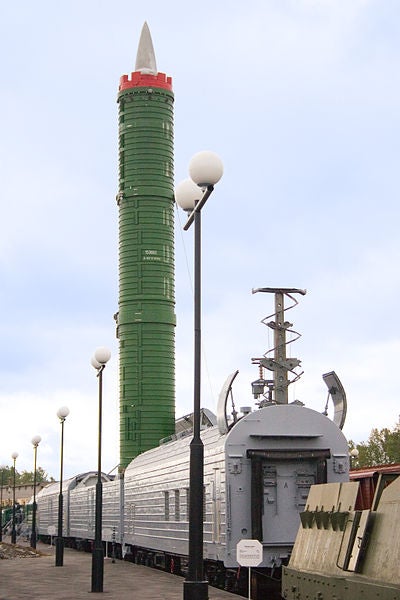
The Russian Ministry of Defence (MoD) has started design work to develop a new rail-mobile intercontinental ballistic missile (ICBM) system to counter global threats, the country’s deputy defence minister Yury Borisov has announced.
Borisov was quoted by RIA Novosti as saying that a research and development programme for ICBM production has been initiated by the Moscow Institute of Thermal Technology and is currently in preliminary stages.

Discover B2B Marketing That Performs
Combine business intelligence and editorial excellence to reach engaged professionals across 36 leading media platforms.
Without disclosing the programme’s duration, Borisov noted that the total project cost was yet to be determined by the MoD.
However, an undisclosed senior MoD official told the news agency in December 2012 that the ICBM prototypes were likely to be deployed by 2020.
Using domestically manufactured components, the new systems are expected to weigh less than the decommissioned Soviet-era built ICBMs and can be fitted into one railway carriage.
Deployed in 1987, the Russian military’s first rail-portable long-range missile system featured Yuzhnoye Design Bureau-built 104t SS-24 Scalpel missiles, required three locomotives for movement and also damaged railroad tracks due to heavy weight.
The systems also complicated counter-strike manoeuvres, as the missiles were mounted on trains instead of stationary launchers, in an effort to make their detection and destruction more difficult.
Moscow had a total of 12 ICBMs in its inventory by 1991, and the last was dismantled in 2007, as part of the bilateral Strategic Arms Reduction Treaty II (START II) signed with the US for the reduction and limitation of strategic offensive arms in January 1993.
Agreed in 2010, the treaty’s successor, START III, does not forbid the development of rail-mobile ICBM systems.
Image: A SS-24 Scalpel ICBM railroad-based complex being displayed at Saint Petersburg railway museum in Russia. Photo: courtesy of Panther.



