

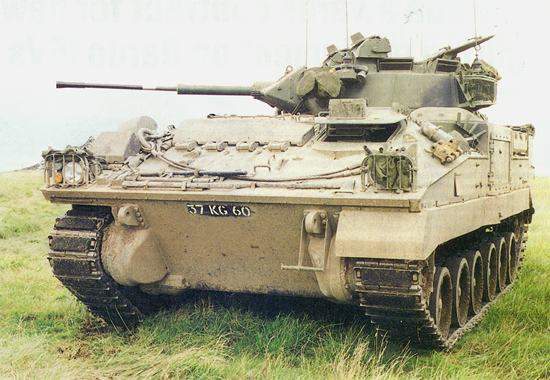


The Warrior family of tracked armoured vehicles, developed by Alvis Vickers (now BAE Systems Land Systems), has been proved in action with the British Army in operations in the Middle East during Desert Storm and Operation Iraqi Freedom and on United Nations duties in Bosnia. Warrior vehicles were also deployed to Afghanistan.
Recommended White Papers

Recommended Buyers Guides

Desert Warrior infantry fighting vehicle family
The Desert Warrior family of vehicles has been adapted for operations in hostile desert conditions. Between 1987 and 1995, 789 FV510 Warriors were produced for the British Army and 254 Desert Warrior infantry fighting vehicles were manufactured for the Kuwaiti Land Force.
Warrior section vehicles carry driver, commander, gunner and seven fully equipped soldiers together with supplies and weapons for a 48-hour battlefield day in NBC (nuclear / biological / chemical) conditions.
The Warrior adapts to a range of roles with weapon fits ranging from machine pistols to 90mm guns, mortars and missile systems. The Warrior is in service in the following variants: infantry section vehicles, infantry command, repair vehicles, recovery vehicles, observation post vehicles, artillery command and anti-tank guided weapon carriers.
Warrior armoured vehicle upgrade programme
The British Army has upgraded its Warriors to extend their service life to 2025. The upgrade included the General Dynamics UK Bowman tactical communications system and the addition of a night fighting capability in the form of the Thales Optronics battle group thermal imaging (BGTI) programme.
BGTI includes a thermal imager, eyesafe laser rangefinder, GPS / inertial navigation system and fire control system.
BGTI entered service on the Warrior in March 2005. Approximately 350 vehicles were fitted with BGTI in 2007. Bowman was deployed on Warrior vehicles in Iraq in November 2005.
Warrior manned turret integration programme
Under the British Army’s manned turret integration programme (MTIP), a new two-person GKN Sankey turret with a 40mm stabilised case telescoped weapon system (CTWS) cannon, to allow firing on the move is being trialled. GKN Sankey’s turret is equipped with L21A1 30mm Rarden cannon that can destroy the most advanced APCs from a maximum range of 1,500m. The turret was developed by CTA International, a joint venture formed by BAE Systems and Nexter Systems (formerly Giat). A contract was awarded in June 2004 for the delivery of one Warrior vehicle fitted with the turret by December 2006.
The upgraded vehicle’s cased telescoped armament system (CTAS) began company firing trials in June 2006 and MoD firing trials in October 2006. It completed the trials in December 2008 with high levels of accuracy and reliability. During the trials, the upgraded Warrior fired 90 rounds from the 40mm gun and 600 rounds from the chain gun.
Thales has delivered a new STAG (surveillance, targeting, acquisition and gunnery) gunner’s sight for the MTIP which is stabilised in two axes and includes a second generation thermal imager and eyesafe laser rangefinder.
Warrior Capability Sustainment Programme
The UK Ministry of Defence has undertaken a £1bn ($1.6bn) British Army-introduced Warrior Capability Sustainment Programme (WCSP) to upgrade 643 of its Warriors and extend their life until 2040.
BAE Systems and Lockheed Martin competed for the WCSP contracts. Under a £642m ($1bn) contract awarded in October 2011, Lockheed Martin will lead the WCSP, which is expected to create 600 jobs.
Under the programme the vehicles will be upgraded with Warrior Modular Protection System (WMPS) and Warrior Enhanced Electronic Architecture (WEEA). Within this programme 449 vehicles will be fitted with a new turret and weapon system under the Warrior Fightability Lethality Improvement Programme (WFLIP).
Self-protection
Smoke grenade launchers are mounted on either side of the turret.
In United Nations operations in Bosnia the high level of protection of the crew against small arms, missiles and anti-tank mines was proven.
The aluminium armour construction provides protection against 14.5mm armour piercing rounds, 155mm air burst shell fragments and 9kg anti-tank mines.
Enhanced protection against other threats can be provided with applique armour.
From late 2007, Warrior vehicles operating in Iraq are being fitted with ‘wrap two’ armour, with increased effectiveness against improvised explosive devices (IEDs). The old bar or slat armour was removed.
Propulsion
The Warrior has four-speed fully automatic transmission and hydrostatic drive steering. The Perkins Rolls-Royce V8 Condor engine produces 550bhp giving road speeds of 75km/h. The suspension provides high-speed crossing across rough terrain at speeds faster than most main battle tanks.
The vehicle is fitted with TR30 single pin tracks from Astrum. All major systems including the power pack can be removed and replaced in less than one hour by two men.
Warrior reconnaissance vehicle
The reconnaissance vehicle is fitted with additional armoured protection against conventional and chemical attack. Armour shielding covers the front, sides and the suspension of the vehicle.
The Warrior reconnaissance vehicle is normally operated by a crew of three, the driver, the commander and the gunner. The vehicle has capacity to accommodate a reconnaissance officer and additional surveillance equipment.
Armament
The vehicle is equipped with an electrically operated turret designed by Delco which can traverse through a full 360°. The turret is fitted with a ATK Ammuniton Systems (formerly Boeing Ordnance) M242 chain gun on a stabilised mount which allows the gun to be used while the vehicle is in motion. The turret also has an M240 7.62mm machine gun.
TOW missile launchers are mounted on each side of the turret. The TOW wire guided anti-tank missile from Raytheon Missile Systems travels at 200m/s to a range of 3,750m. The vehicle has the capacity to carry four TOW missiles in the vehicle and two in the launchers.
Fire control and observation
The gunner’s station has an optical sight and can be fitted with an electro-optical day / night thermal sight. The commander has seven optical periscopes which provide 360° observation and a dedicated sight for weapon aiming.
Thales (formerly Pilkington) Optronics supplied new thermal imaging gunner’s sights for 450 British Army Warriors, under the battle group thermal imaging (BGTI) programme, replacing the current image intensifying sights with modified TI sights that increase the effectiveness of the vehicle at night.
The BGTI programme also provides new laser rangefinder, GPS navigation system and associated display screens.
The driver’s station is equipped with three optical periscopes, the central periscope is replaceable with an electro-optical periscope which gives passive night vision capability. A mast mounted sensor with a driver’s thermal viewing system can be installed.
Warrior 2000
Warrior 2000 is a version of the Warrior which was developed for the Swiss Army requirement. The first prototype was completed in 1998.
Improvements included all-welded aluminium hull, increased passive applique armour protection, digital fire control system, more powerful engine and a Delco or Land Systems Hagglunds E30 direct electric drive turret with ATK Bushmaster II mk44 30mm cannon.
