

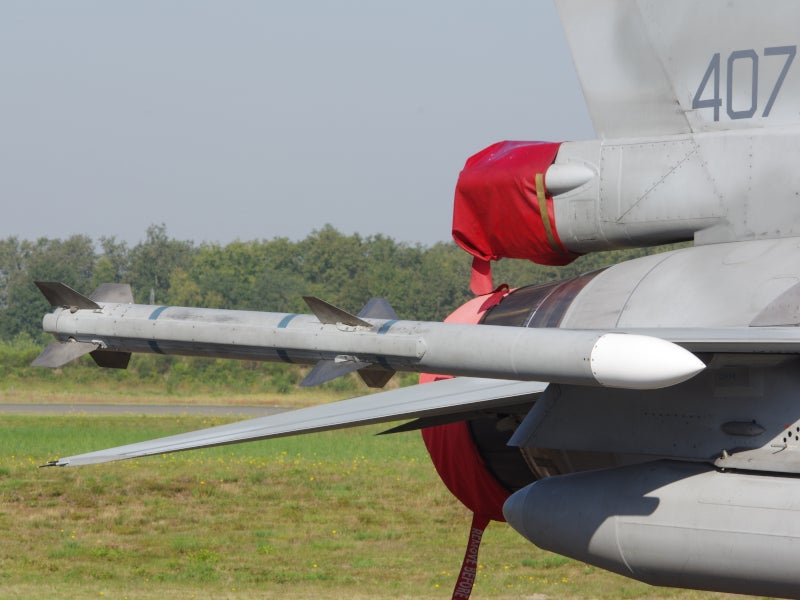
The surface-launched advanced medium-range air-to-air missile (SL-AMRAAM) is an advanced air defence system developed by Raytheon to counter both existing and evolving cruise missiles, as well as various airborne threats.
The air defence system uses the AMRAAM fire-and-forget missile, a surveillance radar, a fire distribution centre and AMRAAM launchers.
Recommended Buyers Guides
In April 2001, the US Marine Corps awarded Raytheon a contract to develop the Complementary Low-Altitude Weapon System (CLAWS).
In February 2004, the US Army Aviation and Missile Command awarded Raytheon a contract to develop SL-AMRAAM. In November 2005, approval was given for five SL-AMRAAM prototypes to be built and tested.
The US Joint System Program Office at Eglin Air Force Base in Florida manages the ground-launched AMRAAM common launcher programme for the US Army and US Marine Corps. The AIM-120 AMRAAM missile is in full production at Raytheon’s manufacturing facility in Tucson, Arizona.
Raytheon announced the development of additional capabilities for SL-AMRAAM: the SL-AMRAAM ER missile in June 2007.
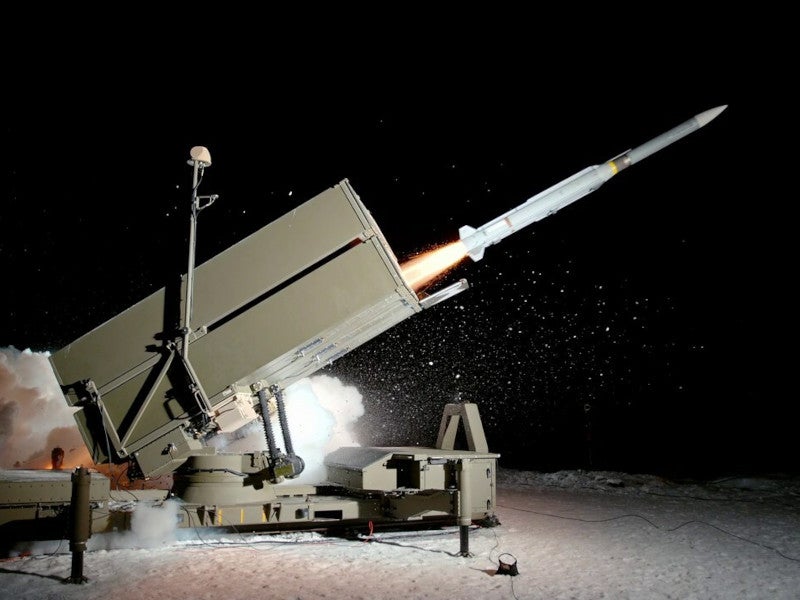
In February 2024, Raytheon and Kongsberg Defence & Aerospace in cooperation with the Norwegian Ministry of Defense and Armed Forces, carried out a successful flight test for the AMRAAM-Extended Range missile from the Norwegian advance SAM system (NASAMS).
The newly developed ground-launched system is designed to intercept targets at greater distances and higher altitudes.
SL-AMRAAM air defence system development
Boeing delivered the first integrated fire control shelter in May 2006 and the system successfully completed critical design review in July 2006. System field testing of SL-AMRAAM began in March 2008 with a successful acquisition and tracking test and was completed in May 2009.
Field integration testing, completed in July 2008, demonstrated interoperability with Patriot and Avenger systems, including data exchange with Patriot units and providing targeting data to Avenger units for precision Avenger gun turret targeting.
SL-AMRAAM is set to gradually replace the Avenger air defence system in the US Army.
Raytheon led the team in developing SL-AMRAAM, with Boeing being responsible for developing the SL-AMRAAM integrated fire control station. The team also includes Kongsberg Defence and Aerospace of Norway.
The US Army explored firing SL-AMRAAM missiles from the HIMARS high-mobility artillery rocket system, used by the army and marine corps.
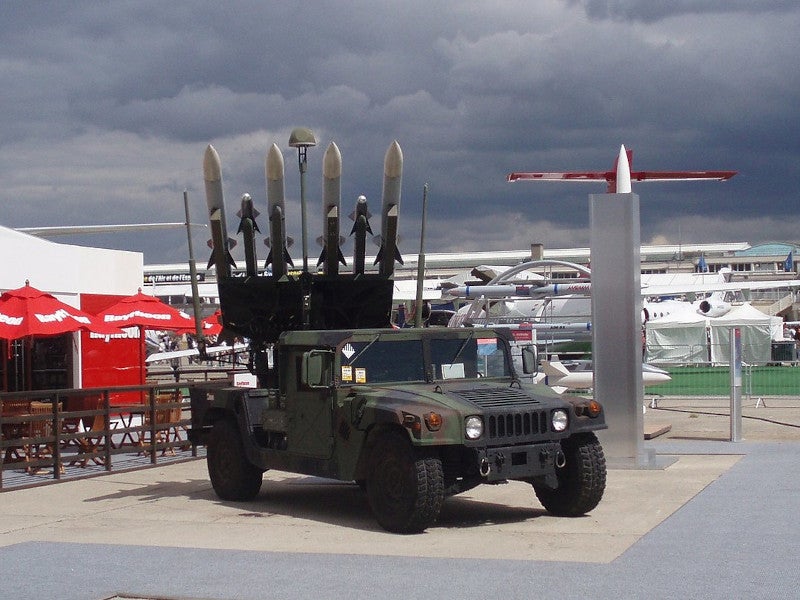
SL-AMRAAM HMMWV mounted launcher
The SL-AMRAAM HMMWV-mounted launcher accommodates six AMRAAM missiles on a turreted High-Mobility Multipurpose Wheeled Vehicle (HMMWV), providing 360-degree coverage. The launcher points towards the target area, launching missiles at a maximum angle of 70 degrees without compromising the intercept and kill probability.
SL-AMRAAM fire control, tracking, and radar
The Boeing integrated fire control station provides Battle Management Command, Control, Computers, Communications and Intelligence.
It uses data from air defence sensors, including the Sentinel radar and the future Joint Land-Attack Cruise Missile Elevated Netted Sensor (JLENS).
JLENS consists of a large aerostat connected via tether to a ground-based processing station with a long-range surveillance radar and a fire control radar. It can operate at altitudes up to 15,000ft to provide over-the-horizon surveillance for defence against cruise missiles.
In November 2005, Raytheon was awarded a US Army contract for System Development and Demonstration, to be completed by 2011.
CLAWS
CLAWS, developed by the US Army Aviation and Missile Command’s Missile Research, Development and Engineering Centre, underwent successful trials with the Marine Corps, demonstrating intercept ranges of more than 15km.
Operational testing concluded in November 2005, and the system was ready for deployment and Initial Operating Capability. However, in August 2006, the USMC recommended CLAWS termination amidst air defence spending cuts.
A CLAWS unit has a fire distribution centre and up to eight launchers mounted on an AM General M1097A2 HMMWV.
The launch vehicle, equipped with a remote terminal unit for voice and data communications, locks the launch assemblies during transit. Once in position, the crew remotely adjusts and fires the missile from up to 50m away.
Surveillance radar
The US Army uses the Raytheon AN/MPQ-64 Sentinel radar to carry out the surveillance and target search, acquisition, identification and tracking functions.
The electronically scanned phased array radar uses range gate pulse Doppler operation at X-band. Sentinel uses a high scan rate of 30rpm. The range is 75km.
Fire distribution centre
The fire distribution centre, mounted on a high mobility vehicle such as the AM General 4×4 HMMWV, provides tactical operational control, including target detection, identification, threat prioritising, engagement and kill assessment.
NASAMS
NASAMS was developed by Hughes (now Raytheon) and Norsk Forsvarteknologia (now Kongsberg Defence).
The first production contract for NASAMS was placed in 1994 by the Royal Norwegian Air Force and the system entered service in 1995. The Spanish Army has four NASAMS systems acquired in 2003 and the US has one system.
The NASAMS firing platoon or unit is operated by 22 soldiers and includes a fire direction centre, a Raytheon TPQ-36A three-dimensional radar and three transportable missile launchers.
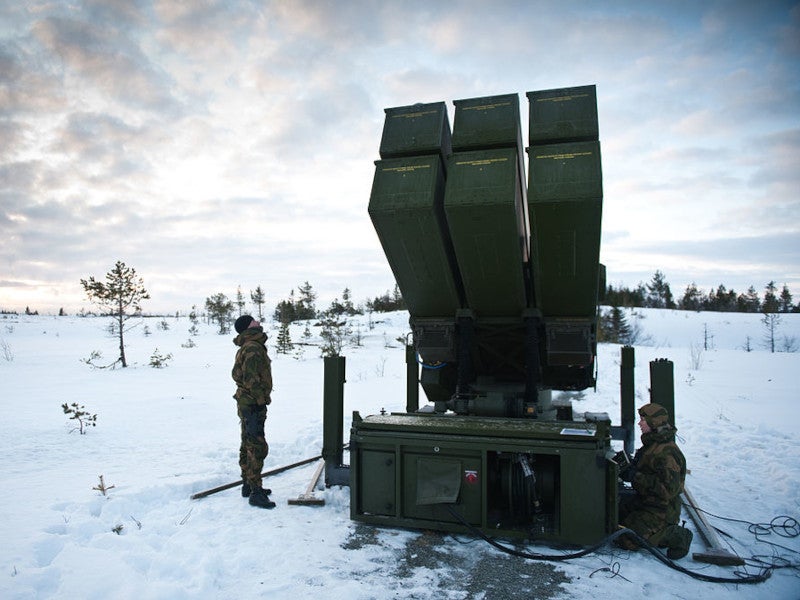
The NASAMS launcher is unmanned and is mounted on a transportable pallet with four jack-type stabilisers. The launcher is carried on a Norsk Scania Vabis P133H truck.
A hydraulic crane on the truck is used to position the launcher at a selected launch site.
Data from the fire direction centre is downloaded to the launcher by fibre optic cable, landline or by digital radio. The NASAMS launcher has six ready-to-fire AMRAAM missiles.
In August 2005, Kongsberg was awarded a contract from the Norwegian Air Force to supply a Link 16 tactical datalink for NASAMS, which allows the system to be fully integrated with NATO network-based defence systems.
The upgraded system, NASAMS II entered service with the Norwegian Air Force in July 2007.
AIM-120 air-launched fire-and-forget missile
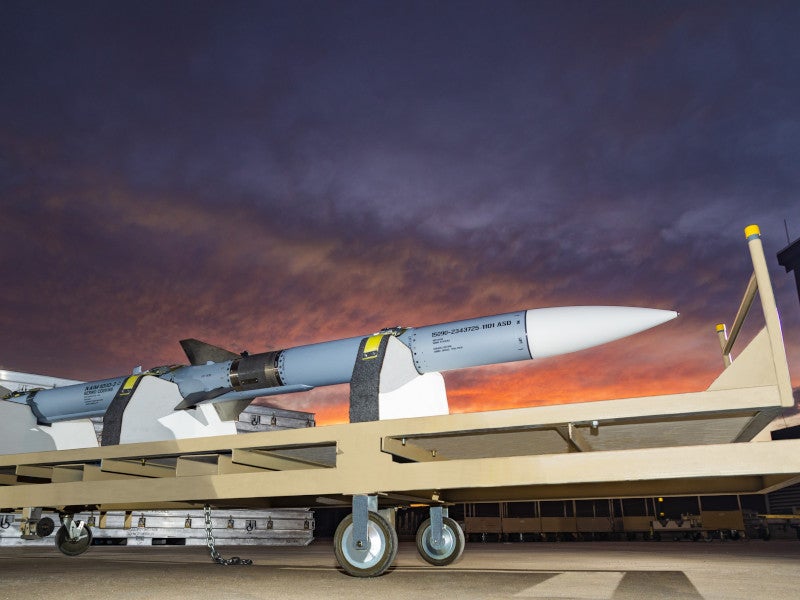
The AMRAAM, AIM-120, was developed and is best known as an air-launched fire-and-forget missile deployed on the F-15, F-16, F/A-18, F-22, F-4F, Sea Harrier, Harrier II Plus, Eurofighter, JAS-39 Gripen, JA-37 Viggen and the Tornado.
The high-velocity AIM-120 missile is manufactured in two variants. The AIM-120B is field programmable and the AIM-120C is fitted with smaller control surfaces than the A or B variants, has longer range and has very high agility to counter targets making evasive manoeuvres.
The missile travels at Mach 4.
The missile is fitted with an ATK WPU-6B booster and sustainer rocket motor, which uses RS HTPB solid propellant fuel. The low smoke motor reduces the probability of detection of the launch or flight of the missile.
The missile is equipped with a Northrop strap-down inertial reference unit and uses inertial and command/inertial guidance.
A data link antenna is located in the tail of the missile to receive mid-course guidance data.
A terminal active radar homing seeker operating at X-band is installed in the nose. The 23kg-high explosive warhead designed by Chamberlain is fitted with a smart RF proximity fuse.
Hawk-AMRAAM air defence system
Raytheon and Kongsberg Defence have jointly developed the HAWK-AMRAAM air defence system, which combines the capabilities of HAWK and AMRAAM missiles within a distributed architecture.
The missiles are mounted on universal launchers, and a fire distribution centre controls target detection, identification, threat ordering, engagement, and kill assessment, as well as short-range air defence cueing.
The system can include the Sentinel radar and the HAWK AN/MPQ-61 high-power illuminator for target tracking and illumination, although it is possible to hook up any number of radars and missile systems to the fire distribution centre.
Contracts and deliveries
In September 2005, Raytheon was awarded a contract for the fifth and sixth CLAWS production systems.
The Dutch Army contracted Kongsberg in December 2006 for six NASAMS II systems. Deliveries started in 2009.
In September 2008, the United Arab Emirates requested the foreign military sale of several SL-AMRAAM systems.
In July 2014, Raytheon won a $163.2m contract for the AMRAAM Program Support and Sustainment. The contract encompasses repair and service obligations for both the US and foreign military sales.
Raytheon secured a $491.4m contract in December 2014 for AMRAAM missiles, which involves foreign military sales (FMS) to Korea, Oman, Singapore, and Thailand.
In September 2015, Kratos Defense & Security Solutions was awarded a $3.8m contract by Raytheon Missile Systems to supply radar tracking transponders for the AMRAAM missile.
Raytheon Missile secured a $634.2m contract to manufacture lot 31 of the AMRAAM in December 2017. The contract encompassed FMS to Japan, Korea, Morocco, Poland, Indonesia, Romania, Spain, Turkey, Bahrain, and Qatar.
In December 2019, Raytheon Missile Systems secured a contract worth $768.2m for the production of AMRAAM missiles for a non-classified FMS to various countries, including Australia, Belgium, Canada, Denmark, Indonesia, Japan, Kuwait, and Morocco.
Raytheon Missiles & Defense won a $972m contract for improved AMRAAM missiles in August 2022. It is the first contract awarded for AIM-120D3 and AIM-120C8 missiles developed as part of the Form, Fit, Function Refresh (F3R).
In June 2023, Raytheon Missiles and Defense was granted a $1.15bn contract for AMRAAM lot 37 production, with unclassified FMS to numerous countries.
RTX, a Raytheon company, was awarded a $1.15bn contract for AIM-120 D-3 and C-8 AMRAAM missiles, encompassing the fifth production batch under the F3R programme during the same.
The contract supports the US Air Force and Navy and delivers missiles and/or spares to 18 countries, including Ukraine, thus extending the production line for both the US and its allies.
