

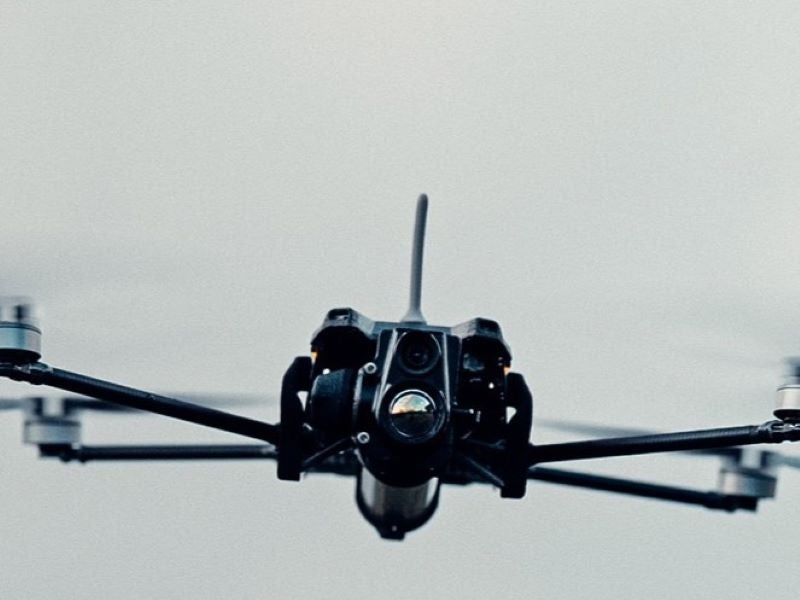
The Trace unmanned aerial vehicle (UAV) is a military-grade, pocket-sized nano UAV developed by Vantage Robotics.
The UAV is designed to offer capabilities more commonly found in larger drones, while retaining a nano-scale form factor. The approach is intended to improve operator safety, reduce the platform’s detectability and enhance portability, while also supporting lower costs and a broader range of potential use cases.
Recommended Buyers Guides

Trace UAV security meets the US Department of Defense Blue unmanned aerial systems requirements and complies with the National Defense Authorization Act.
The product stems from a partnership announced in July 2024 between Taiwanese intelligent Internet of Things solutions provider Sysgration and Vantage Robotics to develop two lightweight drone systems, Vesper and Trace.
The arrangement brings together Sysgration’s edge AI capabilities and Vantage Robotics’ tactical UAV platforms to support wider uptake of smart aerial systems in Taiwan for real-time situational awareness and autonomous inspection.
Vantage Robotics launched the Trace nano UAV in September 2024.
Trace nano design and features
Trace measures 30.7cm × 4.4cm in length and height with rotors out, and 6.4cm × 4cm while in a stowed position. It weighs between 161g and 178g at take-off, depending on the configuration.
The UAV can remain airborne for up to 40 minutes, reach a top speed of 52km/h and produces under 34 a-weighted decibels at 30m. It has a low visual signature, making it difficult to spot from 10m when viewed against terrain.
The platform is designed to operate in GPS-denied environments through indoor collision avoidance, visual position control and integrated scene illumination. Trace can fly in winds up to 25 knots and across a temperature range of -20°C to 45°C, with IP53-rated ingress protection.
The drone is available with two battery options: a one-cell, 4.2V endurance battery and a two-cell, 8.4V endurance plus battery.
For autonomous missions, the UAV supports multi-constellation GPS and can be launched by hand or from the ground, with the ability to perch and maintain surveillance while stationary.
Gimbal and camera
The Trace nano UAV uses a two-axis stabilised electro-optical and infrared gimbal with pitch control ranging between -90° and +70°.
It features an electro-optical camera that offers 48 megapixels with an f1.8 lens and autofocus, producing still images at 8000 × 6000 pixels. The camera has a digital zoom of up to 25X, with a horizontal field of view (HFOV) ranging from 67° to 2.7°. The UAV can capture video in MPEG-4 format at either 1080 pixels or 4K resolution.
The infrared sensors feature an uncooled VOX sensor with a resolution of 320 × 240, and are available with either a 24° or 57° HFOV. A thermal alternative with a resolution of 640 × 480 is also available.
Flight control and communications
Trace offers a line of sight range of up to 2km or a maximum of 6km, depending on configuration and conditions. The non-line of sight range is up to 500m.
The UAV supports operating frequencies at 2.36GHz for military use as well as 2.4GHz industrial, scientific, and medical (ISM) alternatives.
The proprietary Poplar radio link is designed to maintain resilience through automatic channel hopping and is compliant with Micro Air Vehicle Link and Robotic and Autonomous Systems-Air standards.
The platform is compatible with ground control station (GCS) software, including QGroundControl, Android Team Awareness Kit, Windows Management Instrumentation and Robotic and Autonomous Command and Control.
The UAV also works with controllers such as Vantage Vision 2, Kutta KTAC, S20 TE and the Tomahawk Mimic or Grip GCS.
The platform is designed, sourced and manufactured in the US, with AES 256 encryption applied across communications and stored data. It also avoids remote data connectivity to reduce exposure to external networks.
Trace nano UAV portability
Trace UAV can be deployed in around 30 seconds. Its folding arms allow the aircraft to be packed away in a compact form for transport and storage.
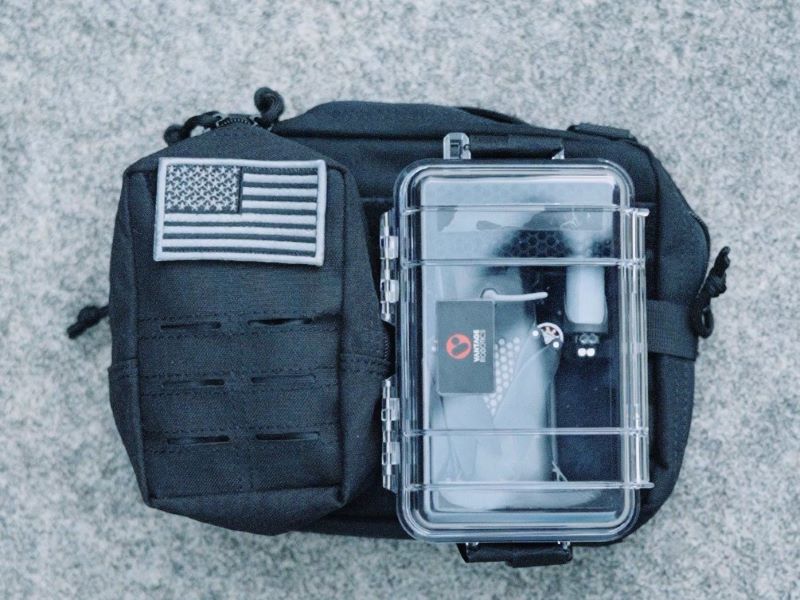
For field use, it is supplied in an IP67-rated waterproof case intended to withstand demanding handling, including high crush resistance and drops from up to 1m.
With the field case, two batteries and the Vision2 GCS included, the total carry load remains under 1kg and within a volume of roughly 1,000cm3. The transport case is sealed against water and dust and is built to resist dents.
