
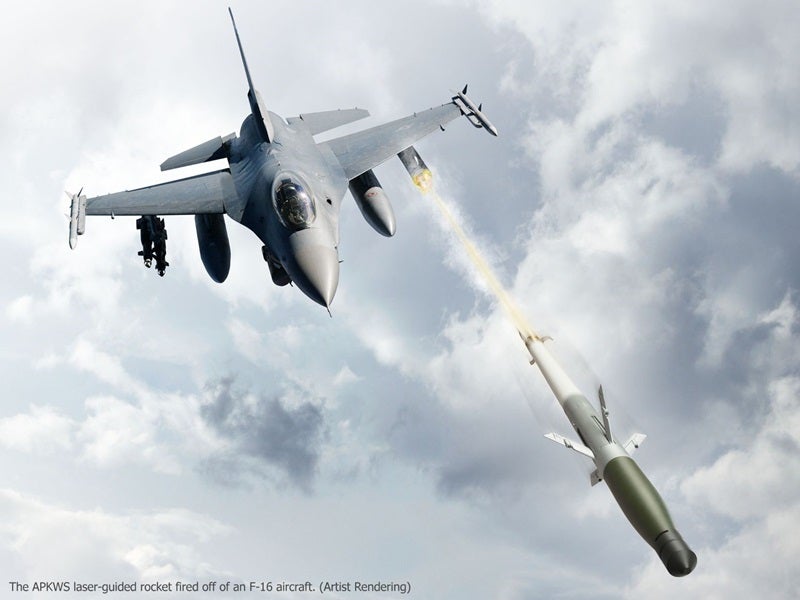

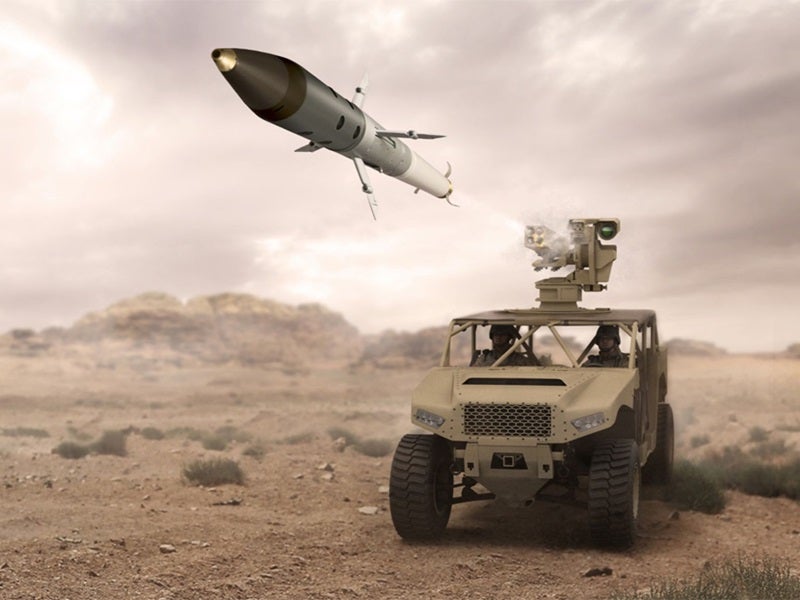
The Advanced Precision Kill Weapon System (APKWS) is a combat-proven, laser-guided 70mm rocket system designed and manufactured by BAE Systems in collaboration with the US Government.
The weapon system is currently deployed by US military forces.
Recommended Buyers Guides

The lethal weapon system can be launched from rotary-wing and fixed-wing aircraft and unmanned platforms to strike ground, air and sea-based targets, and also supports close air support operations.
APKWS design and features
The advanced, highly precise APKWS rocket system features a point-and-shoot design and requires no maintenance. It can engage stationary and moving enemy targets with greater flexibility, while offering superior survivability for the crew.
The semi-active laser-guided rocket system comprises three main components: M151/MK152 and M282 warheads, a M423/MK435 fuse and a standard MK66 rocket motor.
The rocket system is equipped with wing assemblies and folding fins. Each wing is mounted with unique, low-cost laser seeker collection optics. The weapon system is also fitted with a micro-electromechanical systems inertial measurement unit and an advanced digital signal processing technique for improved communication.
Guidance and control system
The APKWS is fitted with a plug-and-play compatible distributed aperture semi-active laser seeker (DASALS) guidance and control system between the warhead and rocket motor.
DASALS is used to transform unguided rockets into precision munitions. It allows the weapon system to engage soft and lightly armoured targets in restricted areas with minimum collateral damage.
The APKWS guidance kit’s mid-body design continues to ensure it remains highly adaptable for use with other 70mm unguided rockets, irrespective of the rocket motor configuration.
APKWS development history
The APKWS development programme was started by the US Army in 2002 but was cancelled in January 2005. The US Army commenced a new development programme called APKWS II in 2005. BAE Systems was selected as the prime contractor for the programme in April 2006, while other contractors included General Dynamics and Northrop Grumman.
The US Army transferred executive oversight of the programme to the US Navy and the US Marine Corps (USMC) in November 2008. The design and development of the rocket system were completed in November 2009.
BAE Systems received the first low-rate initial production (LRIP) contract from the US Navy in July 2010 and the second LRIP contract in January 2011.
In February 2011, BAE Systems signed a $19.7m contract with the US Navy for a 27-month programme to expand APKWS’ capabilities from rotary-wing aircraft to the US Air Force’s (USAF) A-10 Thunderbolt II (Warthog) and the USMC’s AV-8B Harrier fixed-wing aircraft.
The US Navy gave approval to begin production of APKWS rockets for deployment from AH-1W Cobra helicopters in April 2011, and the weapon system was successfully fired from a UH-1Y helicopter in October 2011.
The initial operational test and evaluation phase of the APKWS II programme was completed in March 2012. The rocket system was deployed to fight against insurgency forces in Afghanistan in April 2012.
The weapon system entered full-rate production in August 2012. BAE Systems received a $28m support package from the US Navy for full-rate production of APKWS rocket systems in January 2013.
Test firings using advanced weapon system
The weapon system was first test-fired from the USMC’s AH-1W Super Cobra helicopter in September 2007 and from the OH-58 Kiowa helicopter in December 2007.
A Hawker Beechcraft AT-6C aircraft successfully fired the APKWS rocket in February 2012.
The US Army and the US Navy conducted test firing of the weapon system from airborne helicopters at Eglin Air Force Base in Florida in May 2012. Using inert M282 and standard M151 warheads, the APKWS successfully engaged targets at close range.
APKWS was successfully fired from the US Navy’s MH-60S helicopter and engaged several maritime targets in April 2013. It was also test-fired from Bell Helicopter’s 407GT helicopter in Arizona in March 2013.
The USAF’s A-10 Warthog jet launched two APKWS rockets at altitudes of around 10,000ft and 15,000ft, at air speeds of up to 348 knots at Eglin Air Force Base in Florida in April 2013. The US Army’s AH-64D Apache helicopter successfully fired an APKWS weapon in October 2013.
BAE Systems completed test firings of its APKWS laser-guided rockets from a ground-based tactical weapon system for the first time in June 2020.
The tests were conducted at the US Army’s Yuma Proving Ground using Arnold Defence’s FLETCHER 2.75in/70mm Weapon System concept, a purpose-built laser-guided rocket launcher for ground vehicles, and achieved several successful firings.
BAE Systems conducted further ground-to-air test firings in November 2020 to demonstrate the effectiveness of 70mm rockets equipped with APKWS guidance kits against Class-2 unmanned aerial systems (UAS).
The demonstration involved the launch of five APKWS-guided counter-UAS rockets from a containerised weapon system, successfully neutralising all targets including high-speed drones.
In October 2021, BAE Systems successfully conducted precision strike trials of its APKWS laser-guided rockets against Class 2 UAS.
The 2.75in test rockets integrated standard M151 warheads and Mk66 motors with APKWS precision guidance kits and a newly developed proximity fuse. This combination enabled the rockets to target and neutralise airborne drones at a significantly lower cost compared to conventional counter-UAS (C-UAS) strike solutions.
In March 2023, the Joint Counter-Small Unmanned Aircraft Systems Office conducted successful trials of the APKWS laser-guidance kits in a C-UAS operation.
The exercise saw 70mm APKWS-guided rockets achieve complete effectiveness against drones weighing between 25 pounds (lb) and 50lb, which were travelling at speeds exceeding 100mph.
Orders and deliveries
In May 2014, the Hashemite Kingdom of Jordan and the US Navy formally signed a letter of offer and acceptance for Jordan’s first international purchase of APKWS laser‑guided rockets. The weapon system is installed on Jordanian armed forces’ CASA-235 light gunship aircraft.
In October 2015, the US Army acquired an initial batch of APKWS for use in ongoing operations in Iraq and Afghanistan. This deployment represented the first occasion on which Army personnel used the laser‑guided rocket.
In June 2016, the USAF procured APKWS laser‑guided rockets for operations in Iraq and Afghanistan. The service deployed the initial rounds to meet an urgent operational requirement for F‑16 and A‑10 aircraft. This deployment represented the first operational use of the system from a USAF fixed‑wing platform.
In June 2017, the US Navy awarded BAE Systems a $180.5m contract to continue production of APKWS laser‑guided rockets to meet rising domestic and international demand. The US Navy awarded a further $59.5m contract for additional APKWS guidance kits in October 2017.
In September 2019, BAE Systems revealed that the US Navy had awarded a $2.68bn indefinite-delivery/indefinite-quantity contract for the procurement of thousands more APKWS laser-guided rockets.
