

After reaching minimum viable product last year, the future deployment of ZODIAC, the UK military's Land Intelligence, Surveillance, Target Acquisition, and Reconnaissance (ISTAR) programme, has been made public in a UK parliamentary written response.
On 22 April, Maria Eagle, the Minister for Defence Procurement and Industry, confirmed that this digital architecture will serve as the “backbone” of the British Army’s divisional ISTAR system in the forthcoming Warfighter exercise (WFX) alongside the United States in May 2025.
The British Army has two divisions, the 1st and 3rd divisions, with the latter at continual readiness. Each division comprises as many as 10,000 soldiers across three brigades.
ZODIAC integrates sensors, decision-makers, and effectors into a single network for command and control. This ISTAR system will empower British troops during the WFX next month.
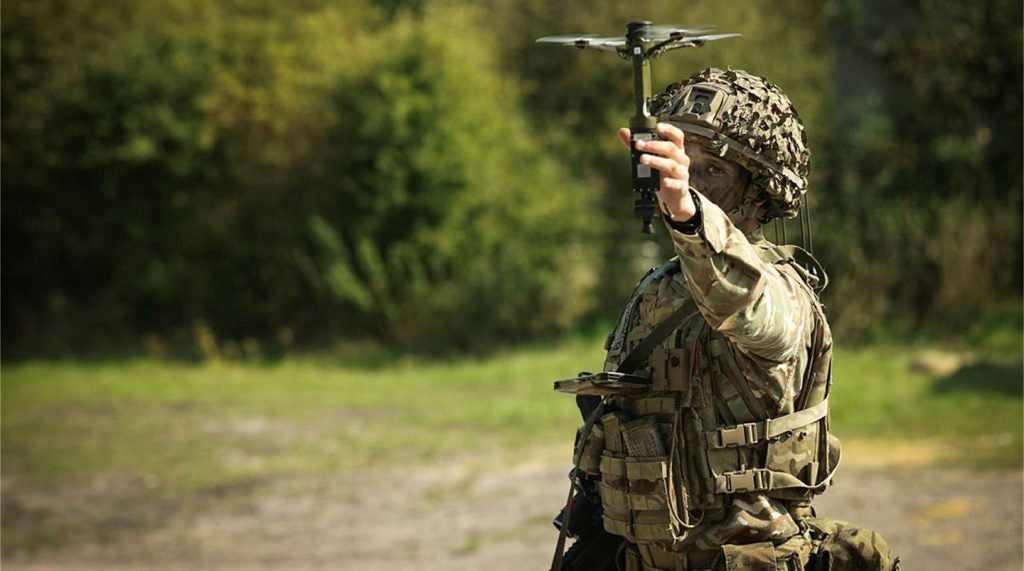
According to Eagle, the UK Ministry of Defence will acquire a new suite of sensors systems for this ISTAR network. One of these, she added, will include brigade-level small uncrewed air systems (sUAS) developed under Project TIQUILA.
This programme has just reached initial operating capability, delivering three trained and equipped detachments into the Joint Aviation Command. TIQUILA is anticipated to reach full operating capability in mid-2026, delivering two types of sUAS to 24 detatchments overall.
This project comes just as an ISTAR UAS capability gap opens up after the government put the legacy Watchkeeper programme to rest in November 2024.

A new strategy that hinges on ISTAR
The UK is following in the footsteps of the US Army, which has begun to kit its Brigade Combat Teams with sUAS. Army Technology has learned that industry have delivered at least 300 systems to units so far.
These new technologies support a modern Army strategy, informed by the abundance of drones in the Russia-Ukraine war, in which the US Army aim to stop trading blood for first contact. It is in this new context in land warfare that ISTAR plays an integral role in providing a holistic and changing picture of the battlespace.
The US Army will also deploy other systems to achieve this end, such as their family of Next Generation Combat Vehicles which come in light, medium, and heavy variants.
WFXs are distributed, simulation supported, tactical command post exercises fought competitively against a live-thinking regional adversary in a complex environment to prepare units for future large-scale combat operations.
“It’s the only time our corps and divisions are collaboratively immersed against a near-peer competitor, where they're forced to really understand and improve their wartime mission,” said US Army Colonel Robert Molinari during WFX 22-1 in 2021.