

The US Army face technical delays in fielding new long-range weapons, because the service has neglected leading practices in ‘iterative product development’, according to a recent assessment from the US Government Accountability Office (GAO) on 5 June 2025.
Since 2018, the Army have sought to modernise artillery, rocket, and missile systems to counter adversaries in conventional, direct combat with peer adversaries as the service move away from the irregular, counter-insurgency methods adapted in the last 20-years.
Go deeper with GlobalData


Discover B2B Marketing That Performs
Combine business intelligence and editorial excellence to reach engaged professionals across 36 leading media platforms.
New concepts have emerged such as the Extended Range Cannon Artillery (ERCA), Precision Strike Missile (PrSM), Mid-Range Capability (MRC), and Long-Range Hypersonic Weapon. Each of these weapons fill capability gaps: longer range, endless firepower, faster mobility, and increased survivability that extend beyond the limited and regional conflicts that defined US involvement in Afghanistan and Iraq.
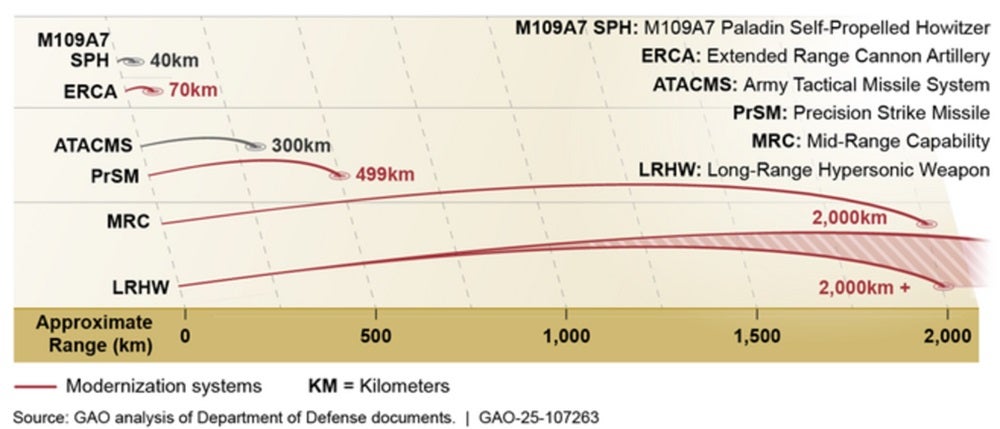
Iterative versus linear development for long-range weapons
The iterative process involves a continuous cycle, through which companies rapidly develop and deploy products.
Notably, the GAO found that the Army did not maintain a sound business case by reevaluating the technical feasibility of ERCA development, which contributed to the termination of the programme.
Instead, the Army is now seeking a self-propelled howitzer to meet this requirement.
US Tariffs are shifting - will you react or anticipate?
Don’t let policy changes catch you off guard. Stay proactive with real-time data and expert analysis.
By GlobalDataA sound business case consists of elements such as using mature technologies, continuous evaluation of progress, and a willingness to end development if the business case is no longer sound.
Likewise, the Army used a linear (versus iterative) approach for PrSM, aided by digital modelling. Adopting an iterative approach, which includes digital engineering, could shorten development of future increments.
Digital engineering
A digital twin is a virtual representation of a physical system, it helps detect, prevent, predict, and optimise the physical environment using artificial intelligence (AI), analytics, visualisation, and simulation tools. This contrasts with modelling which is a static visualisation of a model that needs to be updated manually.
GlobalData, a leading data and analytics company, expects the global digital twins market will reach $154.3bn by 2030.
The Army used some elements of an iterative approach when it came to the MRC development, including establishing a sound business case with flexible requirements.
However, for greater success, the GAO found that other tools, such as a digital twin, could aid future development and production.
Programme officials told the GAO that the contractor, Lockheed Martin, completed digital models for some of the newer components on the MRC system, and maintained a system integration lab comprised of hardware-in-the-loop and software-in-the-loop configurations.
The contractor also used a pluggable interface known as a “missile in a box” that represented the characteristics of the Standard Missile-6 and Tomahawk cruise missiles for testing purposes.
The programme expects to assess the feasibility of implementing a digital twin and digital thread by the end of fiscal year 2025.



