

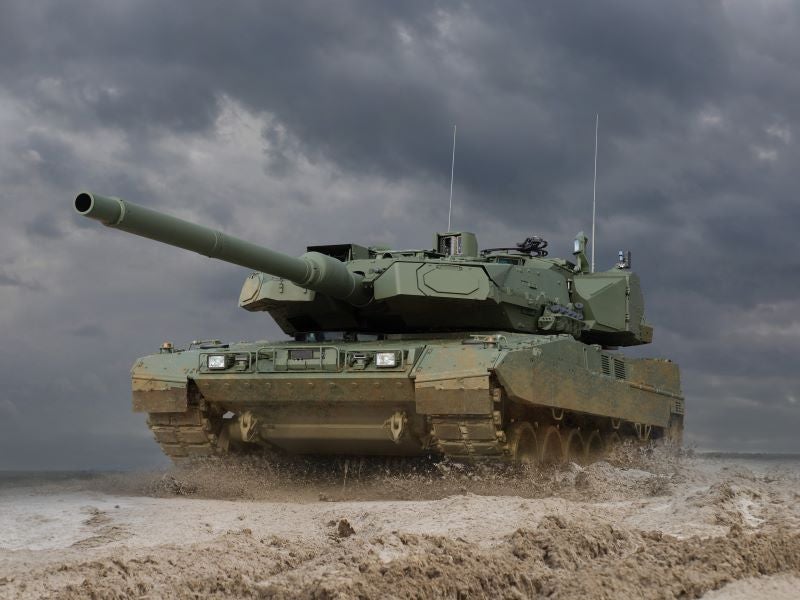
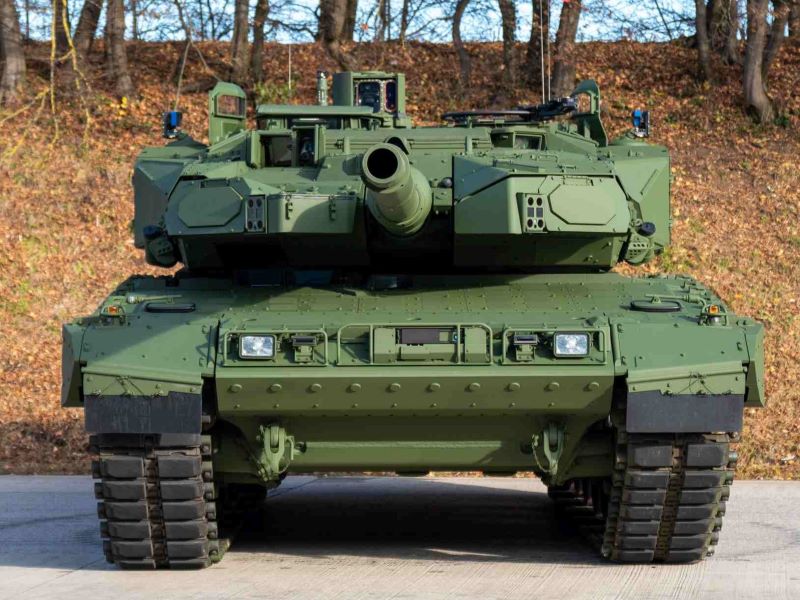
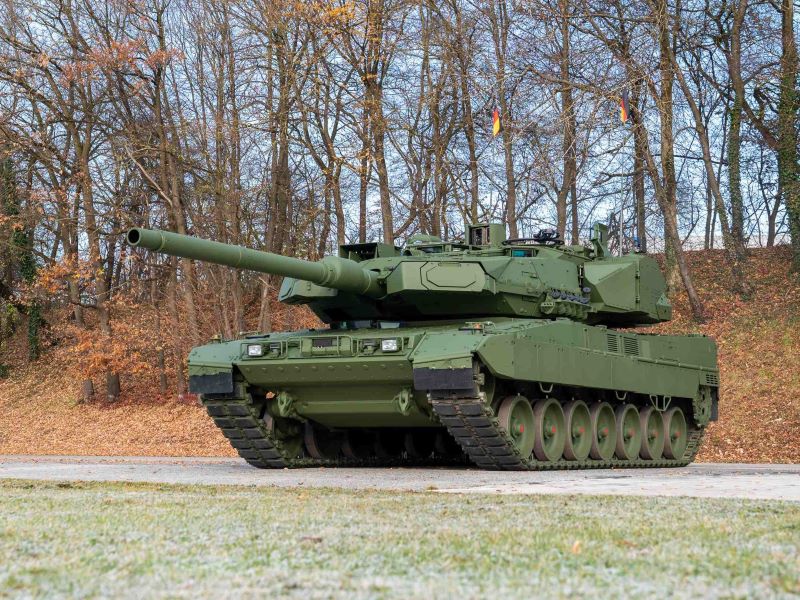
The Leopard 2 A8 main battle tank is the newest version of the Leopard 2 platform produced by KNDS Deutschland, part of the KNDS Group.
The new variant was presented in Munich, Germany, in November 2025 alongside PzH 2000 155mm self-propelled howitzers. Both are intended for the German and Norwegian armed forces.
Recommended Buyers Guides

The Leopard 2 A8 has undergone extensive trials in extreme climates, with test activity reported in Qatar in late 2010, the United Arab Emirates (UAE) in 2011, Saudi Arabia in 2012, Oman in 2016, and Norway in early 2022.
The design aims to balance protection and mobility while maintaining accurate fire from stationary positions and on the move against both fixed and moving targets.
Leopard 2 A8 design and features
The Leopard 2 A8 has a combat weight below 69.5 tonnes (t) (153,221lb), depending on configuration. It is 8.05m (26.41ft) long, or 11.17m with the gun in a forward position, and 3.8m wide.
The tank has a height of 2.72m to the turret roof and 3.13m to the panoramic periscope, along with a 500mm ground clearance. The vehicle is operated by a four-person crew.
A 20kW auxiliary power unit provides electrical power during silent watch, reducing the need to run the main power pack. Cooling capacity is provided through 8kW units fitted in the chassis and turret, supporting crew endurance and the operation of electronic systems in hot conditions.
Further measures include added internal insulation to limit heat build-up, improved engine air filtration using optimised cyclone filters for dusty environments, and an optional removable visual and infrared camouflage set that also helps reduce solar heating across most of the exterior.
The Leopard 2 A8 includes a battlefield management system linked to a hybrid navigation interface, a digital intercom with an external tank to infantry telephone, and an electric gun laying system.
Armament details of the Leopard 2 A8
The Leopard 2 A8 main battle tank is armed with a fully stabilised 120mm smoothbore gun in the L55A1 configuration, offering an elevation range of -7.4º to +17.4º and full 360º traverse. The tank has an engagement range beyond 5,000m.
Ammunition options include kinetic energy armour-piercing rounds and programmable high-explosive munitions. A fully stabilised 7.62mm general-purpose machine gun is also mounted coaxially with the main armament.
The turret can also be equipped with a remote weapon station such as FLW 200 or Protector for 7.62mm or 12.7mm machine guns or a 40mm grenade launcher. A separate remotely operated weapon station is described with 360º coverage and elevation from -10º to +70º, supported by a CCD camera for daytime use and a thermal imager for night operations.
Other optional items include smoke grenade launchers, a 75W spotlight and a laser rangefinder.
Observation and fire control system details
For observation and target engagement, the commander’s RTWL periscope sight provides an elevation range of -15º to +45º and direct-view optics with 14.6×, 3.8× and 2× magnification settings.
It integrates a third-generation ATTICA thermal imager operating in either the 3µm-5µm or 8µm-12µm wavebands, an eye-safe laser rangefinder and a CCD overview camera.
The gunner’s EMES 15 sight includes direct-view optics with 12× and 3× magnification levels, a third-generation ATTICA thermal imager covering the same wavebands and an eye-safe laser rangefinder, with the Fero Z18 available as an auxiliary telescope offering 8× magnification.
Leopard 2 A8 armour and protection systems
The Leopard 2 A8 is presented as a highly protected main battle tank for tank-to-tank combat, with its protection commonly assessed against the performance of its own weapon system.
Additional armour kits are offered for specific operational requirements and can be procured later, provided the tank is fitted with the relevant interfaces, even if it is not initially delivered with a particular kit.
According to GlobalData’s report, a growing proportion of newly delivered European main battle tanks, including the Leopard 2 A8, featuring advanced active protection systems, reflects a continent-wide shift toward next-generation survivability and digitalisation standards.
Survivability is further supported by standard equipment, including a nuclear, biological, chemical (NBC) protection system for contaminated environments, 76mm multi-purpose grenade launcher tubes on both sides of the turret for smoke or other munitions, fire detection and suppression systems for the crew and engine compartments, and an internal spall liner.
Optional packages include all-round protection against rocket-propelled grenades, additional mine and improvised explosive device mitigation, and roof protection with sliding hatches. Further options include mobile camouflage, frontal engineering equipment and the Trophy active protection system to counter anti-tank guided missiles and shoulder-launched threats.
Engine and mobility details of the Leopard 2
The Leopard 2 platform is powered by a 12-cylinder multi-fuel MTU engine rated at 1,100kW, paired with a RENK transmission.
The Leopard 2 A8 has a maximum road speed of 60km/h, an approximate road range of 400km, and a reverse speed of around 30km/h, with pivot turning to support manoeuvre and withdrawal.
An upgraded final drive has been developed to increase torque for operations requiring higher protection in urban areas or improved mobility in difficult terrain such as sand, dunes and mountainous ground.
The suspension uses torsion bars with hydraulic shock absorbers and friction dampers, while rubber-bushed connector tracks are intended to reduce shock transfer to the crew and onboard systems.
The Leopard 2 A8 also features the Spectral Technology for Unlimited Sight (SPECTUS) driver assistance system, which combines daylight and third-generation thermal imagery into a single display to support situational awareness in low light, dust and low-contrast conditions. Switchable infrared headlights provide improved visibility with low emitted radiation.
The main battle tank is capable of crossing ditches up to 3m wide and climbing vertical obstacles up to 1.05m. It has a military load classification (MLC) of 70 to 80 and can ascend gradients of up to 60% while handling side slopes of up to 30%. In terms of water operations, it is described as having submerged mobility to 4m, with deep fording capability to 2m and standard fording to 1m.
Contactors involved
In December 2025, KNDS Deutschland and TATRA DEFENCE concluded an agreement covering the manufacture of 150 hulls for the Leopard 2 A8 main battle tank, with an option to increase the order by up to a further 300 units.
Under the deal, TATRA DEFENCE will carry out the hull welding work and oversee associated quality assurance and production processes.
Orders and deliveries
Germany’s Federal Office of Bundeswehr Equipment, Information Technology and In-Service Support (BAAINBw) placed an order in May 2023 for 18 Leopard 2 A8 tanks to replace vehicles transferred to Ukraine, under a framework that also allows further purchases up to 105 and includes support and maintenance.
Sweden tasked KNDS Germany with supplying 44 Leopard 2 A8 main battle tanks for the armed forces. An initial agreement, signed in November 2024, covered 24 tanks, followed by a second contract for a further 20 vehicles signed in December 2024.
After transferring ten Leopard 2 tanks to Ukraine, Sweden is procuring the first 24 Leopard 2 A8s as replacements. Deliveries of the newly built tanks, which will be known in Sweden as STRV 123 B, are expected to start in the second half of 2027.
Lithuania signed for 44 tanks in December 2024 as part of its first establishment of an armoured unit, with the deal reported to include spares and logistics support and valued at €950m ($996m). The Czech Republic signed an agreement for 44 tanks in September 2025 with an option for 14 more, alongside servicing, logistics support and a separate package for national modifications, with the overall value estimated at €1.34bn ($1.57bn).
