
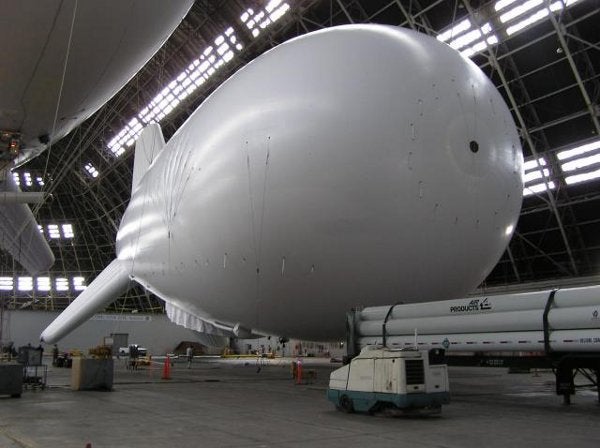
Raytheon’s joint land attack cruise missile defence elevated sensor (JLENS) system has demonstrated its tactical ballistic missile defense (TBMD) capabilities during a series of tests at White Sands Missile Range in New Mexico, US.
During testing, a total of four ballistic-missile surrogates, including two ripple-fired and two individually fired, were successfully detected and tracked by the JLENS X-Band radar during their ascent phase.
Go deeper with GlobalData


Discover B2B Marketing That Performs
Combine business intelligence and editorial excellence to reach engaged professionals across 36 leading media platforms.
Raytheon Integrated Defense Systems business global integrated sensors vice president David Gulla said: "This TBMD demonstration and JLENS’s other recent successes prove that the system is ready to deploy for a combatant commander operational evaluation."
US Army JLENS programme manager Dean Barten said: "JLENS’s TBMD capability, when coupled with its ability to conduct 360° long-range surveillance capability and simultaneously detect and engage threats like swarming boats and anti-ship cruise missiles from up to 340 miles away, gives commanders a powerful proven capability."
Flight profiles similar to the ones followed by hostile tactical ballistic missiles in high-threat regions worldwide were flown by surrogates during the testing.
The missile demonstrated its ability to destroy cruise missiles by tracking Patriot and Standard Missile-6 cruise-missile surrogates during separate tests in April and September 2012.
Two developmental tests and a 14-day endurance test were completed by the missile at Great Salt Lake and at a test range in Utah, US, in October 2012 and 2011 respectively.
Equipped with a powerful integrated radar system and two tethered, 74m-long aerostats, the JLENS is an elevated, persistent over-the-horizon sensor system designed to detect, track and engage hostile cruise missiles, low-flying manned and unmanned aircraft, as well as tactical ballistic missiles and moving surface vehicles.
Image: The 74m long tethered aerostat of the joint land attack cruise missile defence elevated sensor system. Photo: courtesy photo from Army.Mil.



