

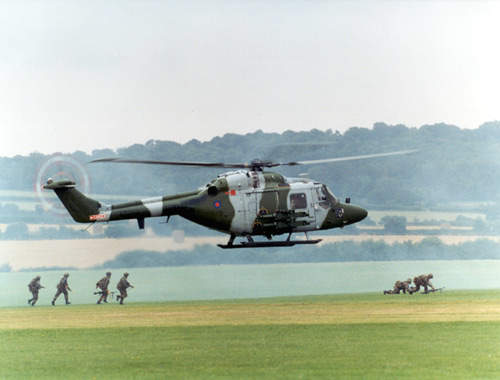
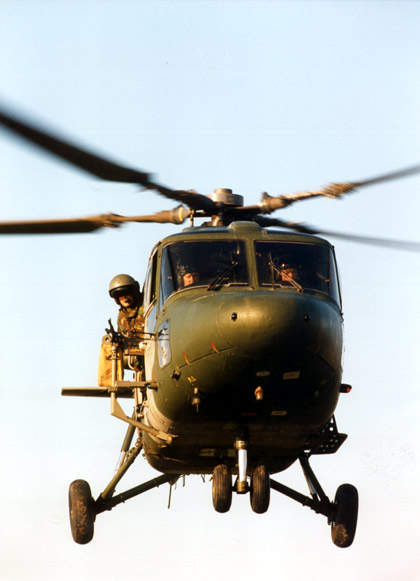
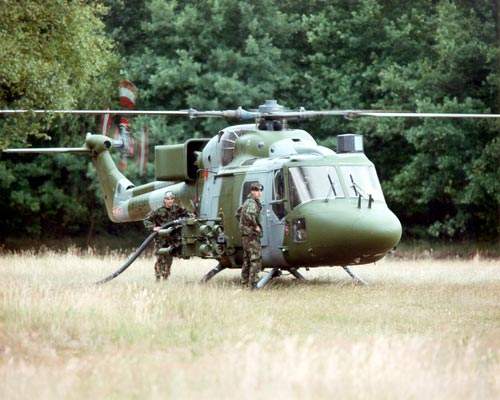
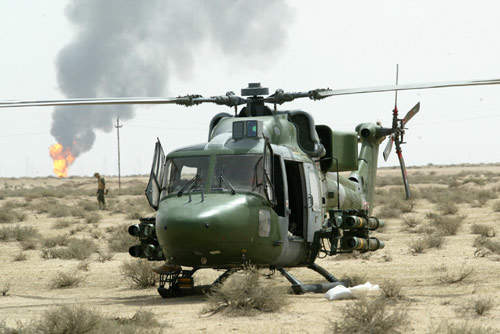
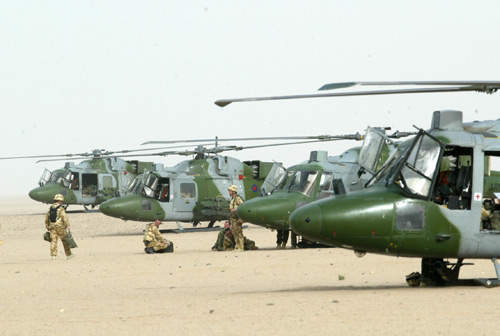
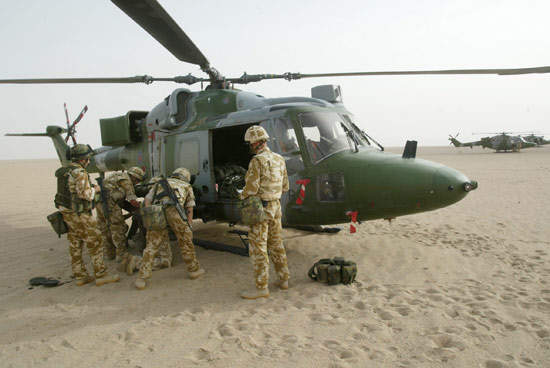

The UK Army Air Corps operates the Lynx army helicopter (Lynx AH) mk7 and mk9, and the export version of the Army Lynx, known as the Battlefield Lynx. Around 77 AH mk7 versions and 22 AH mk9 helicopters are in service with the UK Army.
Recommended White Papers
Recommended Buyers Guides
The Army Lynx first flew in 1977. The initial role as a utility helicopter, a tactical troop and stores carrier, airborne command, and for casualty evacuation was expanded with the addition of air-to-ground missiles, cannon and rockets for armed reconnaissance, armed escort, anti-tank and air-to-surface strike roles.
In Operation Telic in Iraq, the Joint Helicopter Force Iraq (JHF(I)), a joint unit based in Basra and manned by members of the navy, army and air force, deployed Sea King mk4 and Lynx mk7 helicopters from the commando helicopter force (CHF), and also Merlin helicopters from RAF Benson.
The UK Ministry of Defence (MoD) has a £1bn programme for the AW159 Lynx Wildcat, which is based on an upgraded version of the Lynx helicopter.
Lynx helicopter development and upgrades
In December 2008, the UK MoD signed a contract with AgustaWestland for the upgrade of 12 Lynx AH mk9 aircraft. The upgraded aircraft are fitted with CTS800-4N engines.
In September 2009, the first upgraded aircraft successfully completed its maiden flight. The remaining twelve aircraft were delivered in 2010.
The Lynx helicopters operated in Iraq were modified with the installation of sand filters, new communications, night vision-compatible cockpit lighting, and a new defensive aids suite, a helicopter DAS, which included directed infrared countermeasures.
Super Lynx, Battlefield Lynx and AH mk9 Lynx helicopter variants
The Super Lynx helicopter is of conventional semi-monocoque pod and boom design. There is a jettisonable cockpit door and large sliding cabin door with jettisonable windows on each side of the fuselage.
The large cabin doors allow rapid emplane and deplane. The cabin provides internal access to the cockpit.
The Battlefield Lynx and the AH mk9 are fitted with non-retractable tricycle-type landing gear with twin nosewheels. The AH mk7 has a skid type undercarriage which can be fitted with snow skis for Arctic operations. The aircraft is fitted with a wire-strike protection system.
Lynx multirole helicopter cockpit
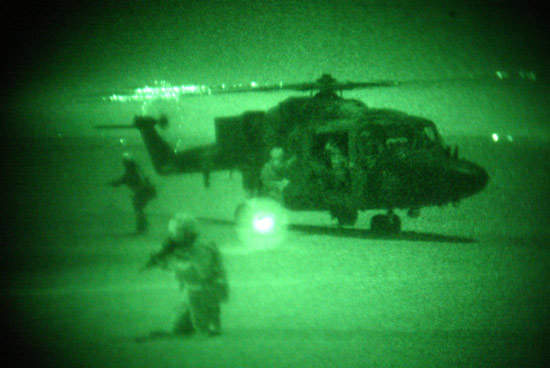
The cockpit accommodates the pilot and co-pilot but can be flown by a single pilot. A night vision-compatible cockpit allows the helicopter to be used for covert operations.
The navigation systems include a Racal Doppler 91 and RNS252, Honeywell AN/APN-198 radar altimeter, Rockwell Collins 206A automatic direction finder, BAE GMM9 Gyrosyn compass, distance measuring equipment (DME), Rockwell Collins VIR 31A VHF omni-directional ranger and instrument landing system (VOR/ILS), Rockwell Collins AN/ARN-118 tactical air navigation system (TACAN).
The avionics system includes a BAE Systems mk34 automatic flight control system and a BAE Systems automatic stabiliser.
Lynx cabin
The helicopter can carry up to nine armed troops. The cabin seats can be quickly removed for freight transport. The maximum internal freight load is 910kg.
For casualty evacuation, the helicopter carries the pilot and co-pilot, up to six stretcher patients and a medical attendant. Underslung loads up to 1,360kg (3,000lb) can be carried. The aircraft has the capacity for up to four ropes for fast roping or rappelling. A rescue hoist can be deployed to recover personnel from confined spaces.
Helicopter weapons
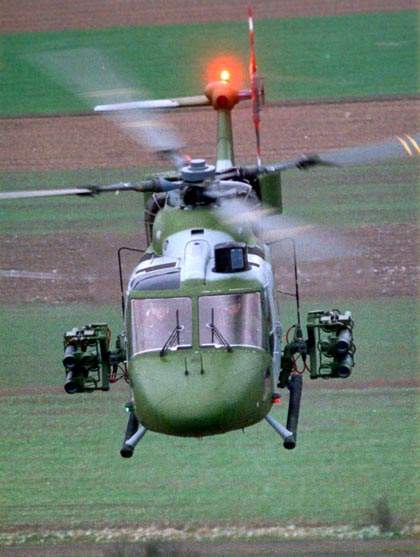
The army version helicopter has a pintle-mounted 7.62mm machine gun installed inside the cabin and two 20mm cannon can be mounted externally. External weapons pylons can carry two miniguns, gun pods, rocket pods, or up to eight air-to-surface missiles such as HOT, Hellfire or TOW. Up to eight missiles can be carried in the cabin ready for reloading.
Countermeasures
A BAE Systems information & electronic warfare systems (IEWS) AN/ALQ-144 infrared jamming system is installed under the tailboom. The helicopter is equipped with the BAE AWARE-3 ARI 23491 radar warning receiver and the Sky Guardian mk15 electronic warfare system.
Lynx helicopter sensors
A roof-mounted sight manufactured by BAE Systems under licence from Raytheon (formerly Hughes) is installed on the Lynx helicopters armed with TOW missiles. Optical sighting systems include lightweight targeting sights, vertical cameras, oblique cameras, low-light television, infrared line scanners and night-vision goggles.
Engines
The helicopters are powered by two Rolls-Royce Gem mk42 turboshaft engines, rated at 835kW. The exhaust is fitted with diffusers to reduce the infrared signature. The four-blade semi-rigid main rotor and a four bladed flapping tail rotor are powered by main rotor gearbox.
There are five internal fuel tanks of capacity 985l. The 150kt transit speed gives a good tactical speed of response. The Super Lynx has exceptional agility allowing tactical nap-of-the-earth flight.
