

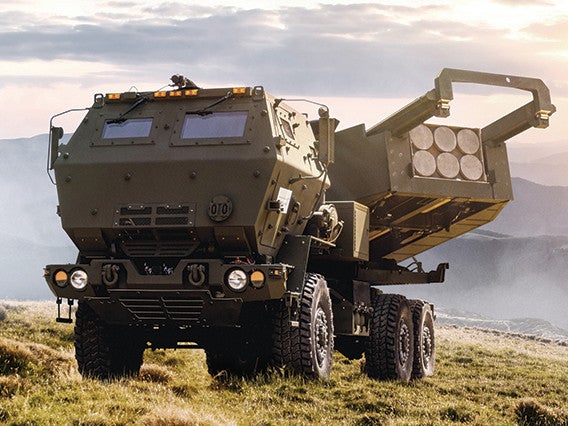
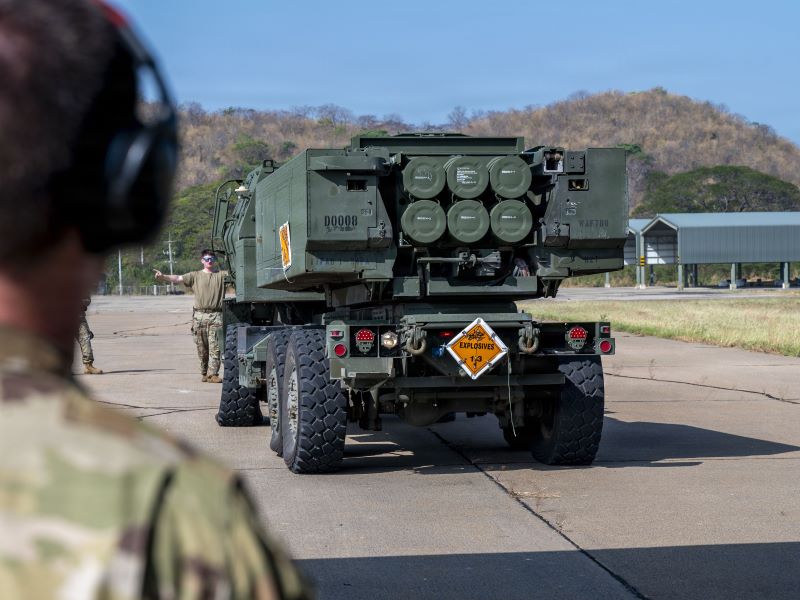
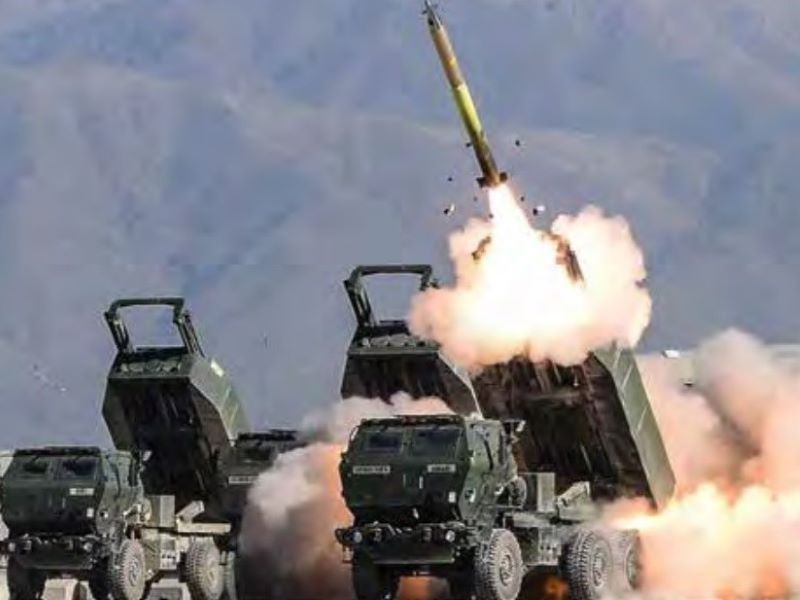
HIMARS is a highly mobile artillery rocket system offering the firepower of a multiple launch rocket system (MLRS) on a wheeled chassis.
It was developed in 1996 by Lockheed Martin Missiles and Fire Control under an advanced concept technology demonstration programme.
Recommended Buyers Guides

HIMARS is intended to engage and defeat artillery, air defence concentrations, trucks, and light armour and personnel carriers, as well as support troop and supply concentrations. The system launches its weapons and moves away from the area at high speed before enemy forces locate the launch site.
Combat use of HIMARS
According to a statement from US Central Command (CENTCOM) published on X in March 2026, the HIMARS system was deployed to deliver advanced long-range strike capabilities during operations against the Iranian regime. This deployment formed part of Operation Epic Fury, which commenced in February 2026.
Additionally, CENTCOM indicated that the next-generation precision strike missiles (PrSM) were utilised in combat for the first time during Operation Epic Fury, specifically targeting Iranian assets.
Ukraine deployed the system against Russian forces during the 2022 Russian invasion of Ukraine.
HIMARS rocket fire control system
HIMARS is 7m (22.9ft) long, 2.4m wide, 3.2m high and has a range of 480km.
The platform retains the same self-loading and autonomous features installed on the MLRS.
The high-mobility artillery rocket system is operated by a crew of three: the driver, gunner and section chief. However, the computer-based fire control system enables a crew of two or a single soldier to load and unload the system.
The fire control system includes video, keyboard control, a gigabyte of programme storage and a global positioning system (GPS). The fire control computer allows firing missions to be carried out in automatic or manual mode.
In a typical mission, a command and control post would transmit the selected target data via a secure data link to the HIMARS on-board launch computer. The computer then aims the launcher and provides prompt signals to the crew to arm and fire a pre-selected number of rounds.
The launcher can aim at a target in just 16 seconds. The crew can select pre-programmed multiple mission sequences, which have been stored in the computer.
The improved launcher mechanical system (ILMS) upgrade and electronics of the improved fire control system (IFCS), which upgraded MLRS M270 launchers, are also fitted to HIMARS vehicles.
Lockheed Martin’s universal fire control system (UFCS), a further evolutionary upgrade of the fire control system, has been fitted to full-rate production HIMARS since 2008.
Successful HIMARS test firings of the Army Tactical Missile Systems (ATACMS) missile (in March 2008) and GMLRS rockets (in May 2008) took place using the new GPS-guided UFCS.
High mobility artillery rocket system munitions
In addition to the standard MLRS round, HIMARS can launch the entire MLRS family of munitions, including the extended-range rocket, the reduced-range practice rocket and all future variants.
The high-mobility artillery rocket system can fire extended-range guided MLRS (GMLRS) rockets, ATACMS missiles, and the next-generation PrSMs.
The extended-range MLRS rocket (ER-MLRS) improves the basic M26 range of 32km to more than 45km and the area of influence by 107%.
Extension of the HIMARS rocket motor has resulted in a reduction in the payload to 518 M85 grenades, but the dispersion of the grenades is improved for better effectiveness with fewer grenades.
In April 2004, HIMARS successfully test fired the new extended-range guided rocket GMLRS, with a range of more than 70km.
The Lockheed Martin GMLRS rocket has a GPS, an inertial guidance package and small canards on the rocket nose to enhance accuracy. GMLRS completed system development and demonstration (SDD) tests in December 2002 and entered low-rate initial production in April 2003.
Initial operating capability was achieved in 2006, but the system has been operationally deployed since September 2005 in Iraq. The GMLRS is an international programme involving the UK, Italy, France, Germany, as well as the US. The industrial team includes Diehl, MBDA and FiatAvio.
In October 2003, Lockheed Martin was awarded an SDD contract for 86 unitary variant rockets.
In May 2005, the first deliveries were made of a unitary variant of GMLRS, developed by General Dynamics Ordnance and Tactical Systems, with a single 81.6kg (180lb) warhead and a range of up to 70km. GMLRS Unitary entered low-rate initial production (LRIP) in June 2007.
The Extended-Range GMLRS had its first launch and completed Alternative Warhead qualification tests in February 2026.
HIMARS is also compatible with the Joint Reduced Range Rocket (JR3) and advanced medium-range air-to-air missiles.
HIMARS vehicle
The high-mobility artillery rocket system carries a single six-pack of rockets on the army’s family of medium tactical vehicles 6×6 all-wheel drive 5t truck supplied by Armor Holdings Tactical Vehicle Systems Division (now BAE Systems Mobility & Protection Systems) in Texas.
The vehicle weighs approximately 24,000lb (10,886kg) compared to more than 44,000lb for the MLRS M270 launcher.
HIMARS is transportable on the C-130 aircraft, allowing the system to be moved into areas previously inaccessible to the larger C-141 and C-5 aircraft required for the M270 launch vehicle.
HIMARS orders and deliveries
Lockheed Martin received an initial contract in January 2000 to build six HIMARS launchers, with two more ordered later for a two-year US Marine Corps (USMC) evaluation.
In March 2003, the US Army and USMC placed an LRIP contract for 89 launchers for the Army and four for the USMC. Follow-on LRIP awards included 25 (Army) and one (USMC) in January 2004, and 37 (Army) and one (USMC) in January 2005.
The UAE requested 20 launchers in September 2006, plus munitions (101 ATACMS Block 1A, 101 ATACMS Block 1A Unitary, 104 MLRS, 130 GMLRS and 130 GMLRS Unitary rocket pods). The first unit was delivered in late 2009.
Lockheed Martin won a January 2007 contract for 44 HIMARS systems (Army) and 16 (USMC).
Singapore’s proposed foreign military sale (FMS) in September 2007 covered 18 launchers, 32 Unitary GMLRS pods and 30 MLRS practice rocket pods, with first delivery in July 2010 and commissioning into the Singapore Armed Forces in September 2011.
A January 2009 contract covered 64 launchers; 57 for the Army and seven for the USMC.
BAE Systems signed a $16.3m US Army Tank-Automotive and Armaments Command contract in November 2010 for 44 HIMARS vehicles, following a June 2010 $24m award for 63 vehicles and appliqué kits.
In January 2011, the US Army awarded Lockheed Martin a $139.6m contract for 44 HIMARS, taking the total to 375; the 400th launcher was received in September 2011.
Qatar requested seven M142 HIMARS in December 2012, while the United Arab Emirates requested 12 HIMARS launchers plus 100 M57 ATACMS T2K and 65 M31A1 GMLRS unitary pods in September 2014.
Lockheed Martin received a $23.17m Life Cycle Launcher Support III modification contract in December 2015 and a $73.8m Long Range Precision Fires phase two contract in July 2017. The first fully built chassis-and-launcher was delivered in July 2017.
Romania requested 54 HIMARS launchers in August 2017 at an estimated cost of $1.25bn.
Lockheed Martin received contracts valued at $218m in August 2018 for 18 launchers and $289m in September 2018 for 24 launchers. Around 500 had been delivered by October 2018.
A $1.14bn GMLRS FMS contract from Poland, Bahrain and Romania followed in March 2019, along with a $492m contract in July 2019 to support the delivery of M142 HIMARS launchers to the US Army, USMC, Romania and Poland by 2022.
Lockheed Martin won $431m in December 2022 to deliver M142 HIMARS for the US Army.
Poland’s $10bn FMS package (including 18 launchers) was approved in February 2023, with first shipments in May 2023.
In April 2023, Lockheed Martin received a $615m full-rate production contract for HIMARS launchers. The US Department of State approved the potential sale of HIMARS rockets to Morocco for an estimated $524.2m in the same month.
Australia received the first of 42 launchers in March 2025 under a $1.6bn contract, while Estonia received its first launchers in April 2025.
The Government of the Republic of Croatia agreed to procure HIMARS systems in December 2024.
A $1.75bn possible FMS, including 26 M142 HIMARS, was approved by the US to the Government of Canada in October 2025.
The US announced the sale of 82 HIMARS to Taiwan in December 2025 at an estimated cost of $4.05bn as part of a $11.1bn arms package.
The US approved an FMS of M142 HIMARS systems to the Government of Sweden at an estimated total cost of $930m in March 2026.
The system is also operational with the Jordanian Armed Forces.
