

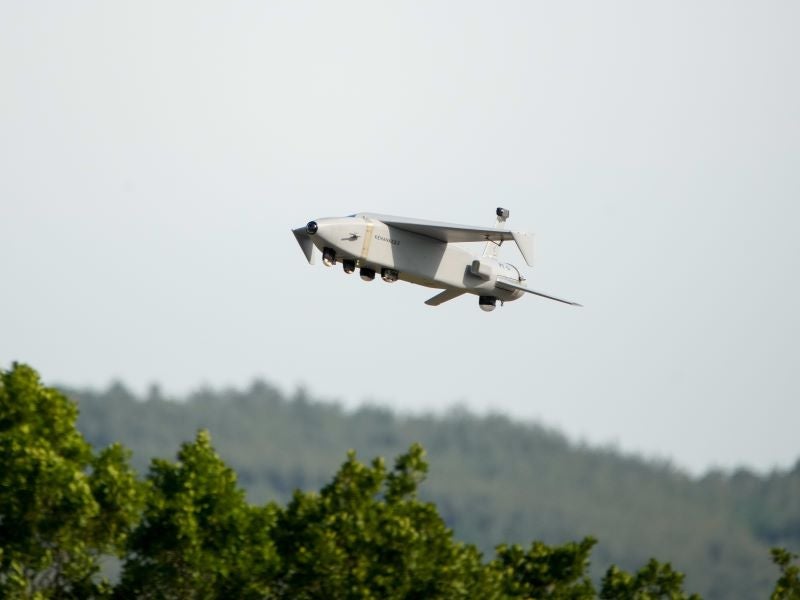
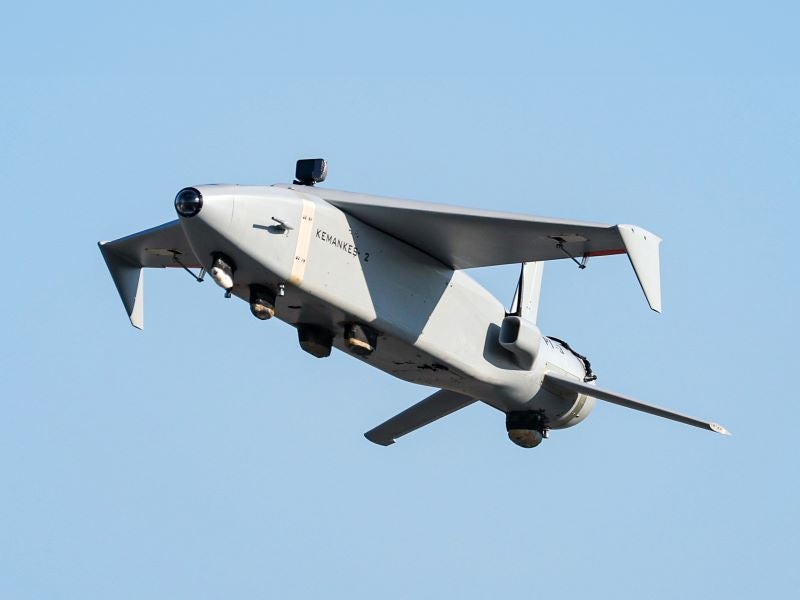
KEMANKES 2 is a ground-launched mini-intelligent cruise missile developed indigenously by Türkiye’s Baykar.
The mini cruise missile is designed to operate autonomously using an AI-supported autopilot and is intended to strike high-value targets behind enemy lines.
Recommended Buyers Guides

Although conceived as a ground-launched system, KEMANKES 2 also carried out its first air launch in March 2026.
Two missiles were launched from an AKINCI unmanned combat aerial vehicle (UCAV) to test firing, cruise and dive capabilities. The first missile firing tested cruise, dive and visual coordination, while the second missile firing evaluated long-range flight and system identification.
KEMANKES 2 development details
The KEMANKES 2 cruise missile development programme builds on the development of Baykar’s earlier air-launched KEMANKES 1 mini-intelligent cruise missile.
KEMANKES 1 is also an indigenous Baykar development aimed at strategic target sets. It was publicly unveiled for the first time at TEKNOFEST 2023, held at Ataturk Airport.
The first firing test for KEMANKES 2 was completed in April 2024 at the Baykar Flight Training and Test Centre in Kesan, Edirne.
KEMANKES 2 design and features
The KEMANKES 2 mini cruise missile measures 2.47m (8.1ft) in length with a 1.35m wingspan and a height of 0.49m. It has a maximum take-off weight of 75kg and a payload capacity of 20kg.
The cruise missile, with its AI-assisted autopilot, is designed to fly autonomously and rapidly engage assigned targets at key positions in deep territories with a high degree of accuracy.
The missile is designed for deployment from unconventional locations including sites without road or runway access by using a rocket-assisted take-off system. It is also intended to be fielded from mobile platforms such as pick-up trucks and to operate when integrated with the Bayraktar AKINCI UCAV.
The missile’s AI-assisted optical guidance system delivers high accuracy, helping it to detect, identify and engage targets, even in demanding operational conditions.
Payload and mission capabilities
The payload suite of KEMANKES 2 combines an integrated camera system with AI-enabled control functions and an AI-assisted optical cruise package, supporting operation in daylight and low-light conditions.
For intelligence, surveillance and reconnaissance tasks, the payload includes an AI-assisted high-definition electro-optical camera, while terminal guidance is provided by electro-optical methods or via global navigation satellite system support.
The cruise missile is intended for day and night operations and includes anti-jamming measures to support performance in contested electromagnetic environments.
The system can also transmit imagery and mission data back to a ground control station to support operator oversight and tracking. It features high-performance image stabilisation.
KEMANKES 2 engine and performance
Propulsion is provided by a jet engine, giving a cruise speed of 130 knots indicated airspeed (kias) and a maximum speed of 160kias.
The missile has a stated range of 150km, an endurance of 30 minutes and a communications range of more than 80km. It is listed with a service ceiling of 10,000ft and an operational altitude of 7,500ft.
