

- Gute II builds on a layered anti-drone system proven in Gotland last year
- Gute II utilises the Giraffe 1X radar, a C2 system, 40mm and 30mm guns
- The FMV has committed to contracts with suppliers at a cost of nearly $1bn
On the Baltic island of Gotland, about 56 miles east of mainland Sweden, local conscripts alongside the Defence Material Administration (FMV) conducted a military exercise proving a range of sovereign air defence systems in June 2025.
Gute I, as it is now known, fast-tracked the development and testing of a protoype system-of-systems network comprising various sensors and effectors, which soliders could quickly deploy to counter uncrewed aerial systems (C-UAS).
Go deeper with GlobalData


Discover B2B Marketing That Performs
Combine business intelligence and editorial excellence to reach engaged professionals across 36 leading media platforms.
Russia and Ukraine have demonstrated the effectiveness of low-cost, slow-moving drones in the battlespace for years. About a year ago, it was found that UAS now account for 80% of casualties in the war.
Likewise, Iranian strikes across the Near and Middle East this past month highlighted, once again, the cost gap between legacy interceptors and cheap Shahed attack drones.
In this backdrop, Sweden has formalised its C-UAS solution into a deployable and modular anti-drone concept known as Gute II.
The FMV has committed to contracts with suppliers at a cost of 8.7bn krona ($934m) collectively.
Among the systems, the Giraffe 1X radar provides early detection, tracking and classification.
Decision-making and visualisation is achieved through a short range air defence (SHORAD) command and control system.
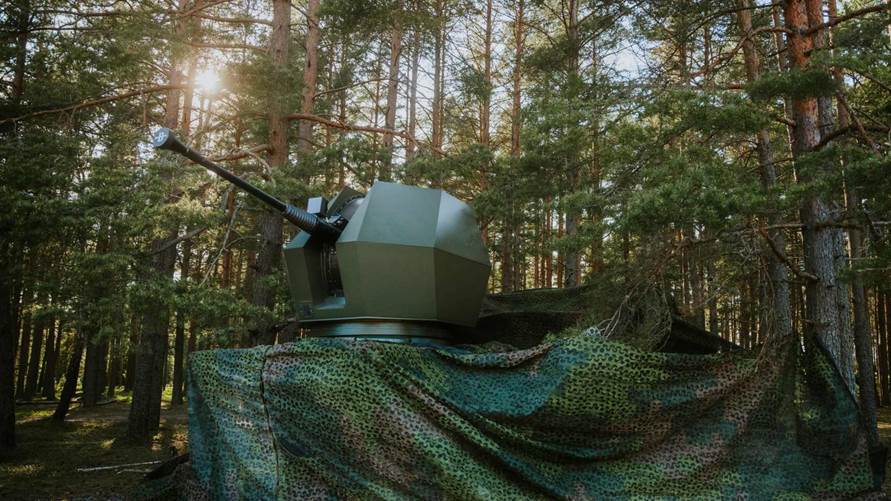
Finally, the kinetic effectors include Saab’s Trackfire Aerial Response (ARES) weapons station equipped with a 30mm gun and BAE Systems’ Tridon Mk2 truck-mounted 40mm Bofors gun.
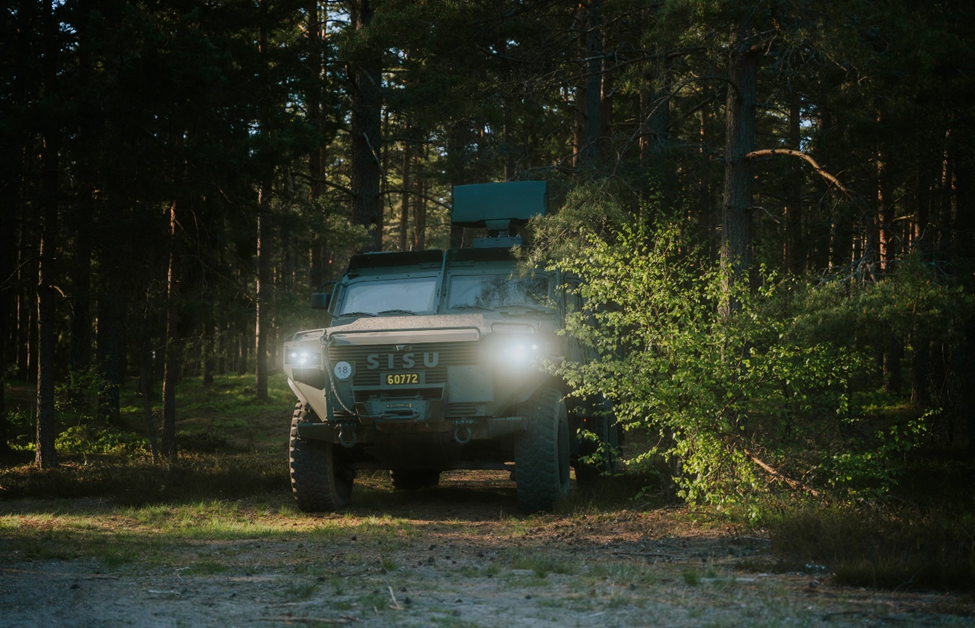
These systems will be mounted on mine-resistant Finnish Sisu GTP 4×4 trucks.
The order concerns equipment for a first and initial unit deployment and deliveries to take place continuously from 2027 to 2028.
Combining new and legacy systems
Master Sergeant Kristoffer Rahlskog, programme manager for C-UAS at the Swedish Army Staff, explained that the “complexity and combination of systems that work together” in Gute II makes the concept unique in a fast growing market.
This refers to Sweden’s continued use of legacy systems, such as the Bofors 40mm gun, featured on Type 31 frigates as well as CV90, and indeed Tridon, along with pre-fragmented programmable and proximity-fused (3P) ammunition.
It is easier and faster to take an existing system and “tweak them” to work against a new threat than it is to develop a brand new system, Rahlskog maintained.
“We have done extensive testing and the 40mm 3P… works well against current UAS.”
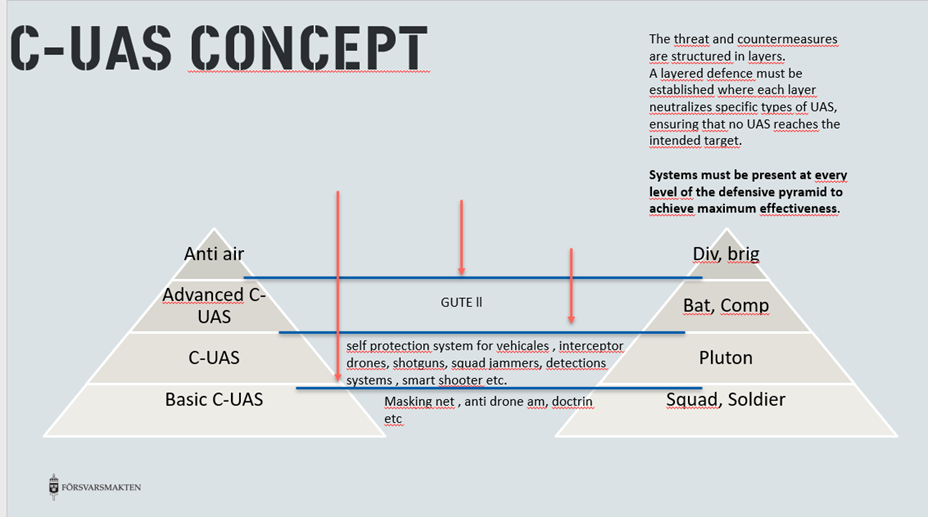
However, the Army has decided upon a mix of well proven legacy systems and new capabilities that complement each other to create a layered defence system.
“We prioritised urgency to be able to counter and neutralise UAS threats that exist here and now.”
The Army expressed vindication for the concept when speaking to Army Technology.
For over a month Iran has launched hybrid salvos across the Gulf, demonstrating the necessity for anti-air and advanced C-UAS capabilities.
“It has confirmed that we are on the right path of our chosen concept that builds on different layers where each layer pushes the UAS further away from its target – or are being engaged with cost effective ammunition or electronic warfare.”
Fast development cycle
The real leap in innovation lies not primarily in the technology, but in how the project has been implemented according to the Armed Forces.
“We have had a clear goal, delegated strong mandates to the operation and only had a requirements document as guidance,” said Jonas Lotsne, head of the Army operational area at FMV, speaking at the time Gute I took place in the summer of 2025.
In just ten months, this operation resulted in a proposal for a technical solution to meet the drone threat.
While Gute II comprises a working system-of-systems network in this short time, there are other European made weapons systems which have been developed relatively quickly, and provide some context to the modern development cycle.
Most recently, the UK deployed Rapid Sentry in Iraq, and later Bahrain and Kuwait. The British C-UAS system also utilises Saab’s Giraffe 1X radar unit. The whole system was developed within two years.
Other systems include two other UK-made missile launchers: the versatile Raven, which can fire ASRAAMs – these are typically air-to-air missiles – and Gravehawk, which launches Soviet era missiles. These systems were developed in three and 18 months respectively.



