
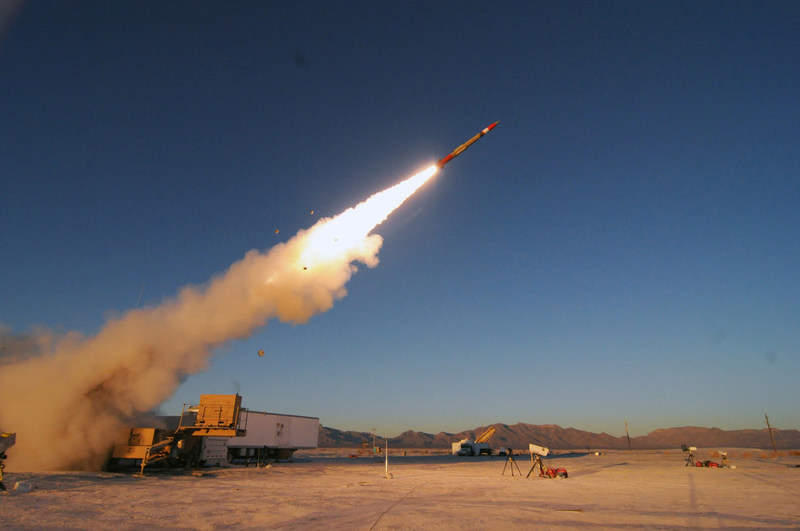
The US Army has used a Patriot Advanced Capability 3 (PAC-3) missile segment enhancement (MSE) interceptor to successfully intercept an air-breathing threat (ABT), which represents fixed-wing aircraft or cruise missiles.
The missile defence flight test demonstrated the hit-to-kill capability of the PAC-3 family of missiles, which are used to defend against threats through body-to-body contact.
Go deeper with GlobalData


Discover B2B Marketing That Performs
Combine business intelligence and editorial excellence to reach engaged professionals across 36 leading media platforms.
During the test conducted at White Sands Missile Range, New Mexico, the US Army reconfirmed PAC-3 MSE’s ability to detect, track and intercept incoming ABTs or missiles.
The test was carried out by representatives from the US Army and a current Foreign Military Sales PAC-3 MSE customer.
Lockheed Martin Missiles and Fire Control PAC-3 programmes vice-president Jay Pitman said: “PAC-3 MSE continues to be successful against today’s evolving threats, and this most recent test validates its effectiveness at extreme distances.
“Today’s global security environment demands reliable solutions. We expect PAC-3 hit-to-kill interceptors to continue serving as an essential element in integrated, layered defence systems.”
US Tariffs are shifting - will you react or anticipate?
Don’t let policy changes catch you off guard. Stay proactive with real-time data and expert analysis.
By GlobalDataThe PAC-3 cost reduction initiative (CRI) and MSE are high-velocity interceptors that defend against incoming threats, including tactical ballistic missiles, cruise missiles and aircraft.
To date, 12 nations across the globe have acquired the PAC-3 missile defence interceptor. These comprise the US, Germany, Kuwait, Japan, Qatar, Republic of Korea, Kingdom of Saudi Arabia, Taiwan, Romania, Poland, the Netherlands and the United Arab Emirates (UAE).



