

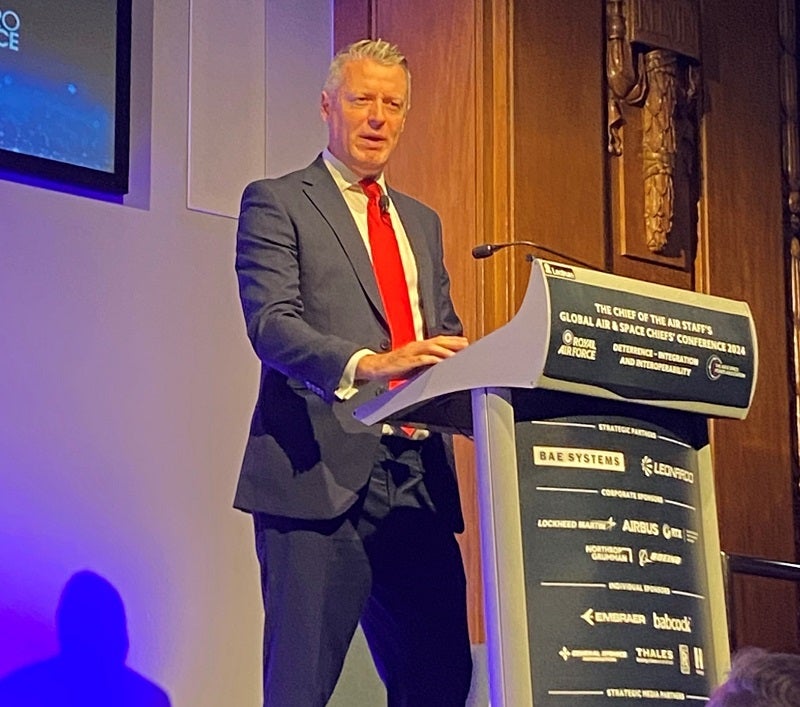
“Britain is back,” declared the UK Minister for the Armed Forces, Luke Pollard, in a speech addressing a gathering of air and space power chiefs in a London conference on 18 July 2024.
A new Labour Government brings with it, he said, a more extensive commitment to defence and aerospace.
Go deeper with GlobalData


Discover B2B Marketing That Performs
Combine business intelligence and editorial excellence to reach engaged professionals across 36 leading media platforms.
However, this latest show of confidence is undercut by Labour’s enduring ambiguity over when it can commit to spending 2.5% of the UK’s gross domestic product (GDP) on defence.
In 2006, Nato set a base target for defence spending to reach 2% of a member’s GDP. Currently the latest figures tell us that the UK spent 2.3% of GDP on defence last year.
The next 12 months will be a busy time for the Ministry of Defence (MoD) as it undergoes a “root and branch” evaluation of the the UK Armed Forces – Britain’s third Strategic Defence Review in the last five years – to be completed by the end of the first half of 2025. This assessment will provide some insight into the country’s position in a contentious security environment, which is now characterised as being in a state of ‘pre-war’.
Luckily, Pollard assured those gathered that a roadmap for reaching the new spending target does not hinge on the findings of the forthcoming Review, but that a timeline will come with the Chancellor’s autumn budget statement.
“How we get to 2.5% will be laid out by the Chancellor, Rachel Reeves, at a fiscal event, which is government code for a budget, or an autumn statement. So looking at that, she will be setting up the path to that.”
“It’s about how we spend it”
Pollard was eager to emphasise that it’s not just about reaching the target, “it’s about how we spend it.”
The reality of the Russian threat perception is only growing for European militaries, and none more so than with the British military, whose stocks are insufficient to meet a threat in the near-term.
For some, this leads to difficult questions over where it is best to allocate what little funds governments are willing to spend on defence. One well-regarded voice from academia, Justin Bronk, a senior fellow in airpower an technology at the Royal United Services Institute, projected that converging factors indicate a potential military conflict with Russia may take place by 2028.
“We’re clear that we want to grow the economy,” Pollard stated. “So a larger economy means more defence spending at 2.5%.”
With an imminent need to secure sufficient stocks to wage war, the UK Government will need to restructure their agenda to accommodate for the needs of the armed forces. Defence cannot depend on economic growth alone to expand its resources.
Sustainable spending
In his speech, the UK Chief of the Air Staff, Air Chief Marshal Richard Knighton, provided a useful comparison to Britain’s defence spending during the Second World War.
“In 1936 we spent 3.1% of GDP on defence, by 1939 we spent 9%, and by 1945 we spent over 50%. We paid the last of our debts to America and Canada… in 2006. We want to avoid that kind of war,” he maintained.
“So our job in Armed Forces is to stop us getting into that kind of all out war.”



