

- Sweden will spend 15bn krona ($1.6bn) on ground based air defence (GBAD) in an effort to protect specific disaggregated targets with additional point defence layers
- These short-range mobile systems will protect military and civilian targets across the country, including combat units, bridges or power plants
- A diverse range of weapons and sensors will be utilised in combination: such as anti-aircraft artillery in tandem with radar systems
The Swedish Government has announced another round of investment in the GBAD sector with plans to acquire point defence systems which will bring together a combination of various weapons and sensors.
Sweden’s first order for such systems is planned for the first quarter of 2026, with more procurements to come later this year.

Discover B2B Marketing That Performs
Combine business intelligence and editorial excellence to reach engaged professionals across 36 leading media platforms.
This will see, for example, anti-aircraft artillery operate alongside radar units operating as part of a missile defence system. This mimics Russian tactics, where forces protect air defence units from Ukrainian drone strikes by adding an extra layer of short range air defence (SHORAD) defence: Pantsir S-1 systems are deployed to protect S-400 radars.
Point defence
But contrary to Sweden’s previous focus on integrated air and missile defence (IAMD) systems specifically – which the department claim amounted to around $4.3bn in total, including the purchase of American-made Patriot systems – the latest $1.6bn investment in 2026 will prioritise numerous point defence and SHORAD capabilities.
Strengthening this last-ditch inner layer air defence ring will “raise the threshold for attacks” assured Sweden’s Defence Minister Pål Jonson in a statement in which he considered the need for a resilient GBAD network in Ukraine.
Raising the threshold of attacks will make integrated nodes, sensors and effectors more survivable. This reporter observed first hand Nato’s rotational contingent – currently led by the Italian Air Force – operating a SAMP/T GBAD system at Estonia’s Ämari Air Base, where the system was only made survivable by disaggregating the launcher, the radars and the command and control (C2) units in a linear formation.
US Tariffs are shifting - will you react or anticipate?
Don’t let policy changes catch you off guard. Stay proactive with real-time data and expert analysis.
By GlobalDataPotential C-UAS purchase
It is worth noting that Sweden’s previous air defence investment in November 2025 included a range of vehicles for platoon, company and C2 levels. This indicates a desire to integrate an assortment of modular weapons and sensors together for mobile units.
To this end, the Ministry of Defence will likely consider detection and interception systems to counter uncrewed air systems (C-UAS), particularly in the age of drone strikes – a proven Russian tactic in Ukraine.
This C-UAS concept proved to be a global phenomenon at the AUSA exhibition in Washington last October, in which one company serves as a lead integrator of assorted capabilities.
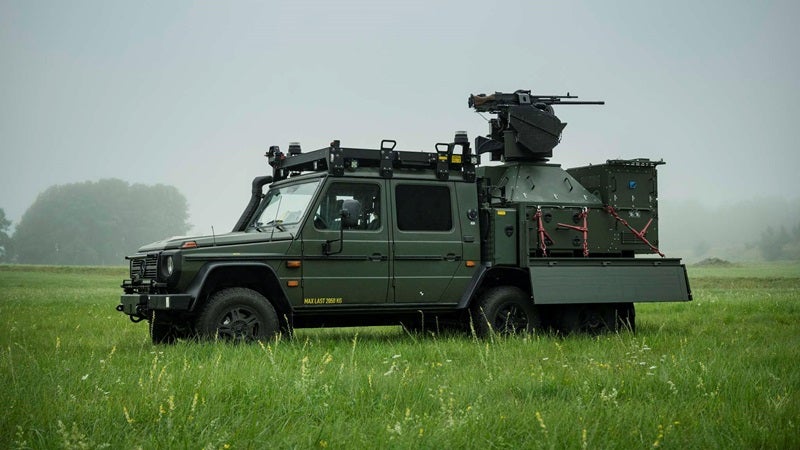
Sweden, however, will seek to incorporate indigenous systems made by their leading defence contractor Saab. Last year, the supplier revealed it had tested its own mobile C-UAS solution – known as Loke – in a live Nato mission. The modular system integrates a mobile radar, Saab’s Giraffe 1X, with a Trackfire Remote Weapon Station armed with heavy and medium machine guns, as well as electronic warfare components.
The Swedish Air Force 21st Wing are now training to operate Loke as a platoon-level (30 personnel) capability.
Existing Swedish air defence
“By building up ground-based air defence units, we are adding to the existing air defence and strengthening protection of combat unit mobilisation,” Jonson detailed.
Currently, Sweden operate four MIM-104 Patriot systems and short range IRIS-T SLS systems but waiting on a delivery of medium range (SLM) systems. Mobile units also operte the RBS 70 NG guided missile system and the older RBS 23.
According to GlobalData intelligence, the missiles and missile defence segment will be the third largest market for the Scandinavian country between 2025 and 2030; the cumulative value of the sector in this period will reach $2.3bn.


