
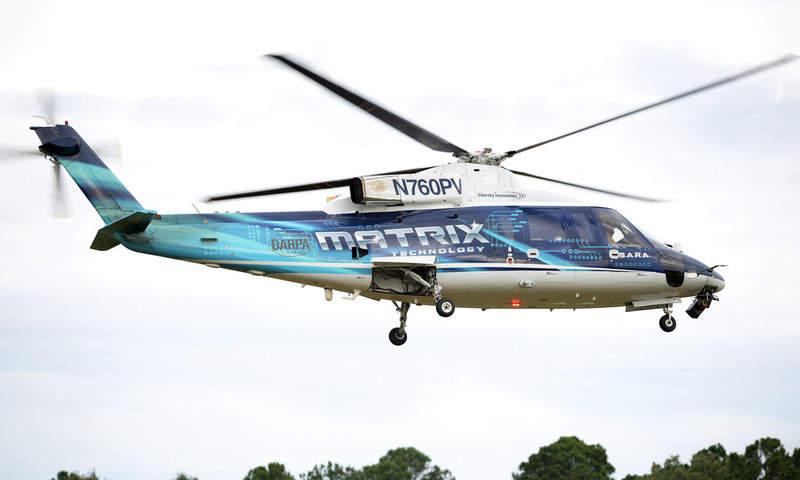
The US Army has flight tested an autonomous optionally piloted helicopter (OPV) developed by Lockheed Martin company Sikorsky.
During the series of missions, US army pilots exercised supervised autonomy to direct the Sikorsky Autonomy Research Aircraft (SARA) to demonstrate the technology developed by the company together with the US Defense Advanced Research Projects Agency (DARPA).
Go deeper with GlobalData


Discover B2B Marketing That Performs
Combine business intelligence and editorial excellence to reach engaged professionals across 36 leading media platforms.
The flights marked the first time that non-Sikorsky pilots operated the SARA as an OPV aircraft. SARA is a modified and upgraded variant of the S-76B commercial helicopter.
Sikorsky Innovations vice-president Chris Van Buiten said: “Future vertical lift aircraft will require robust autonomous and optimally piloted systems to complete missions and improve safety.”
During the tests, the optionally piloted helicopter successfully demonstrated the advanced capabilities developed as part of the third phase of DARPA’s Aircrew Labor In-Cockpit Automation System (ALIAS) programme.
At different times, the autonomous system was operated by pilots on board and on the ground.
The MATRIX Technology autonomous software and hardware developed by Sikorsky and installed on SARA enabled the aircraft to carry out a range of missions, including automated take-off and landing, obstacle avoidance, automatic landing zone selection and contour flight.
Sikorsky flight test center Stratford, Connecticut, US, chief pilot Mark Ward said: “We’re demonstrating a certifiable autonomy solution that is going to drastically change the way pilots fly.
“We’re confident that MATRIX Technology will allow pilots to focus on their missions. This technology will ultimately decrease instances of the number one cause of helicopter crashes: controlled flight into terrain (CFIT).”
The Mission Software Flight Demonstration was conducted as a collaboration between the US Army’s Aviation Development Directorate, Sikorsky and DARPA.
The DARPA ALIAS programme has been designed to develop an OPV approach, or pilot directed autonomy, which will enable aircraft to be operated safely, reliably and affordably in optimally piloted modes enabling flight with two, one or no crew.



