
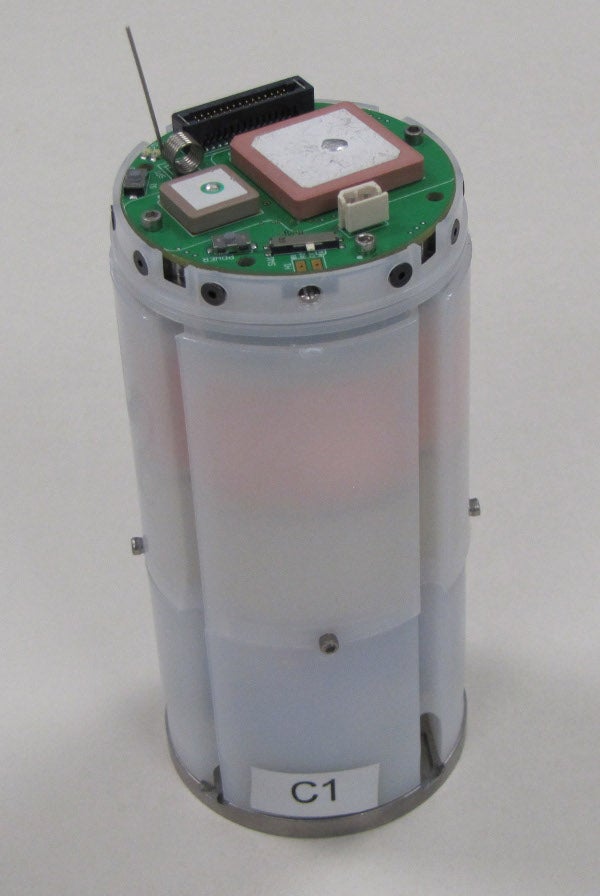
The US Army’s Edgewood Chemical Biological Center (ECBC) has developed a new remote sensor for the Global Strike Near Real-Time Battle Data Assessment (NRT-BDA) system, to improve troops’ battlefield awareness.
Equipped with unattended sensors and a remote soldier interface, the Global Strike NRT-BDA system is designed to provide soldiers with prompt reporting of battlefield conditions during reconnaissance operations.
Go deeper with GlobalData


Discover B2B Marketing That Performs
Combine business intelligence and editorial excellence to reach engaged professionals across 36 leading media platforms.
Intended to be air deployable, the sensor features a chemical agent detector similar in shape and size to a soft-drinks can, for accurate detection of chemical agents and other threats, in addition to seismic activity.
Already tested from a P-3 Orion aircraft at 1,000ft altitude, the sensor is equipped with an accelerometer that triggers release of the cap and small parachute, as well as spring-loaded legs, which pop open enabling it to sit upright soon after landing.
A GPS tracking device is also fitted to initiate the detector’s start sequence allowing threat detection, followed by transmission of the information to a satellite and eventually to troops manning a soldier interface located a few thousand miles away.
Previous Global Strike NRT-BDA system versions featured a GPS antenna, an iridium antenna for data transmission, as well as a short-range communications antenna, which are not required in the latest variant.
US Tariffs are shifting - will you react or anticipate?
Don’t let policy changes catch you off guard. Stay proactive with real-time data and expert analysis.
By GlobalDataECBC Engineering Directorate advanced design and manufacturing division electronic design integration branch chief Robert Pazda said the Global Strike NRT-BDA is a pre or post-assessment tool.
"You could drop it and know something is there and strike, or you know something’s there and avoid the area," Pazda said.
ECBC is planning to extend the system’s operational time to several days, as opposed to the existing four to six hours.
Other supporting organisations include ECBC’s engineering design and analysis branch, Johns Hopkins Applied Physics Lab, Air Force Research Laboratory, Naval Surface Warfare Center Dahlgren Division, Kansas State University and Smiths Detection.
Image: The newly developed remote sensor of the Global Strike NRT-BDA System. Photo: courtesy of US Army.




