
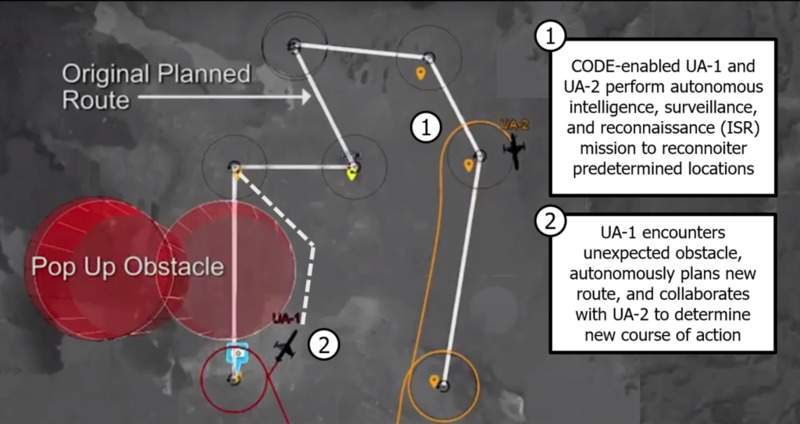
The US Defense Advanced Research Projects Agency’s (DARPA) collaborative operations in denied environment (CODE) programme has entered into Phase III testing.
The CODE programme has successfully completed Phase II flight tests. It intends to enhance the capability of the US military’s existing unmanned aircraft systems (UAS).
Go deeper with GlobalData

Discover B2B Marketing That Performs
Combine business intelligence and editorial excellence to reach engaged professionals across 36 leading media platforms.
Upgraded UAS would be capable of carrying out long-distance engagement of highly mobile ground and maritime targets in denied battlespaces.
Under the supervision of a single human mission commander, several CODE-equipped autonomous aircraft would navigate to their destinations. The aircraft will find, track, identify and engage targets under established rules of engagement.
Raytheon has been appointed to complete the development of the CODE software during Phase III of the programme.
CODE’s scalable capabilities would be able to broadly enhance the survivability, flexibility and effectiveness of existing air platforms while reducing the development times and costs of future systems.
DARPA CODE programme manager and Tactical Technology Office acting deputy director Jean-Charles Ledé said: “CODE is working to develop a low-cost approach to upgrade legacy unmanned aircraft and make them more effective through groundbreaking algorithms and software that enable them to work together with minimal supervision.”
Phase II flight test series was carried out by teams led by Lockheed Martin and Raytheon at Naval Air Weapons Station China Lake in California, US.
Several flight tests were conducted by the teams to validate the software open architecture and test-support framework.
The tests were conducted using RQ-23 Tigershark remote aircraft upgraded with CODE hardware and software to control flight direction, altitude, speed and sensors.


