
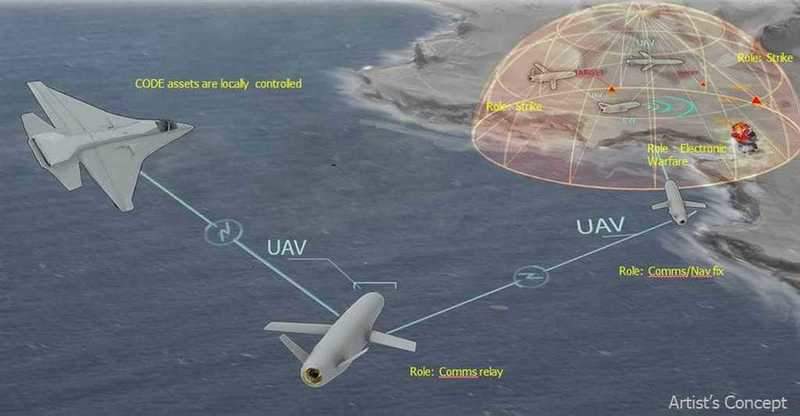
The US Defense Advanced Research Projects Agency’s (DARPA) collaborative operations in denied environment (CODE) programme has conducted ground and flight tests of CODE-equipped unmanned aerial systems (UASs).
Conducted recently at the Yuma Proving Ground in Arizona, US, the tests successfully demonstrated aircraft autonomy and collaboration with minimal live human commands.
Go deeper with GlobalData

Discover B2B Marketing That Performs
Combine business intelligence and editorial excellence to reach engaged professionals across 36 leading media platforms.
The DARPA programme exhibited the capability of a range of CODE-enabled UASs to adapt and respond to unexpected threats in an anti-access / area denial (A2 / AD) environment.
During trials, the autonomous aircraft could efficiently share data, cooperatively plan and allocate mission objectives, make coordinated tactical decisions, and collaboratively react to a dynamic, high-threat environment with minimal communication.
This allowed for the CODE-equipped UASs to support dynamic, long-distance engagements of highly mobile ground and maritime targets in challenging or denied battlespace.
As part of the programme, a series of ground and flight tests were carried out in a live / virtual / constructive (LVC) environment for a period of three weeks, which included up to six live and 24 virtual unmanned aircraft operated as surrogate strike assets, receiving mission objectives from a human mission commander.
Following this, the UASs autonomously collaborated to navigate, search, localise and engage both pre-planned and pop-up targets protected by a simulated integrated air-defence system (IADS) in communication and GPS-denied environments.
DARPA CODE programme manager Scott Wierzbanowski said: “The test series expanded on previously demonstrated approaches to low bandwidth collaborative sensing and on-board planning.
“It demonstrated the ability to operate in more challenging scenarios, where both communications and GPS navigation were denied for extended periods.”
CODE’s scalability can help significantly increase the survivability, flexibility and effectiveness of existing aircraft systems while reducing development times and costs of future UAS.
The CODE programme is expected to conclude in spring next year.
In January, the DARPA programme entered Phase III testing following the successful conclusion of the Phase II flight tests with an aim to enhance the capability of the military’s UAS fleet.



