
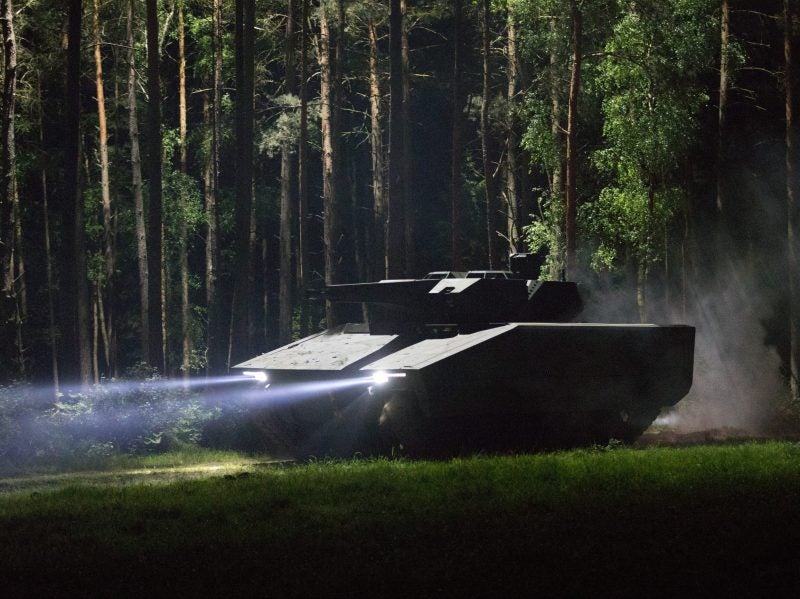
Raytheon Rheinmetall Land Systems and General Dynamics Land Systems have submitted bids for the US Army’s Optionally Manned Fighting Vehicle (OMFV) competition.
Earlier this year BAE Systems announced it would not be offering a vehicle for the programme, which was originally developed under the name Next-Generation Combat Vehicle (NGCV). The army made the change to widen the net of what vehicles could be submitted.

Discover B2B Marketing That Performs
Combine business intelligence and editorial excellence to reach engaged professionals across 36 leading media platforms.
Raytheon and Rheinmetall announced the formation of the joint-venture last week, saying they would offer the Lynx Infantry Fighting Vehicle to the army.
General Dynamics Land Systems has yet to announce the vehicle it submitted, however in the run-up to the deadline it was expected it would submit the Griffin III, a vehicle based on the company’s AJAX programme in development for the British Army.
General Dynamics Land Systems vice-president and general manager Don Kotchman said: “General Dynamics Land Systems submitted our OMFV proposal and bid sample to the US Army on 27 September.
“GD’s bid sample was purpose-built to address the desired system lethality, survivability and mobility as substantiation of our response to the Army’s request for proposal.”
All three companies were expected to submit bids for the programme when it was announced. The US Army is looking for an OMFV to replace the in-service BAE Systems Bradley Fighting Vehicle which has been a mainstay of the army since 1981.
Raytheon Rheinmetall Land Systems said in a press release: “Lynx is a next-generation, tracked armoured fighting vehicle designed to address the critical challenges of the future battlefield.
“The vehicle provides ample growth capacity to support new technologies over its lifetime, and features lower life-cycle costs.”
Raytheon Land Warfare Systems vice president Sam Deneke said: “US Army soldiers deserve the best possible fighting vehicle when they go into battle and that’s exactly what this team is offering.
“Lynx provides unparalleled troop protection and features advanced technology that will keep our men and women in uniform ahead of the threat.”
If either bid is accepted the US Army could field the new vehicle by 2026. Replacing the Bradley is considered to be one of the army’s main modernisation priorities, ensuring that the military has modern vehicles capable of navigating a range of terrains.
Rheinmetall Vehicle Systems division Ben Hudson said: “Our team has spent the last year assembling a US supply chain to ensure that Lynx will be built in America by American workers.
“This next-generation combat vehicle will help save lives on the battlefield and further bolster the US industrial base – now that’s a win-win.”
The Lynx vehicle offered to the army features Raytheon made Active Protection Systems and a supporting Coyote unmanned aerial system (UAS). The UAS acts as an ISR platform for the vehicle, while also identifying enemy UAS and destroying them, giving the vehicle protection from non-conventional threats.
Raytheon is also making its tube-launched, optically-tracked, wireless-guided (TOW) missile available for the platform to increase anti-vehicle firepower.
According to congressional documents the OMFV programme has nine main requirements for the vehicle including for it be optionally manned, carry at least six troops, fit in a C-17 Globemaster, have two separately operating weapons for urban engagements, feature ‘contemporary’ protection systems, have room for future development, have an embedded training system, and feature increased range and fuel efficiency.
Finally, the army requires that the successful vehicle “apply immediate, precise, and decisively lethal extended range medium-calibre, directed energy, and missile fires in day/night/all-weather conditions, while moving and/or stationary against moving and/or stationary targets. The platform should allow for mounted, dismount, and unmanned system target handover.”


