

- FY26 NDAA passes US House, moving closer to Senate vote and Trump signature
- Record $900.6bn defence budget prioritises operations, personnel, and next‑gen air/sea power
- NDAA boosts Indo‑Pacific deterrence vs China and pressures Nato allies to pay more
The latest legislative approval given to the US administration’s FY26 National Defense Authorization Act (NDAA) marks a significant step for President Donald Trump’s efforts to reshape defence and refocus foreign policy towards transactional deal making.
From reforming procurement, to adopting commercial practices and attempting to improve the at-times patchy availability of key capabilities, the passing of the FY26 NDAA by the US House of Representatives moves the bill closer to reality. Just a single step remains before President Trump signs it off: the US Senate.
Go deeper with GlobalData


Discover B2B Marketing That Performs
Combine business intelligence and editorial excellence to reach engaged professionals across 36 leading media platforms.
The top lines cover the vast sums involved, to a total in excess of $900bn, with operation and maintenance the largest share at $291bn.
US Representative Mike Rogers (R-AL), Chairman of the House Armed Services Committee, released a statement on 10 December applauding the House passage the FY26 NDAA.
“As we face the most complex security environment since World War II, the FY26 NDAA delivers on President Trump’s Peace Through Strength agenda and ensures our warfighters are the most ready, lethal, and capable force in the world,” Rogers said.
“I urge the Senate to quickly pass the FY26 NDAA so President Trump can sign it and we can begin implementing his agenda.”

US Tariffs are shifting - will you react or anticipate?
Don’t let policy changes catch you off guard. Stay proactive with real-time data and expert analysis.
By GlobalData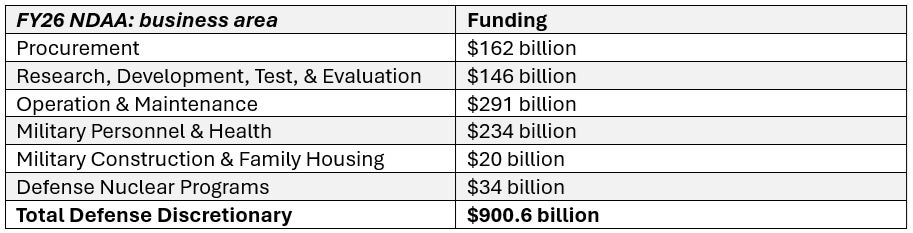
In terms of platform acquisitions, upgrades, and modifications, the FY26 NDAA provides over $68bn across the three combat domains, with funding of $38bn (the largest share) to air systems, including full funding for the US Air Force’s (USAF) F-47 and US Navy’s F/A-XX 6th generation aircraft programmes, as well as the B-21 stealth bomber.
Total FY26 funding was also committed tom the USAF’s autonomous Collaborative Combat Aircraft and the US Navy’s MQ-25 uncrewed carrier-launched aircraft.
A prohibition of the retirement of some F-15E, A-10, C-130, E-3, RQ-4, and Grey Eagle aircraft has also been formalised, as well as preventing the closure of the E-7A Wedgetail production line.
A total of $26bn is to be dedicated to shipbuilding and sustainment requirements, including construction and support for the third Columbia-class nuclear-powered ballistic missile submarine (SSBN). In addition, full funding was given to the Ford-class aircraft carrier programme as well as advanced procurement for future DDG-51 Arleigh Burke-class destroyers.
However, a key programme to have fallen the wrong side of the Pentagon’s efficiency drive has been the Constellation-class frigates, which will now just deliver two of a planned 20 warships.
The smallest share goes to land, with just $4bn committed, indicative possibly of a desire by the Trump administration to focus on air and sea power. It should be noted that one of the first casualties of the Trump presidency was the M10 Booker light tank programme, which had already begun to deliver initial vehicles into service.
According to intelligence firm GlobalData, the 2025 US defence budget underwent a contraction with the allocated funding dropping to $921bn, a decrease from the previous year’s $968bn.
Munitions and maintenance
Elsewhere, highlights include $25bn to “restore America’s arsenal of munitions”, including Precision Strike Missiles; Joint Air-to-Ground Missiles; Naval Strike Missiles; Javelins; Stingers; Joint Air-Surface Standoff Missiles, Tomahawk cruise missiles; Guided Multiple Launch Rocket Systems; Advanced Medium-Range Air-to-Air Missiles; Sidewinder and Standard missiles; Long Range Anti-Ship Missiles; Advanced Anti-Radiation Guided Missiles; Joint Direct Attack Munitions; MK-48 Torpedoes, and artillery rounds.
A further development sees the mandate of at least 90 days’ worth spares for the F-35 stealth fighter fleet by the end of September 2028, ensuring that US Navy amphibious assault ships receive “a proportional share of ship maintenance appropriations”, and increased transparency of long maintenance periods for warships.
Other programmes to receive funding includes the Golden Dome air defence network, specifically for the procurement of Terminal High Altitude Area Defense (THAAD), SM3-IIA, and Patriot missile defence systems.
The ongoing recapitalisation of the US military’s nuclear defence triad will see additional funding given to “accelerate key modernisation activities”, including the development of the next-generation Sentinel ICBM and the nuclear sea-launched cruise missile (SLCM-N).
The US Department of War, nee Department of Defense, will also not be permitted to reduce the country’s ICBM fleet below 400 missiles, while block boy authority has been given for up to five Columbia-class SSBNs.
FY26 NDAA: the why
It is little secret that the US has taken an increasingly strident line to counter China, which is beginning to supplant the US in areas of the Western Pacific region as the main superpower.
The NDAA extends the Pacific Deterrence Initiative (PDI) to “enhance US posture” in the Indo-Pacific region and increases funding for “innovative new technologies” to deter China, including in areas such as hypersonics, AI, autonomous systems, cyber, mobile micronuclear reactors, and high energy lasers.
Key is a prohibition from acquiring critical minerals, including molybdenum, gallium, and germanium from China “and other adversaries”, the granting of loans to entities that do business with companies owned or controlled by China, and to support the Pentagon’s efforts to “mitigate dependencies” on China for rare earth magnets.
Taiwan also receives $1bn in funding through the Taiwan Security Cooperation Initiative and notably will be the beneficiary of a planned joint programme with the Pentagon to field uncrewed systems. The Philippines similarly will benefit, receiving $1.5bn in new security assistance.
Nato and Europe: paying for protection
This is particularly damning, as the NDAA states that the Department of War will be authorised “to collect funds from Nato allies to offset the cost of US force posture in Eastern Europe”, as well as monitoring US allies’ progress towards spending 5% of their GDP on defence which will inform decision on basing and training.
Critically, the Pentagon will be required to “assess the impact on US security prior to reducing US force structure in Europe below 76,000 [personnel]”.
In essence, Europe will have to pay the US for protection, stretching the notion of collective deterrence and Nato solidarity towards doctrines such as Article 5.
Recent analysis of the defence spending of European Nato members broadly shows increases, but it will be years, if ever, that the majority are able to reach the 5% benchmark.



