

Unmanned technologies have changed the character of high-intensity warfare in the three years since Russia’s war of aggression against Ukraine, and unmanned ground vehicles (UGVs) have been an overlooked force driving this change. While UGVs only account for a fraction of unmanned technologies employed in the war, the scope and scale of their use has grown dramatically as both sides look to mitigate personnel challenges.
In Ukraine and beyond, UGVs are classified into four segments based on their primary purpose: combat, explosive ordinance disposal, intelligence, surveillance, and reconnaissance, and logistics (often casualty evacuation). Each segment is growing rapidly with a compound annual growth rate of more than 6.0% across the next decade, but the combat and logistics segments are growing especially fast. Indeed, these are the two key segments of interest for military leaders in Ukraine, where advancements in combat and logistics vehicles can keep military personnel away from especially dangerous environments. Currently, it is estimated that 90% of military UGVs in Ukraine support logistical needs.
Go deeper with GlobalData


Access deeper industry intelligence
Experience unmatched clarity with a single platform that combines unique data, AI, and human expertise.
In 2025, Ukraine has set out to achieve grand ambitions in the UGV space, announcing that it plans to deliver 15,000 UGVs this year, up from roughly 2,000 in 2024. To achieve this aim, Ukraine’s armed forces are not only supported by the systems of allies but also through a robust domestic unmanned ground vehicles industry. As of July 2025, it is reported that 40 Ukrainian companies have produced more than 200 variants of UGVs. While not all are available at scale, the battlefield is proving a testing ground for continuous advancements.
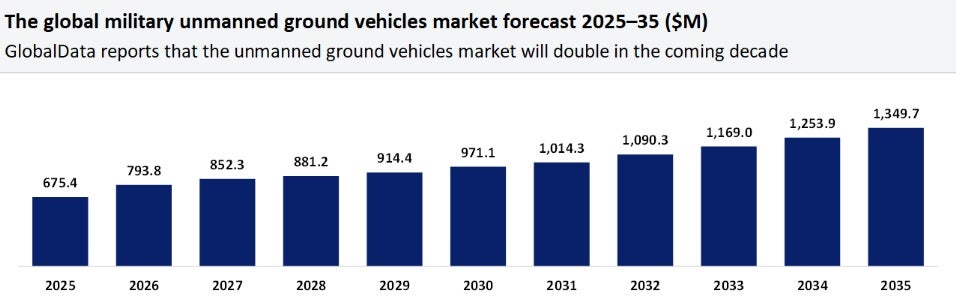
Military leaders across the globe are reflecting on the ways Russia’s war in Ukraine will change the future of war, and the powerful roles of unmanned ground vehicles are a clear takeaway. The US and other great powers are the largest investors in the military UGV market, which is expected to double in size in the next ten years, reaching an estimated global value of $1.35bn by 2035. UGVs, like most unmanned technologies, were perceived until recently as merely ‘nice to have’ but are now a necessary acquisition segment for modern armed forces.
Innovators will continue to improve the capabilities of UGVs with advancements in AI, batteries, and sensor technologies. The much feared and anticipated unmanned aeiral vehicle swarms will shortly be followed by swarms of UGVs that attack personnel and destroy infrastructure that supports ground lines of communication. Increasingly powerful batteries, quieter than combustion engines, will increase the range and stealth of ground robots. Arguably most important of all, unmanned ground vehicles may reduce personnel burdens through manned-unmanned teaming efforts and unmanned surveillance measures.
See leading data and analytics company GlobalData’s recently published report on unmanned ground vehicles for more information.

