


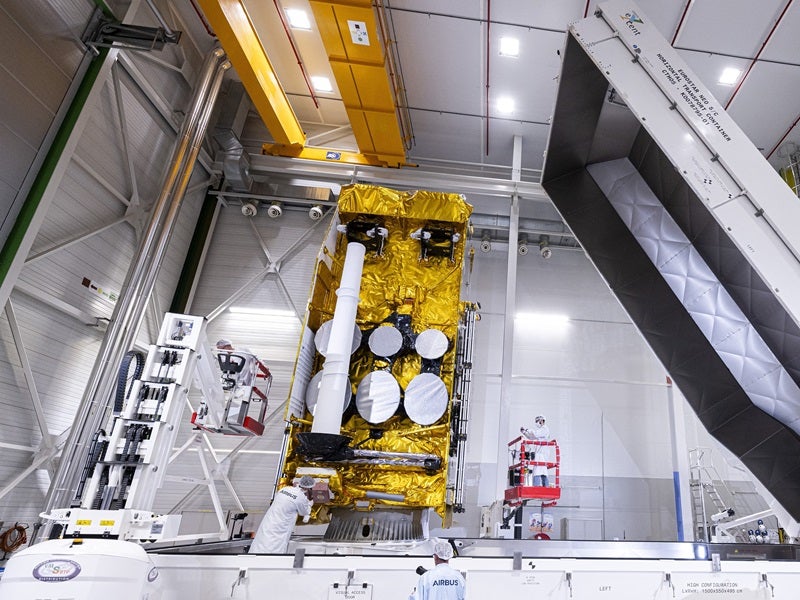
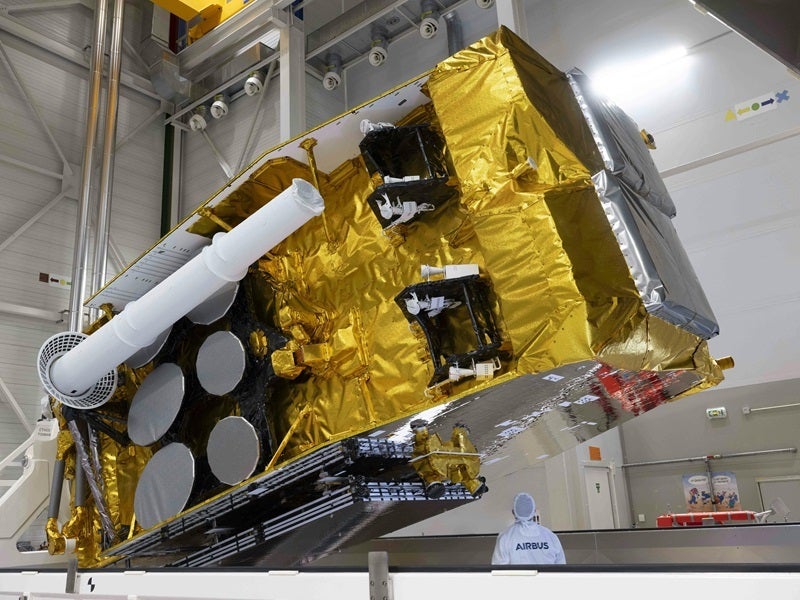
The SpainSat Next Generation (NG) programme, led and operated by the Spanish Government satellite operator Hisdesat, comprises two satellites, SpainSat NG I and NG II.
The programme is designed to provide military‑grade secure communications to the Spanish Armed Forces and international organisations such as the European Commission under the GOVSATCOM initiative, Nato, and other allied governments.
Recommended White Papers

Recommended Buyers Guides

In May 2019, Hisdesat selected a four‑party co‑prime consortium, comprising Airbus and Thales Alenia Space, to build the two SpainSat NG satellites.
The SpainSat NG I satellite was launched on a Falcon 9 from Cape Canaveral in January 2025 and completed its initial in‑orbit activation in September.
In October 2025, SpainSat NG II was launched from the Kennedy Space Centre in the US, completing the SpainSat NG constellation.
Scheduled to initiate operations in 2026, the satellites will replace the existing Spainsat and XTAR-EUR satellites.
Each satellite has a planned operational life of 15 years, with service running through to 2037.
SpainSat NG programme development background
Key innovations for the programme, particularly the active antennas, were developed under a public-private partnership (PPP) between the European Space Agency (ESA) and Hisdesat, known as the Pacis 3 Partnership, within ESA’s Advanced Research in Telecommunications Systems (ARTES) programme, with support from the Spanish Space Agency.
The communications payloads for both satellites were supplied by the Spanish space industry, with integration of the communications module undertaken in the European country.
Airbus Defence and Space Spain is responsible for the X‑band payload while Thales Alenia Space Spain provided the UHF and Ka‑band payloads.
The programme passed its preliminary design reviews (PDRs) for both payload and full satellite in October 2020, including the PDRs for Pacis 3 PPP elements.
In December 2021, the programme cleared another key milestone with successful critical design reviews (CDRs) for the payload and complete satellite, including CDRs for the Pacis 3 project.
The reviews confirmed strong progress in testing of the X‑band payload development models.
In May 2024, acceptance testing of the active transmit antenna for SpainSat NG I was completed following final radiation pattern tests. The antenna was integrated with the satellite at Airbus’s Toulouse facility ahead of thermal‑vacuum (TVAC) and vibration testing.
SpainSat NG I entered its final test phase by November 2023, with most critical components integrated and major systems validated in preparation for launch.
SpainSat NG design and features
The SpainSat NG satellites use Airbus’s proven Eurostar Neo platform and deliver roughly ten times the connectivity capacity of the previous generation. Their active antennas support high‑speed data transmission and are fully reconfigurable in orbit.
The platform provides enhanced capacity and flexibility, with each satellite carrying a fully flexible X‑band payload.
The payload was built entirely in Spain through a collaboration involving Airbus Defence and Space (Spain), Thales Alenia Space España, Sener, Indra, Arquimea, Tecnobit, GMV, Iberespacio and the Spanish Centre for the Development of Industrial Technology (CDTI).
An onboard digital processor links the military X‑ and Ka‑band payloads, enabling cross‑band services with a dedicated high‑speed service link for rapid reconfiguration.
The SARA X‑band transmit and receive antennas, developed by Airbus Defence and Space in Madrid, mark a notable step forward for Spain’s industrial capabilities.
The active antennas also include a geolocation system that can accurately locate emitters on Earth.
Located at positions 30ºW and 29ºE, the satellites feature beam‑hopping, allowing configuration changes thousands of times per second to adapt to the most demanding operational environments.
SpainSat NG satellite details
SpainSat NG I has a launch mass of approximately 6.1 tonnes (t), with its payload accounting for more than 45% of the cost.
By combining UHF, Ka‑band and X‑band on a single platform, SpainSat NG I offers far greater flexibility, a stark contrast compared to earlier generations.
SpainSat NG II measures 7m and weighs 6t. It carries an innovative payload featuring an X‑band active receive‑and‑transmit antenna system that delivers the equivalent functionality of 16 traditional antennas.
It ensures reliable communications for military and government missions, and can adapt and change coverage up to 1,000 times per second.
Both satellites incorporate resilience and security features designed to survive high‑altitude nuclear events and meet stringent Nato requirements for signals intelligence and interference protection.
Ground control station details
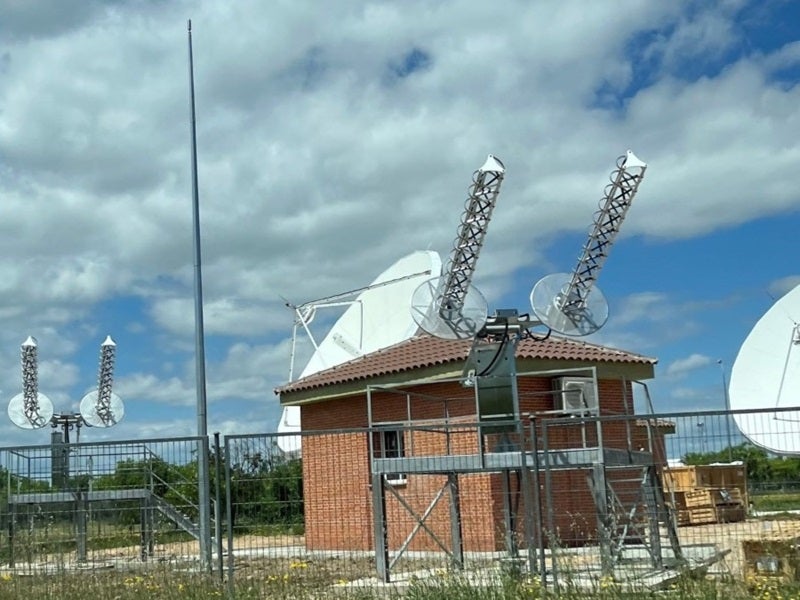
Internet service provider Viasat collaborated with the Spanish Ministry of Defence to install a pair of redundant network control stations to manage the new satellite capability.
One of these ground facilities operates the UHF Time Domain Multiple Access networks, with the second site configured to ensure continuity of service if required.
Viasat completed delivery of the control infrastructure in November 2025, ahead of SpainSat NG I’s planned commercial service entry.
SpainSat NG mission capabilities
The SpainSat NG satellites will provide dependable beyond‑line‑of‑sight command and control across approximately two‑thirds of Earth, ensuring communications in theatres lacking terrestrial infrastructure.
Their advanced flexible‑payload technology makes the tri‑band (X, Ka and UHF) capability especially valuable for critical communications over extensive areas.
They will enhance on‑the‑move satellite communications with increased capacity and security, enabling a fully networked, net‑centric battlespace. The satellites also incorporate advanced protection against jamming and spoofing.
