
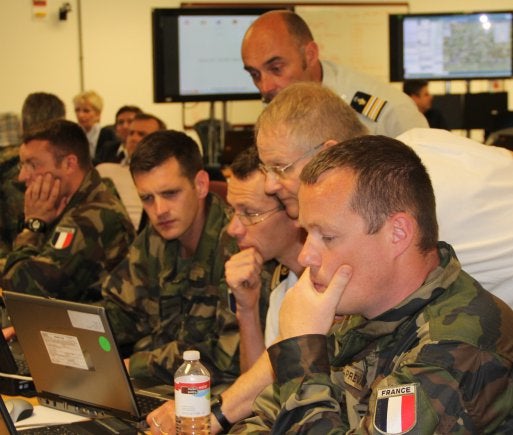
The US Army Project Manager Mission Command has conducted a coalition experiment to validate future network structures, designed to provide better interoperability for coalition ground forces at Aberdeen Proving Grounds in Maryland, US.
Go deeper with GlobalData


Discover B2B Marketing That Performs
Combine business intelligence and editorial excellence to reach engaged professionals across 36 leading media platforms.
Conducted as part of the 5-Powers Net-Centric agreement, signed between the US, UK, France, Germany and Italy, the experiment was also aimed at determining performance inadequacies, to prevent fratricide and increase continuity of operations.
The experiment was supported by the US Army Research, Development and Engineering Command’s communications-electronics RD&E center (CERDEC), which helped the command assess interoperability of the National Command and Control Information System.
The experimentation and interoperability support provided by CERDEC also enabled the army to develop road map with capacities, performance assessments and recommendations for future systems.
CERDEC Command, Power & Integration directorate Cognition Branch chief, Kenneth Grippo, said the friendly force information, delivered by soldiers to coalition partners for mission execution, cannot be received through different methodologies in a net-centric environment due to some challenges.
"When information is translated between different interfaces, problems can arise that degrade the integrity and accuracy of the information. We have to make sure the quality and integrity of those messages stay intact as they move from one country to another," Grippo added.
"We’re using our operational understanding of mission command doctrine, data management/distribution and our technical expertise to observe information systems transactional processes during the experiment to document knowledge gaps."
According to Grippo, the experiment will help in determining interoperability gaps and also to find out whether the specifications, national implementation or the technology itself is contributing to those gaps.
The results will eventually be employed to enhance situational awareness, understand and utilise coalition resources, avoid duplication of coalition efforts, as well as to increase flexibility of functionality to develop the future combat systems of 2015 to 2025.
Image: US Army CERDEC officials during coalition interoperability experiment at Aberdeen Proving Grounds in Maryland, US. Photo: courtesy of the US Army.


