
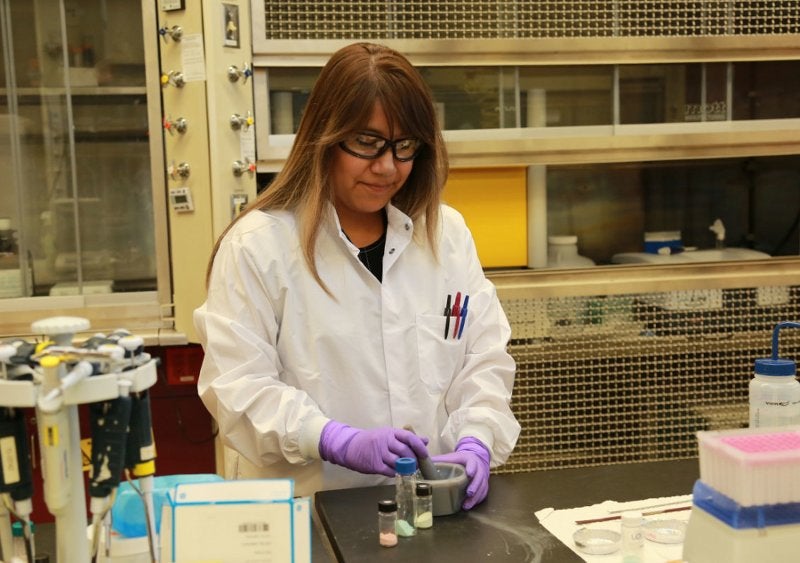
US Army scientists are developing self-indicating colourimetric response materials that will help soldiers with potential toxic chemical threat detection on the battlefield.
The new materials are capable of changing their colour when they come in contact with specific chemical compounds.
Go deeper with GlobalData


Discover B2B Marketing That Performs
Combine business intelligence and editorial excellence to reach engaged professionals across 36 leading media platforms.
This property of the materials is expected to provide soldiers in the field with the capability to determine potential contamination on various surfaces and take proper action.
The development effort is being led by US Army Combat Capabilities Development Command (CCDC) Chemical Biological Center research scientist Dr Jennifer Soliz.
Dr Soliz said: “Self-indicating colourimetric response materials maintain their colour change once exposed, which is one of the primary benefits of these novel materials.
“I have synthesised several inorganic compositions of the self-indicating colourimetric response materials over time and have had them tested and evaluated with agents, opioids, and interferents.
“It was exciting to receive news that exposing the materials to specific analytes produced the expected colour changes and that the materials did not change colour when exposed to interferents, which was a significant breakthrough for the army.”
The new materials are being developed to be able to detect chemical agents that include G-type compounds such as sarin, V-type compounds, and H-type compounds such as sulphur mustard.
They do not require solvents for detection of different concentrations of vapour hazards, opioids and other emerging threat compounds.
According to Dr Soliz, the use of these materials is being expanded for incorporation into films, equipment coatings for unmanned army operations, and ultra-lightweight portable chemical sensors, as well as fibre optic cables for perimeter defence security.
The research project has been receiving funding support from the US Defense Threat Reduction Agency.
Furthermore, the University of Alabama’s physicists and engineers have been selected by Dr Soliz to help explore the use of the materials in the development of chemical sensing prototypes.


