
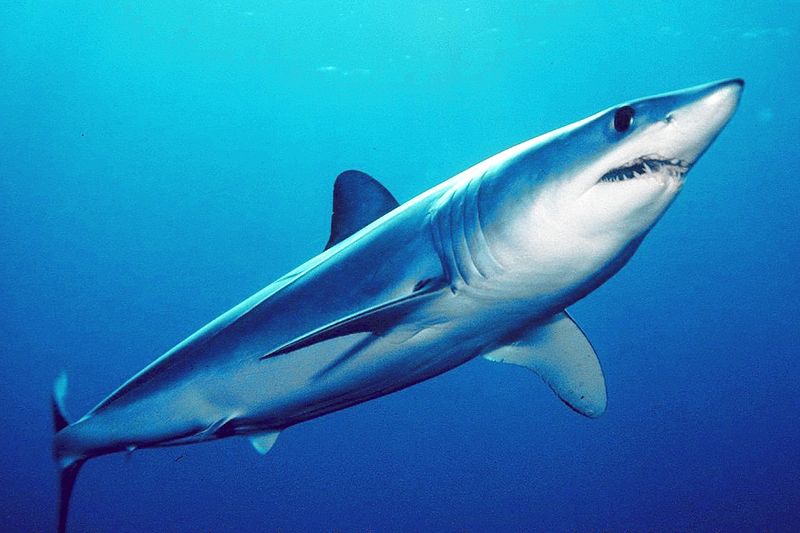
The US Army has funded research to study the skin of the shortfin mako shark as part of efforts to construct faster aircraft and helicopters.
Also known as the ‘cheetahs of the ocean’, mako sharks can achieve speeds of up to 70mph or 80mph.
Go deeper with GlobalData


Discover B2B Marketing That Performs
Combine business intelligence and editorial excellence to reach engaged professionals across 36 leading media platforms.
The investigation is expected to provide insights into how the mako shark is able to achieve high speeds.
Results could help engineers in understanding how the pressure drag on aircraft can be reduced and make them more agile and responsive.
The research is being carried out by aeronautical engineer Amy Lang of the University of Alabama.
Lang, along with colleagues, has studied how the nearly 0.2mm-sized scales can flex at angles more than 40° from the shark’s body.
These flexible scales are located in particular areas of the shark’s body and help the animal control flow separation to reduce pressure drag.
Lang said: “It impedes the flow from reversing near the skin, which would otherwise lead to what we call flow separation.
“This is the drag you experience if you stick your hand out your car window vertical to the airflow.”
The research team conducted water tunnel experiments using real mako shark skin samples. The skin samples were taken from the shark’s flank region.
Lang explained: “We set up an experiment in the tunnel with a measured amount of flow separation induced on a smooth surface. Then we replaced the smooth surface with shark skin and re-quantified the flow separation.
“In all cases with the flank skin, we saw the size of the separated flow region reduced significantly by the presence of the skin.”
“The potential for a man-made surface to utilise this entirely passive mechanism even in the air is very exciting.”
The research work was also funded by Boeing.


